Harai Goshi
0
Harai Goshi·Seiryoku Zenyo
Mark Gilston, 4th degree judo black belt, discusses and demonstrates harai goshi (sweeping hip throw) and responses to d…
Translation: sweeping hip throw
Harai Goshi (sweeping hip throw) is one of judo's most powerful and dynamic techniques, in which the thrower turns in, places the hip beneath the opponent, and sweeps the opponent's leg with the back of the thigh in a large arc while pulling them over the hip with the hands. [1] The throw combines the hip fulcrum of a standard koshi-waza with a sweeping leg action that drives the opponent's supporting leg away, creating a double-action throw that is extremely difficult to defend. [1],[2] Harai-goshi is sometimes confused with uchi-mata because both involve a sweeping leg action during a turning throw, but they differ in the point of contact — harai-goshi sweeps the outside of the opponent's thigh while uchi-mata sweeps the inside. [2],[3]
Harai goshi was included in the original Kodokan gokyo as a third-set technique, classified as an advanced koshi-waza requiring coordination of hip placement and sweeping leg action. [1] The technique has been the signature throw of numerous judo champions, including Isao Okano, who dominated the 1964 Tokyo Olympics with his harai-goshi. [2],[3]
Harai goshi is one of the most commonly scored ippon techniques in IJF competition. [1]
No images yet for this technique.
Sign in to suggest an image.
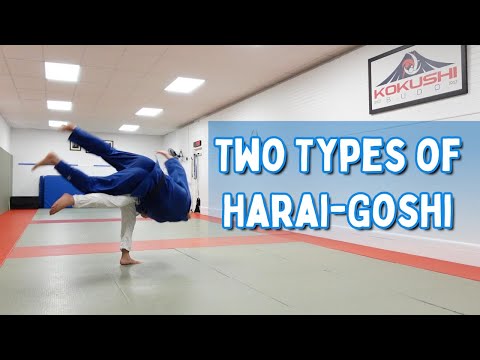
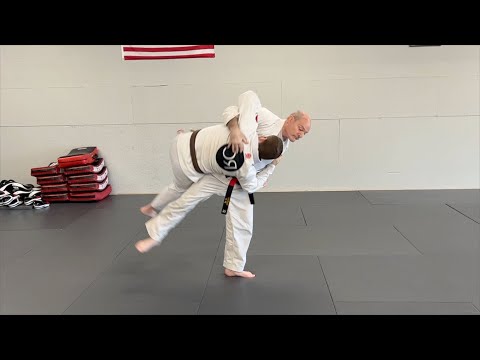
Mark Gilston, 4th degree judo black belt, discusses and demonstrates harai goshi (sweeping hip throw) and responses to d…
The first version is the classical version where you really bring your hips into play. The second version is when you ca…
No instructional courses yet for this technique.
Sign in to suggest a course.
Risk of injury to the person this technique is applied to
Harai-Goshi sweeping hip action; requires good timing
Skill level needed to execute this technique reliably
Whether this technique is allowed under major competition rule sets
Kodokan Judo — Official Nage-waza Classification
Traditional Judo throwing technique terminology (Kodokan Institute)
Official Kodokan ground technique classification system
Standard Japanese martial arts terminology (kanji/hiragana)
Established Japanese martial arts naming convention — native Japanese term (和語/漢語)
Traditional Judo throwing technique terminology (Kodokan Institute)
hip rotation speed, core strength, lower back stability
strong hips and core, good flexibility for turning entry
hip rotators, core, quadriceps, latissimus dorsi
Every move, in any martial art, shares a few universal traits. Mix and match below to pinpoint the right tool — or compare equivalents across styles.
Place your hand right in the middle of the opponent's shoulder blades with your elbow down, pulling them onto your back. Seiryoku Zenyo emphasizes that keeping your bicep relatively vertical makes it stronger for this pull.
Your supporting leg must be positioned between the opponent's legs and centered, not out to the side. Seiryoku Zenyo explains that an off-center leg makes it very difficult to support the opponent's weight, whereas positioning it in the middle distributes the load much more effectively.
Keep your leg completely straight throughout the entire sweep—avoid bending your knee during the execution. Seiryoku Zenyo also notes that you should step in straight with your calves touching rather than spinning out to the side, so the throw goes over you instead of around you.
Try using a small push to get a reaction, then pull the opponent across your body as they resist. Seiryoku Zenyo notes that when the arm is blocked, you can turn and pull them onto your back, stepping behind them so they're already partially on your hip.
Line yourself to the opponent's back hip rather than standing directly in front of them. Shintaro Higashi explains that positioning yourself on the correct angle, bringing them forward and then lifting, makes the hip sweep much more effective.
Harai Goshi (sweeping hip throw) is one of judo's most powerful and dynamic techniques, in which the thrower turns in, places the hip beneath the opponent, and sweeps the opponent's leg with the back of the thigh in a large arc while pulling them over the hip with the hands. The throw combines the hip fulcrum of a standard koshi-waza with a sweeping leg action that drives the opponent's supporting leg away, creating a double-action throw that is extremely difficult to defend.
Harai goshi was included in the original Kodokan gokyo as a third-set technique, classified as an advanced koshi-waza requiring coordination of hip placement and sweeping leg action. The technique has been the signature throw of numerous judo champions, including Isao Okano, who dominated the 1964 Tokyo Olympics with his harai-goshi.
IJF: legal — Legal throwing technique; IBJJF: legal — Legal at all belt levels; UWW: legal — Legal in both freestyle and Greco-Roman; Unified MMA: legal — Legal throwing technique; ADCC: legal — Legal; FIAS Sport Sambo: legal — Legal; FIAS Combat Sambo: legal — Legal
Danger rating 5/10. High — Harai-Goshi sweeping hip action; requires good timing
The standard setup chain: Grip Setup (Kumi-kata) → Off-Balance (Kuzushi) → Entry (Tsukuri) → Execution (Kake).
Standard counters include: Lower Centre of Gravity — bend knees and drop hips to make the throw harder to execute / Block the Hip — post hand on the thrower's hip to prevent loading / Step Around — circle away from the throw direction to avoid being loaded / Grip Break — deny the thrower their preferred gripping configuration.
Common variants: Standard hip throw (full turn-in with hip below the opponent's centre of gravity); No-gi hip throw (adapted without gi grips, using overhook and collar tie); Drop hip throw (dropping to one knee to lower the fulcrum point); Combination hip throw (chaining from a failed foot technique or hand technique).
Harai goshi is one of the most commonly scored ippon techniques in IJF competition.
Top errors to watch for: Sweeping at the ankle instead of the thigh — harai goshi sweeps high on the leg / Not turning in deeply enough before sweeping — the hip must be loaded first / Using a kicking motion instead of a sweeping motion — the leg sweeps back, it doesn't kick / Leaning away from uke to reach the sweep — stay tight against them.
The Harai Goshi is also known as Sweeping Hip Throw, Hip Sweep, Harai Goshi, Podkhvat (подхват).