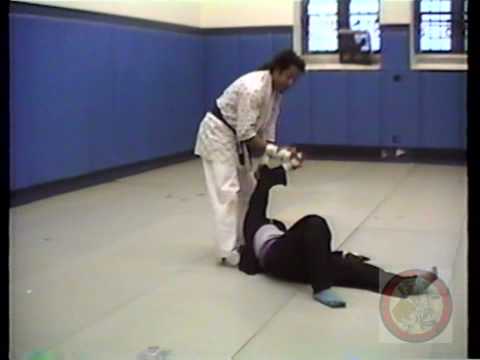
Judo Hip Throw
0
Sweeping Hip Throw·Wilfredo Guzman
Judo Hip Throw by Grand Master George Logan From CT School of Survival A student of DR. Moses Powell [ EYE TO EYE..HEART…
Translation: sweeping/springing hip throw
The Sweeping Hip Throw family covers koshi-waza techniques that combine the hip fulcrum with an active sweeping action of the leg, creating throws that merge hip-throwing and leg-sweeping mechanics into a single powerful action. [1] Sweeping hip throws use the hip as a fulcrum while the attacking leg sweeps, springs, or drives against the opponent's leg, adding rotational or lifting force that amplifies the throwing action beyond what the hip alone would produce. [1],[2] The two principal sweeping hip throws — harai-goshi (sweeping hip) and hane-goshi (spring hip) — are among the most powerful and frequently scored throws in judo competition. [2],[3]
Sweeping hip techniques were classified in the Kodokan system as koshi-waza that integrate leg action, representing a bridge between pure hip throws and leg techniques. [1] Harai-goshi in particular became one of the most successful competition throws in judo history, used by numerous Olympic and World Champions. [2],[3]
Sweeping hip throws are among the most powerful techniques in the Kodokan judo koshi-waza syllabus. [1]
Harai goshi is one of the highest-scoring throws in IJF competition. [1]
No images yet for this technique.
Sign in to suggest an image.
Judo Hip Throw by Grand Master George Logan From CT School of Survival A student of DR. Moses Powell [ EYE TO EYE..HEART…
No instructional courses yet for this technique.
Sign in to suggest a course.
Risk of injury to the person this technique is applied to
Harai-Goshi sweeping hip action; requires good timing
Skill level needed to execute this technique reliably
Whether this technique is allowed under major competition rule sets
Kodokan Judo — Official Nage-waza Classification
Traditional Judo throwing technique terminology (Kodokan Institute)
Official Kodokan ground technique classification system
Standard Japanese martial arts terminology (kanji/hiragana)
Established Japanese martial arts naming convention — native Japanese term (和語/漢語)
Traditional Judo throwing technique terminology (Kodokan Institute)
hip rotation speed, core strength, lower back stability
strong hips and core, good flexibility for turning entry
hip rotators, core, quadriceps, latissimus dorsi
Every move, in any martial art, shares a few universal traits. Mix and match below to pinpoint the right tool — or compare equivalents across styles.
Hane Goshi (spring hip throw) is a koshi-waza technique in which the thrower turns in, places the hip against the opponent, and uses a springing action of the leg against the opponent's inner thigh to lift and throw them over the hip. [1] The 'hane' (spring) element refers to the upward springing action of the attacking leg, which lifts the opponent's leg from the inside, different from harai-goshi's sweeping action against the outside of the thigh. [1,2] Hane-goshi creates an upward lifting force from the inside of the opponent's thigh, which, combined with the hip fulcrum and hand action, produces a high-amplitude throw. [2,3]
Harai Goshi (sweeping hip throw) is one of judo's most powerful and dynamic techniques, in which the thrower turns in, places the hip beneath the opponent, and sweeps the opponent's leg with the back of the thigh in a large arc while pulling them over the hip with the hands. [1] The throw combines the hip fulcrum of a standard koshi-waza with a sweeping leg action that drives the opponent's supporting leg away, creating a double-action throw that is extremely difficult to defend. [1,2] Harai-goshi is sometimes confused with uchi-mata because both involve a sweeping leg action during a turning throw, but they differ in the point of contact — harai-goshi sweeps the outside of the opponent's thigh while uchi-mata sweeps the inside. [2,3]
Harai-goshi was Jigoro Kano's personal favorite throw and the technique he used most often in his own randori. (Kano, Kodokan Judo; Watson, Judo Memoirs of Jigoro Kano)
The Sweeping Hip Throw family covers koshi-waza techniques that combine the hip fulcrum with an active sweeping action of the leg, creating throws that merge hip-throwing and leg-sweeping mechanics into a single powerful action. Sweeping hip throws use the hip as a fulcrum while the attacking leg sweeps, springs, or drives against the opponent's leg, adding rotational or lifting force that amplifies the throwing action beyond what the hip alone would produce.
Sweeping hip techniques were classified in the Kodokan system as koshi-waza that integrate leg action, representing a bridge between pure hip throws and leg techniques. Harai-goshi in particular became one of the most successful competition throws in judo history, used by numerous Olympic and World Champions.
IJF: legal — Legal throwing technique; IBJJF: legal — Legal at all belt levels; UWW: restricted — Legal in freestyle, banned in Greco-Roman (no leg attacks below waist); Unified MMA: legal — Legal throwing technique; ADCC: legal — Legal; FIAS Sport Sambo: legal — Legal; FIAS Combat Sambo: legal — Legal
Danger rating 5/10. High — Harai-Goshi sweeping hip action; requires good timing
The standard setup chain: Grip Setup (Kumi-kata) → Off-Balance (Kuzushi) → Entry (Tsukuri) → Execution (Kake).
Standard counters include: Lower Centre of Gravity — bend knees and drop hips to make the throw harder to execute / Block the Hip — post hand on the thrower's hip to prevent loading / Step Around — circle away from the throw direction to avoid being loaded / Grip Break — deny the thrower their preferred gripping configuration.
Common variants: Standard hip throw (full turn-in with hip below the opponent's centre of gravity); No-gi hip throw (adapted without gi grips, using overhook and collar tie); Drop hip throw (dropping to one knee to lower the fulcrum point); Combination hip throw (chaining from a failed foot technique or hand technique).
Harai goshi is one of the highest-scoring throws in IJF competition.
Top errors to watch for: Sweeping before the hip is loaded — the hip must be in position before the leg sweeps / Using the sweep as the primary force instead of the hip rotation — the hip does the throwing, the leg assists / Reaching too far back with the sweeping leg, which compromises your base / Not maintaining upper-body control (both grips) during the sweep.
The Sweeping Hip Throw is also known as Harai Goshi / Hane Goshi, Hip sweep throws, Combination hip-leg throws.