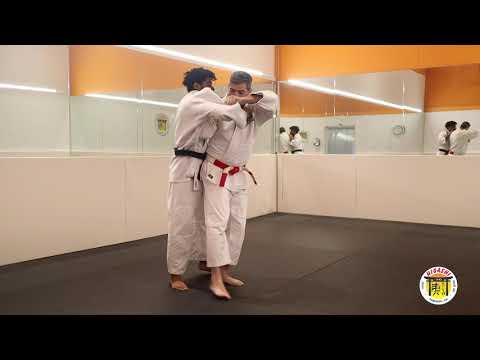
Yama Arashi Part I: Basic Form
0
Standard Yama Arashi·Higashi Canada·Added by Admin
Technique: Yama Arashi: Basic Form Tori: Sensei Jose Eudes Monteiro Uke: Marcelo Wesley Follow us: Facebook: https…
Translation: mountain storm
Standard Yama Arashi executes the classical mountain storm throw where the thrower grips deeply at the opponent's lapel or collar, turns explosively, and drives the opponent forward and over while dropping the body to generate maximum rotational force. [1] The deep grip allows the thrower to control the opponent's posture and direction throughout the throw, while the body drop adds falling-body-weight force to the arm action. [1],[2] The technique produces a powerful, high-amplitude throw when executed with full commitment. [2],[3]
Yama arashi (mountain storm) is a powerful sacrifice-style arm throw that generates tremendous rotational force through the combination of a cross-grip pull and a sweeping leg action. [1] When executed with commitment, it produces devastating ippon-scoring throws, though the cross-grip entry makes it difficult to set up in modern competition. [2]
Yama arashi holds a special place in judo history as the technique used by Shiro Saigo to defeat opponents in the famous 1886 Tokyo Police Tournament that established judo's reputation. [1] It was included in the Kodokan nage-waza system as a te-waza technique. [2] Some historians debate whether Saigo's technique was true yama arashi or a form of uki goshi, but the technique's association with this foundational moment in judo history is firmly established. [3]
Yama arashi is rarely scored in modern competition but remains in the Kodokan syllabus. [1]
No images yet for this technique.
Sign in to suggest an image.
Technique: Yama Arashi: Basic Form Tori: Sensei Jose Eudes Monteiro Uke: Marcelo Wesley Follow us: Facebook: https…
No instructional courses yet for this technique.
Sign in to suggest a course.
Risk of injury to the person this technique is applied to
Sacrifice version adds tori's falling body weight to arm throw mechanics
Skill level needed to execute this technique reliably
Whether this technique is allowed under major competition rule sets
Kodokan Judo — Official Nage-waza Classification
Traditional Judo throwing technique terminology (Kodokan Institute)
Official Kodokan ground technique classification system
Standard Japanese martial arts terminology (kanji/hiragana)
Established Japanese martial arts naming convention — native Japanese term (和語/漢語)
Traditional Judo throwing technique terminology (Kodokan Institute)
coordination, grip strength, hip and core power, balance
athletic build with strong hips and good proprioception
core, hips, legs, grip/forearms
In the regular form, you place your elbow and chest on your opponent and block his leg with your leg before sweeping. In the seoi form variation, you place your elbow in his armpit instead, block his leg, and sweep his leg.
Your elbow should touch your opponent's chest on the same side that you are gripping—not the opposite side.
You pull down and pull up simultaneously to break your opponent's balance before executing the sweep.
Standard Yama Arashi executes the classical mountain storm throw where the thrower grips deeply at the opponent's lapel or collar, turns explosively, and drives the opponent forward and over while dropping the body to generate maximum rotational force. The deep grip allows the thrower to control the opponent's posture and direction throughout the throw, while the body drop adds falling-body-weight force to the arm action.
The standard form of yama arashi has been part of the Kodokan nage-waza catalogue and carries legendary status due to its association with Shiro Saigo and the founding era of judo. The technique remains studied in judo kata and is practised by advanced judoka.
IJF: legal — Legal throwing technique; IBJJF: legal — Legal at all belt levels; UWW: restricted — Legal in freestyle, banned in Greco-Roman (no leg attacks below waist); Unified MMA: legal — Legal throwing technique; ADCC: legal — Legal; FIAS Sport Sambo: legal — Legal; FIAS Combat Sambo: legal — Legal
Danger rating 6/10. High — sacrifice version adds tori's falling body weight to arm throw mechanics
The standard setup chain: Grip Setup (Kumi-kata) → Off-Balance (Kuzushi) → Entry (Tsukuri) → Execution (Kake).
Standard counters include: Lower Centre of Gravity — bend knees and drop hips to make the throw harder to execute / Grip Break — deny the thrower their preferred gripping configuration / Stiff-Arm — maintain distance with straight arms to prevent the entry.
Common variants: Standard technique (primary execution from standard grip and positioning); No-gi adaptation (modified without gi grips for submission grappling or MMA); Combination entry (entering from a failed attack or chain of techniques); Counter throw (applied as a direct counter to the opponent's throw or at…).
Yama arashi is rarely scored in modern competition but remains in the Kodokan syllabus.
Top errors to watch for: Entering without the deep lapel grip — yama arashi depends on the deep grip for control / Separating the entry and the fall into two actions — they must be seamless / Falling forward onto your face instead of rotating to your side or back during the sacrifice / Not pulling the opponent over with the arm action — the fall alone does not throw.
The Standard Yama Arashi is also known as Yama Arashi, Classical Mountain Storm, Standard Mountain Storm Throw.