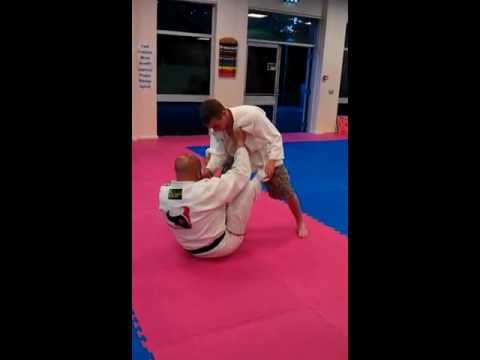
Basingstoke MMA Martial Arts - Sacrifice throw and groundwork tutorial
0
Sacrifice Arm Throw·Basingstoke Martial Arts
Short Instructional clip on sacrifice throws and follow up groundwork techniques. If you are interested in Combat Ju Ji…
Translation: sacrifice arm throw
The Sacrifice Arm Throw family covers te-waza techniques in which the thrower sacrifices their own standing position, falling or dropping to the mat while using the arms to drive the opponent into a throw. [1] These techniques combine the arm-driven mechanics of te-waza with the body-sacrifice principle of sutemi-waza, creating throws where the thrower's falling body weight amplifies the arm action. [1],[2] Yama-arashi (mountain storm) is the primary technique in this family, a devastating throw that uses a powerful lapel grip and body drop to project the opponent. [2],[3]
Sacrifice arm throws occupy a unique position in judo's classification, combining elements of hand technique and sacrifice technique. [1] Yama-arashi in particular holds a special place in judo history as the technique used by Shiro Saigo, one of the Kodokan's earliest and most famous students. [2],[3]
Sacrifice arm throws bridge the te-waza and sutemi-waza categories in judo, combining hand technique principles with sacrifice mechanics. [1]
Sacrifice arm throws are seen in IJF competition and sambo events. [1]
No images yet for this technique.
Sign in to suggest an image.
Short Instructional clip on sacrifice throws and follow up groundwork techniques. If you are interested in Combat Ju Ji…
No instructional courses yet for this technique.
Sign in to suggest a course.
Risk of injury to the person this technique is applied to
Sacrifice version adds tori's falling body weight to arm throw mechanics
Skill level needed to execute this technique reliably
Whether this technique is allowed under major competition rule sets
Kodokan Judo — Official Nage-waza Classification
Traditional Judo throwing technique terminology (Kodokan Institute)
Official Kodokan ground technique classification system
Standard Japanese martial arts terminology (kanji/hiragana)
Established Japanese martial arts naming convention — native Japanese term (和語/漢語)
Traditional Judo throwing technique terminology (Kodokan Institute)
commitment, timing, body weight manipulation, falling skill
heavier build (body weight drives the throw), good ukemi
core rotators, hip flexors, abdominals
Every move, in any martial art, shares a few universal traits. Mix and match below to pinpoint the right tool — or compare equivalents across styles.
Sacrifice arm throws combine the arm throw mechanic with the attacker falling to the ground — higher commitment but harder to defend. In judo, sacrifice throws (sutemi-waza) are considered advanced techniques because the attacker gives up their base. (Kano, Kodokan Judo)
Depending on how you want to finish, you can keep your leg positioned to end up in mount position, or adjust to a half guard position depending on your preference and what works best in the moment.
Start by getting the positioning right from the beginning, focusing on driving through the back leg, and if you can't see properly from your initial angle, you can adjust your position and drive through the back leg again.
The Sacrifice Arm Throw family covers te-waza techniques in which the thrower sacrifices their own standing position, falling or dropping to the mat while using the arms to drive the opponent into a throw. These techniques combine the arm-driven mechanics of te-waza with the body-sacrifice principle of sutemi-waza, creating throws where the thrower's falling body weight amplifies the arm action.
Sacrifice arm throws occupy a unique position in judo's classification, combining elements of hand technique and sacrifice technique. Yama-arashi in particular holds a special place in judo history as the technique used by Shiro Saigo, one of the Kodokan's earliest and most famous students.
IJF: legal — Legal throwing technique; IBJJF: legal — Legal at all belt levels; UWW: legal — Legal in both freestyle and Greco-Roman; Unified MMA: legal — Legal throwing technique; ADCC: legal — Legal; FIAS Sport Sambo: legal — Legal; FIAS Combat Sambo: legal — Legal
Danger rating 6/10. High — sacrifice version adds tori's falling body weight to arm throw mechanics
The standard setup chain: Grip Setup (Kumi-kata) → Off-Balance (Kuzushi) → Entry (Tsukuri) → Execution (Kake) → Fall (Sutemi).
Standard counters include: Lower Centre of Gravity — bend knees and drop hips to make the throw harder to execute / Grip Break — deny the thrower their preferred gripping configuration / Stiff-Arm — maintain distance with straight arms to prevent the entry.
Common variants: Rear sacrifice (falling backward while pulling the opponent over); Side sacrifice (falling to the side to project the opponent laterally); Rolling sacrifice (combining a roll with the sacrifice throw for rotation); Counter sacrifice (using the opponent's forward pressure as the driving force).
Sacrifice arm throws are seen in IJF competition and sambo events.
Top errors to watch for: Falling without pulling the opponent — you end up on the ground with the opponent standing over you / Half-committing to the sacrifice — partial falls result in weak throws and lost position / Not maintaining grip control during the fall — the grips are the only connection to the opponent / Falling backward onto the opponent instead of pulling them past or over you.
The Sacrifice Arm Throw is also known as Sutemi Te-waza, Sacrifice hand throws, Self-falling arm throws.