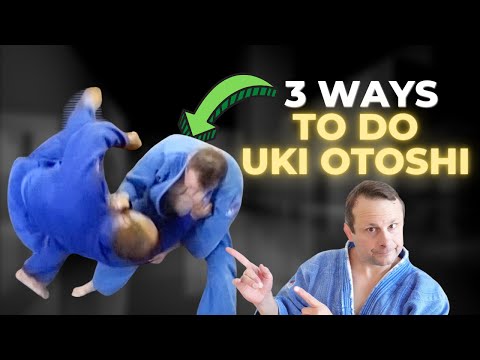
3 Ways To Do Uki Otoshi (One Competition Style Too!)
0
Standard Uki Otoshi·DadBod Judo ·Added by Admin
PEAK PERFORMANCE COACHING (Click the link below and schedule a call) https://tinyurl.com/mvae7f2z Check out my Ebook: …
Translation: floating drop
Standard Uki Otoshi executes the classical floating drop where the thrower steps to the side, drops to one knee, and pulls the opponent forward and downward with both hands to project them over and past the thrower. [1] The throwing force is entirely generated by the combination of the body drop and the pulling hand action, with no hip or leg contact. [1],[2] The technique demonstrates the principle that a well-timed directional pull combined with a sudden level change can produce a powerful throw. [2],[3]
Uki otoshi (floating drop) is a technically demanding throw that uses pure hand action to float the opponent forward and down, with no leg or hip contact. [1] While rarely scored in high-level competition due to its extreme timing requirements, it is considered a fundamental expression of kuzushi principle. [2]
Uki otoshi was included in the original Kodokan gokyo no waza and is the first technique demonstrated in the Nage no Kata, reflecting its foundational importance in understanding hand-based throwing. [1]
Uki otoshi is featured in Nage no Kata demonstrations and occasionally in IJF randori competition. [1]
No images yet for this technique.
Sign in to suggest an image.
PEAK PERFORMANCE COACHING (Click the link below and schedule a call) https://tinyurl.com/mvae7f2z Check out my Ebook: …
No instructional courses yet for this technique.
Sign in to suggest a course.
Risk of injury to the person this technique is applied to
Arm throws use arm leverage; shoulder dislocation risk if arm trapped
Skill level needed to execute this technique reliably
Whether this technique is allowed under major competition rule sets
Kodokan Judo — Official Nage-waza Classification
Traditional Judo throwing technique terminology (Kodokan Institute)
Official Kodokan ground technique classification system
Standard Japanese martial arts terminology (kanji/hiragana)
Established Japanese martial arts naming convention — native Japanese term (和語/漢語)
Traditional Judo throwing technique terminology (Kodokan Institute)
hip rotation speed, core strength, lower back stability
strong hips and core, good flexibility for turning entry
hip rotators, core, quadriceps, latissimus dorsi
Instead of going to the corner with a sumiyotoshi, you can step into the technique, take your opponent hard off their foot, and float them up.
Standard Uki Otoshi executes the classical floating drop where the thrower steps to the side, drops to one knee, and pulls the opponent forward and downward with both hands to project them over and past the thrower. The throwing force is entirely generated by the combination of the body drop and the pulling hand action, with no hip or leg contact.
The standard form of uki otoshi is the foundational hand technique of Kodokan judo, holding pride of place as the first technique in the Nage no Kata since its creation. It has been practised and studied continuously since the founding of the Kodokan.
IJF: legal — Legal throwing technique; IBJJF: legal — Legal at all belt levels; UWW: legal — Legal in both freestyle and Greco-Roman; Unified MMA: legal — Legal throwing technique; ADCC: legal — Legal; FIAS Sport Sambo: legal — Legal; FIAS Combat Sambo: legal — Legal
Danger rating 5/10. High — arm throws use arm leverage; shoulder dislocation risk if arm trapped
The standard setup chain: Grip Setup (Kumi-kata) → Off-Balance (Kuzushi) → Entry (Tsukuri) → Execution (Kake).
Standard counters include: Lower Centre of Gravity — bend knees and drop hips to make the throw harder to execute / Block the Hip — post hand on the thrower's hip to prevent loading / Step Around — circle away from the throw direction to avoid being loaded / Grip Break — deny the thrower their preferred gripping configuration.
Common variants: Standard hip throw (full turn-in with hip below the opponent's centre of gravity); No-gi hip throw (adapted without gi grips, using overhook and collar tie); Drop hip throw (dropping to one knee to lower the fulcrum point); Combination hip throw (chaining from a failed foot technique or hand technique).
Uki otoshi is featured in Nage no Kata demonstrations and occasionally in IJF randori competition.
Top errors to watch for: Not stepping laterally — trying to execute uki otoshi from directly in front does not create the correct angle / Pulling straight down instead of in a spiral — forward, to the side, then downward / Not timing the pull to the opponent's step — the technique requires their forward momentum / Staying upright while trying to pull the opponent down — drop your own centre.
The Standard Uki Otoshi is also known as Uki Otoshi, Classical Floating Drop, Standard Floating Drop Throw.