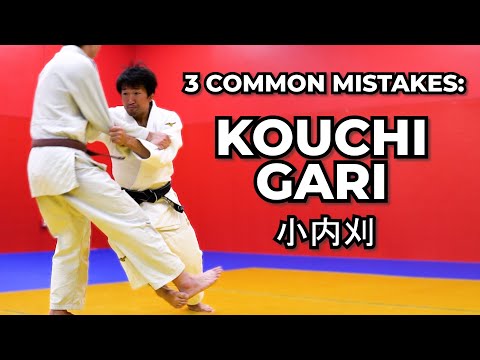
Basic Kouchi Gari TRICK
0
Standard Ko Uchi Gari·Shintaro Higashi
Basic Kouchi Gari Trick, The Japanese way Follow me on Instagram!!! https://www.instagram.com/judoshintaronyc/
Translation: minor inner reap
Standard Ko Uchi Gari executes the classical minor inner reap where the thrower hooks or sweeps the opponent's near foot from the inside with a quick reaping action of the sole, pulling the foot out from under the opponent while the hands push the upper body rearward. [1] The reap is short and sharp, targeting the inner ankle or heel of the near foot, and the hands create a pushing force that loads the opponent's weight onto the attacked foot. [1],[2] The technique can score directly as a throw or, more commonly, serves as an attack that disrupts the opponent's balance and creates the opening for a follow-up technique. [2],[3]
The standard form of ko uchi gari has been a fundamental judo technique since the original gokyo, valued both as a standalone attack and as the premier combination-starting technique in judo. [1] Its effectiveness as a setup has made it one of the most frequently attempted techniques in judo competition history. [2],[3]
Ko uchi gari is an extremely versatile technique, effective both as a standalone throw and as one of the most commonly used setup attacks in judo competition. [1] Its compact mechanics allow it to be executed from virtually any grip position, making it a universal combination tool. [2] When timed to catch an opponent mid-step, ko uchi gari can score ippon outright despite its relatively small range of motion. [3]
Ko uchi gari is one of the most frequently scored ashi-waza techniques at the Olympic Games and World Championships, valued for its versatility as both a direct attack and a combination setup. [1] Tadahiro Nomura (JPN), three-time Olympic gold medallist (1996, 2000, 2004) at 60 kg, used ko uchi gari extensively in his combination sequences. [2]
No images yet for this technique.
Sign in to suggest an image.
Basic Kouchi Gari Trick, The Japanese way Follow me on Instagram!!! https://www.instagram.com/judoshintaronyc/
Do you feel as if your Judo training is not getting you to the level you want to be? If so, check out Nakano Judo Online…
The secret of successful randori session. My DVD👉 https://dannyjudo.com/ To book personal one in one consultation, ca…
Continuing the ashi waza drills, Ronda shows you how to do one of the original 40 throws in judo! Those fast feet are a…
Ko Uchi Gari is a foot-leg reaping technique that requires precise timing, hand usage, and footwork to execute effectively. Distance is critical: instructors Danny Karapanchev and Shintaro Higashi emphasize proper spacing to enable the technique, while Ronda Rousey stresses timing the sweep to the moment when an opponent's weight transfers to the target leg before it fully contacts the ground—analogous to stepping on a banana peel. Hand technique is fundamental and controversial. Shintaro Nakano emphasizes that hands must break balance first through diagonal backward kuzush: the right hand pushes the chin upward and forward while the left hand twists and pushes the sleeve downward, not merely pulling. Karapanchev describes pushing the elbow with the left hand and chin with the right, coordinating hand and step movements. Higashi introduces a weight-shifting "trick" where subtle push-pull movements move weight from one leg to the other before the reap, working on a different plane than traditional shoulder rolls. Regarding the actual reap, Nakano and Higashi agree that a sweep motion—not a knee bend or leg pickup—is essential, with Nakano noting the heel can be used heel-to-heel for deeper penetration. Timing strategies vary: Nakano recommends using fakes (particularly Morote-seoi feints) to provoke backward weight shifts, while Rousey advocates continuous movement and directional changes. Karapanchev shows transition to groundwork with knee pressure after the throw. All instructors underscore that hand and foot actions must coordinate dynamically rather than occur sequentially.
Synthesized from 4 instructors
No instructional courses yet for this technique.
Sign in to suggest a course.
Risk of injury to the person this technique is applied to
O-Uchi-Gari and variants; backward fall risk with head impact (Kano 1986)
Skill level needed to execute this technique reliably
Whether this technique is allowed under major competition rule sets
Kodokan Judo — Official Nage-waza Classification
Traditional Judo throwing technique terminology (Kodokan Institute)
Official Kodokan ground technique classification system
Standard Japanese martial arts terminology (kanji/hiragana)
Established Japanese martial arts naming convention — native Japanese term (和語/漢語)
Traditional Judo throwing technique terminology (Kodokan Institute)
precise timing, ankle coordination, upper body kuzushi ability
excellent balance and quick reflexes
tibialis anterior, calves, hip rotators, forearms (grip)
Your hands are essential for kuzushi (breaking balance). Coach Shintaro Nakano emphasizes that many people neglect hand usage, but you should push diagonally backwards with your hands—pushing upward and forward—to properly unbalance your opponent before the sweep.
Ko uchi gari is fundamentally about sweeping, not picking the leg up by bending your knees. Coach Shintaro Nakano stresses that you should catch the timing and sweep all the way through, rather than just bending at the knee.
Shintaro Higashi recommends sweeping upwards at an angle rather than pulling the foot downward, because pulling down creates friction on the toe that makes the throw harder. Taking the leg upward reduces friction and makes the technique more effective.
Timing is critical—Coach Shintaro Nakano identifies it as the third common mistake and emphasizes that you must catch the leg first and time your sweep to when your opponent is stepping or moving.
Standard Ko Uchi Gari executes the classical minor inner reap where the thrower hooks or sweeps the opponent's near foot from the inside with a quick reaping action of the sole, pulling the foot out from under the opponent while the hands push the upper body rearward. The reap is short and sharp, targeting the inner ankle or heel of the near foot, and the hands create a pushing force that loads the opponent's weight onto the attacked foot.
The standard form of ko uchi gari has been a fundamental judo technique since the original gokyo, valued both as a standalone attack and as the premier combination-starting technique in judo. Its effectiveness as a setup has made it one of the most frequently attempted techniques in judo competition history.
IJF: legal — Legal throwing technique; IBJJF: legal — Legal at all belt levels; UWW: restricted — Legal in freestyle, banned in Greco-Roman (no leg attacks below waist); Unified MMA: legal — Legal throwing technique; ADCC: legal — Legal; FIAS Sport Sambo: legal — Legal; FIAS Combat Sambo: legal — Legal
Danger rating 6/10. High — O-Uchi-Gari and variants; backward fall risk with head impact (Kano 1986)
The standard setup chain: Grip Setup (Kumi-kata) → Off-Balance (Kuzushi) → Entry (Tsukuri) → Execution (Kake).
Standard counters include: Lower Centre of Gravity — bend knees and drop hips to make the throw harder to execute / Lift the Targeted Leg — raise the foot being attacked above the sweeping action / Counter-Throw — exploit the attacker's committed weight to throw them instead / Grip Break — deny the thrower their preferred gripping configuration.
Common variants: Forward sweep (sweeping the foot in the direction the opponent is stepping); Rear sweep (sweeping the foot backward as the opponent retreats); Combination sweep (chaining sweeps to both feet); Counter sweep (timing the sweep as the opponent initiates their own attack).
Ko uchi gari is one of the most frequently scored ashi-waza techniques at the Olympic Games and World Championships, valued for its versatility as both a direct attack and a combination setup. Tadahiro Nomura (JPN), three-time Olympic gold medallist (1996, 2000, 2004) at 60 kg, used ko uchi gari extensively in his combination sequences.
Top errors to watch for: Hooking too gently — the reap must be a firm, committed action that dislodges the foot / Pushing the opponent straight backward without a sideways component — they brace the other leg and resist / Not timing the reap to the opponent's step — catching a planted, weighted foot is much harder / Attempting from outside of close range — you must be right next to the target foot.
The Standard Ko Uchi Gari is also known as Ko Uchi Gari, Classical Minor Inner Reaping Throw, Standard Small Inner Reap, Standard Inside Ankle Pick.