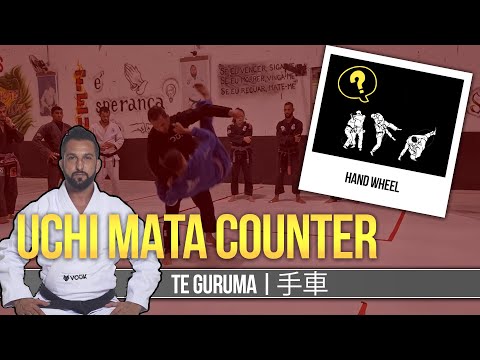
UCHI MATA COUNTER | TE GURUMA - 手車
0
Uchi Mata Counter·Escolas FEU BJJ “Contato FEU BJJ” Academia
Hi guys, I hope you are going well so far, today I will be teaching a very powerful UCHI MATA counter known as TE GURUMA…
Translation: inner thigh throw
The Uchi Mata Counter subfamily covers techniques specifically designed to defeat an incoming uchi-mata attack, using the opponent's turning and lifting momentum against them. [1] Because uchi-mata requires the thrower to turn their back and commit to a one-legged stance, it creates specific vulnerabilities that can be exploited by an alert defender. [1],[2] Common counter methods include blocking the sweeping leg and redirecting the rotation, stepping over the attacking leg, or simply resisting and rolling the attacker over from their compromised position. [2],[3]
Uchi-mata counters developed alongside the technique itself, as judo practitioners sought answers to one of the sport's most dominant throws. [1] The study of kaeshi-waza (counter techniques) against uchi-mata became an essential part of competitive judo preparation, particularly from the 1970s onward as uchi-mata became the most commonly attempted throw in high-level competition. [2],[3]
Uchi mata counters developed as the throw became more prevalent in competition, with judoka developing specific counter-throwing responses. [1]
Uchi mata counters produce some of the most dramatic ippon scores in IJF competition. [1]
No images yet for this technique.
Sign in to suggest an image.
Hi guys, I hope you are going well so far, today I will be teaching a very powerful UCHI MATA counter known as TE GURUMA…
This video shows an Uchi Mata counter against an opponent's Ko Soto Gake or outside leg hook attack. The Welcome Mat ath…
No instructional courses yet for this technique.
Sign in to suggest a course.
Risk of injury to the person this technique is applied to
Inner thigh reaping action; knee ligament strain risk on defender
Skill level needed to execute this technique reliably
Whether this technique is allowed under major competition rule sets
Kodokan Judo — Official Nage-waza Classification
Traditional Judo throwing technique terminology (Kodokan Institute)
Official Kodokan ground technique classification system
Standard Japanese martial arts terminology (kanji/hiragana)
Established Japanese martial arts naming convention — native Japanese term (和語/漢語)
Traditional Judo throwing technique terminology (Kodokan Institute)
precise timing, ankle coordination, upper body kuzushi ability
excellent balance and quick reflexes
tibialis anterior, calves, hip rotators, forearms (grip)
Every move, in any martial art, shares a few universal traits. Mix and match below to pinpoint the right tool — or compare equivalents across styles.
Use uchi mata as a counter. As soon as you feel your opponent hook your leg, immediately step back and throw with uchi mata rather than waiting for them to complete the takedown. Steve Scott emphasizes that timing is critical—counter as soon as you feel the hook.
No, this is primarily a leg-style uchi mata counter that doesn't require much hip movement. Steve Scott notes you can execute it effectively with minimal hip engagement, making it a compact and efficient response.
The Escolas FEU BJJ instructor uses three different leverages in this counter—two going up and one going down. The counter can be executed so the opponent spins on an axle, and positioning the belly correctly can provide immediate blocking action.
The Uchi Mata Counter subfamily covers techniques specifically designed to defeat an incoming uchi-mata attack, using the opponent's turning and lifting momentum against them. Because uchi-mata requires the thrower to turn their back and commit to a one-legged stance, it creates specific vulnerabilities that can be exploited by an alert defender.
Uchi-mata counters developed alongside the technique itself, as judo practitioners sought answers to one of the sport's most dominant throws. The study of kaeshi-waza (counter techniques) against uchi-mata became an essential part of competitive judo preparation, particularly from the 1970s onward as uchi-mata became the most commonly attempted throw in high-level competition.
IJF: legal — Legal throwing technique; IBJJF: legal — Legal at all belt levels; UWW: legal — Legal in both freestyle and Greco-Roman; Unified MMA: legal — Legal throwing technique; ADCC: legal — Legal; FIAS Sport Sambo: legal — Legal; FIAS Combat Sambo: legal — Legal
Danger rating 5/10. High — inner thigh reaping action; knee ligament strain risk on defender
The standard setup chain: Grip Setup (Kumi-kata) → Off-Balance (Kuzushi) → Entry (Tsukuri) → Execution (Kake).
Standard counters include: Lower Centre of Gravity — bend knees and drop hips to make the throw harder to execute / Lift the Targeted Leg — raise the foot being attacked above the sweeping action / Counter-Throw — exploit the attacker's committed weight to throw them instead / Grip Break — deny the thrower their preferred gripping configuration.
Common variants: Forward sweep (sweeping the foot in the direction the opponent is stepping); Rear sweep (sweeping the foot backward as the opponent retreats); Combination sweep (chaining sweeps to both feet); Counter sweep (timing the sweep as the opponent initiates their own attack).
Uchi mata counters produce some of the most dramatic ippon scores in IJF competition.
Top errors to watch for: Countering too early before the opponent commits to the throw — the counter works against their momentum, so they mus… / Trying to resist by pulling backward instead of stepping and redirecting — this makes you easier to throw / Not stepping the target leg out of the sweep's path — the counter requires you to remove the leg the sweep is targeting / Panicking during the entry and losing grip — maintain your grips to control the counter.
The Uchi Mata Counter is also known as Uchi Mata, Uchi Mata Sukashi, Uchi Mata Gaeshi, Inner Thigh Counter.