Uchimata Counter for Judo and BJJ
0
Standard Uchi Mata Counter·Shintaro Higashi·Added by Admin
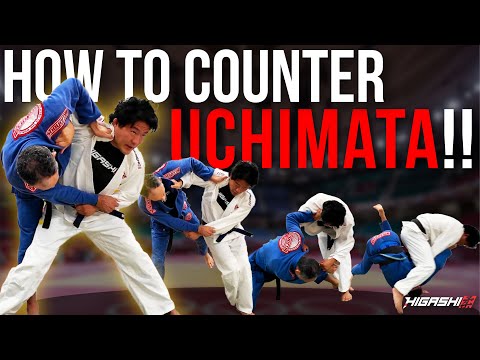
Learn how to counter Uchimata in this step-by-step guide with Shintaro Higashi Subscribe and click the bell 🔔 icon to …
Translation: inner thigh throw
Standard Uchi Mata Counter is the fundamental counter to uchi-mata in which the defender blocks or absorbs the sweeping leg, maintains balance, and uses the attacker's compromised one-legged position and turned back to throw or roll them over. [1] The most common execution involves the defender widening the base, blocking the sweeping leg with the inner thigh, and then wheeling the off-balance attacker forward and over using their own momentum. [1],[2] This counter exemplifies the judo principle of turning the opponent's strength against them — the more committed the uchi-mata attack, the more devastating the counter can be. [2],[3]
Standard uchi-mata counters have been practised since the technique's inclusion in the Kodokan syllabus, forming part of the kaeshi-waza (counter technique) curriculum. [1] Mastering uchi-mata counters became essential for competitive judoka from the 1980s onward as the throw dominated international competition scoring statistics. [2],[3]
Uchi mata counter (uchi-mata-sukashi or uchi-mata-gaeshi) is one of the most effective counter-throws in judo, exploiting the deep commitment required for uchi mata by redirecting the attacker's own momentum. [1] When the attacker's sweeping leg passes without making contact, the defender can step aside and guide the attacker into a fall using their own forward energy. [2]
Counter techniques for uchi mata have been formally recognised in the Kodokan system, with uchi-mata-sukashi (uchi mata void) being added to the official technique list. [1]
Uchi mata counters are frequently scored at the highest levels of international judo, where the prevalence of uchi mata as an attack creates regular counter-throwing opportunities. [1]
No images yet for this technique.
Sign in to suggest an image.
Learn how to counter Uchimata in this step-by-step guide with Shintaro Higashi Subscribe and click the bell 🔔 icon to …
No instructional courses yet for this technique.
Sign in to suggest a course.
Risk of injury to the person this technique is applied to
Inner thigh reaping action; knee ligament strain risk on defender
Skill level needed to execute this technique reliably
Whether this technique is allowed under major competition rule sets
Kodokan Judo — Official Nage-waza Classification
Traditional Judo throwing technique terminology (Kodokan Institute)
Official Kodokan ground technique classification system
Standard Japanese martial arts terminology (kanji/hiragana)
Established Japanese martial arts naming convention — native Japanese term (和語/漢語)
Traditional Judo throwing technique terminology (Kodokan Institute)
precise timing, ankle coordination, upper body kuzushi ability
excellent balance and quick reflexes
tibialis anterior, calves, hip rotators, forearms (grip)
You need to anticipate the entry and sidestep the technique. Shintaro Higashi demonstrates that as your opponent commits to uchi mata, you can evade by moving to the side and then attack with an alternative technique like o goshi.
Focus on defending your hip first and foremost by controlling it. From there, you can use a back-heel to pull your opponent's leg toward you while crowding in to disrupt their balance and positioning.
Standard Uchi Mata Counter is the fundamental counter to uchi-mata in which the defender blocks or absorbs the sweeping leg, maintains balance, and uses the attacker's compromised one-legged position and turned back to throw or roll them over. The most common execution involves the defender widening the base, blocking the sweeping leg with the inner thigh, and then wheeling the off-balance attacker forward and over using their own momentum.
Standard uchi-mata counters have been practised since the technique's inclusion in the Kodokan syllabus, forming part of the kaeshi-waza (counter technique) curriculum. Mastering uchi-mata counters became essential for competitive judoka from the 1980s onward as the throw dominated international competition scoring statistics.
IJF: legal — Legal throwing technique; IBJJF: legal — Legal at all belt levels; UWW: legal — Legal in both freestyle and Greco-Roman; Unified MMA: legal — Legal throwing technique; ADCC: legal — Legal; FIAS Sport Sambo: legal — Legal; FIAS Combat Sambo: legal — Legal
Danger rating 5/10. High — inner thigh reaping action; knee ligament strain risk on defender
The standard setup chain: Grip Setup (Kumi-kata) → Off-Balance (Kuzushi) → Entry (Tsukuri) → Execution (Kake).
Standard counters include: Lower Centre of Gravity — bend knees and drop hips to make the throw harder to execute / Lift the Targeted Leg — raise the foot being attacked above the sweeping action / Counter-Throw — exploit the attacker's committed weight to throw them instead / Grip Break — deny the thrower their preferred gripping configuration.
Common variants: Forward sweep (sweeping the foot in the direction the opponent is stepping); Rear sweep (sweeping the foot backward as the opponent retreats); Combination sweep (chaining sweeps to both feet); Counter sweep (timing the sweep as the opponent initiates their own attack).
Uchi mata counters are frequently scored at the highest levels of international judo, where the prevalence of uchi mata as an attack creates regular counter-throwing opportunities.
Top errors to watch for: Stepping the wrong leg — you must step the leg that the sweep is targeting, not the other one / Stepping but not pulling — clearing the leg alone is not enough; you must redirect the opponent's momentum / Attempting to counter without reading the throw first — misidentifying uchi mata as a different throw leads to the wr… / Pulling the opponent sideways instead of forward and down — they recover balance if not directed to the mat.
The Standard Uchi Mata Counter is also known as Uchi Mata, Classical Uchi Mata Sukashi, Standard Uchi Mata Gaeshi.