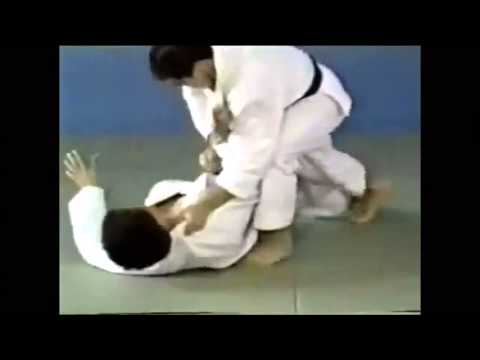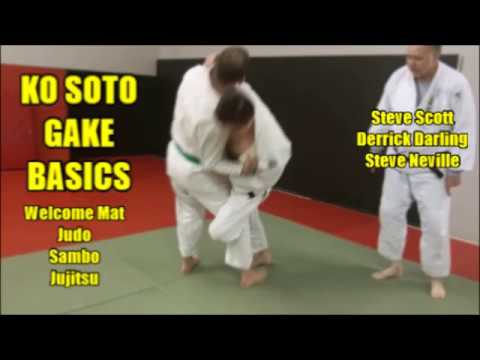
KO SOTO GAKE BASICS
0
Ko Soto Gake·welcomematstevescott
Ko Soto Gake (Minor Outer Hook) and a popular and versatile throwing technique. This video shows the basic skills. View …
Translation: minor outer hook
Ko Soto Gake (minor outer hook) is a judo ashi-waza technique in which the thrower hooks the opponent's heel or ankle from the outside with the sole of the foot, trapping the foot while driving the opponent backward over the hooked support. [1] The 'ko' (minor) designation refers to the smaller range of the technique compared to o-soto-gake, targeting the lower portion of the leg near the ankle. [1],[2] The hooking action prevents the opponent from stepping back to recover balance, while the hand action pushes the opponent's upper body rearward, creating a rotation over the trapped foot. [2],[3]
Ko soto gake was recognised in the Kodokan's expanded classification of judo throws, catalogued as a distinct technique from the reaping (gari) and sweeping (barai) foot techniques. [1] The hooking mechanic represents a different tactical approach — trapping rather than displacing the opponent's foot. [2],[3]
Ko soto gake is part of the Kodokan judo ashi-waza syllabus. [1]
Ko soto gake is scored in IJF judo competition. [1]
No images yet for this technique.
Sign in to suggest an image.
Ko Soto Gake (Minor Outer Hook) and a popular and versatile throwing technique. This video shows the basic skills. View …
pequeño gancho externo
No instructional courses yet for this technique.
Sign in to suggest a course.
Risk of injury to the person this technique is applied to
Hooking action can cause knee/ankle injury if resisted; moderate impact on landing
Skill level needed to execute this technique reliably
Whether this technique is allowed under major competition rule sets
Kodokan Judo — Official Nage-waza Classification
Traditional Judo throwing technique terminology (Kodokan Institute)
Official Kodokan ground technique classification system
Standard Japanese martial arts terminology (kanji/hiragana)
Established Japanese martial arts naming convention — native Japanese term (和語/漢語)
Traditional Judo throwing technique terminology (Kodokan Institute)
single-leg balance, hip flexibility, explosive driving power
long legs for hooking reach, strong standing balance
glutes, hip flexors, hamstrings, core, calves (balance)
Every move, in any martial art, shares a few universal traits. Mix and match below to pinpoint the right tool — or compare equivalents across styles.
According to Welcome Mat Steve Scott, the biggest mistake is getting in a hurry to hook the leg and leaving yourself vulnerable to being countered with an uchimata. Instead, you should always lead with your hips before attempting the hook.
Hip positioning is critical—you must get your hips past the centerline of your opponent's body before hooking. Steve Scott emphasizes that even though it's a leg technique, you always lead with your hips, not with a lunge, or your opponent will counter you.
Point your toe down and perform a chopping motion as you hook the leg in. This is a more controlled action than diving forward with full commitment, giving you better control over the throw.
While you can hook and stand up, Steve Scott recommends going to the mat with the throw because it provides a better transition into a pinning situation on the ground, making it an effective throw-to-ground-fighting combination.
Ko Soto Gake (minor outer hook) is a judo ashi-waza technique in which the thrower hooks the opponent's heel or ankle from the outside with the sole of the foot, trapping the foot while driving the opponent backward over the hooked support. The 'ko' (minor) designation refers to the smaller range of the technique compared to o-soto-gake, targeting the lower portion of the leg near the ankle.
Ko soto gake was recognised in the Kodokan's expanded classification of judo throws, catalogued as a distinct technique from the reaping (gari) and sweeping (barai) foot techniques. The hooking mechanic represents a different tactical approach — trapping rather than displacing the opponent's foot.
IJF: legal — Legal throwing technique; IBJJF: legal — Legal at all belt levels; UWW: restricted — Legal in freestyle, banned in Greco-Roman (no leg attacks below waist); Unified MMA: legal — Legal throwing technique; ADCC: legal — Legal; FIAS Sport Sambo: legal — Legal; FIAS Combat Sambo: legal — Legal
Danger rating 5/10. High — hooking action can cause knee/ankle injury if resisted; moderate impact on landing
The standard setup chain: Grip Setup (Kumi-kata) → Off-Balance (Kuzushi) → Entry (Tsukuri) → Execution (Kake).
Standard counters include: Lower Centre of Gravity — bend knees and drop hips to make the throw harder to execute / Grip Break — deny the thrower their preferred gripping configuration / Stiff-Arm — maintain distance with straight arms to prevent the entry.
Common variants: Standard technique (primary execution from standard grip and positioning); No-gi adaptation (modified without gi grips for submission grappling or MMA); Combination entry (entering from a failed attack or chain of techniques); Counter throw (applied as a direct counter to the opponent's throw or at…).
Ko soto gake is scored in IJF judo competition.
Top errors to watch for: Hooking too high on the calf instead of at the ankle — the ankle hook provides a lower fulcrum and better mechanical … / Not driving forward with the upper body — the hook alone does not throw; you must push them over it / Standing too far away and reaching with the hooking foot — close the distance first / Bending at the waist to reach the hook, which raises your centre of gravity and weakens the drive.
The Ko Soto Gake is also known as Minor Outer Hook, Small Outside Hook, Ko Soto Gake.