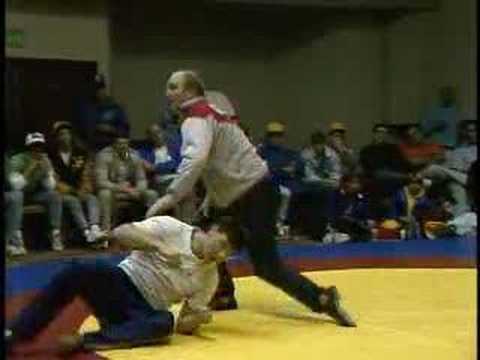
Two-on-One Combinations - Part 1
0
Two-On-One Drag·wrestlercarlw
Demonstration of the two-on-one position and several takedowns initiated from it, including a fireman's takedown, a leg …
Translation: two-on-one drag (katakana)
The Two-On-One Drag subfamily uses a general two-on-one grip configuration — both hands controlling one of the opponent's arms — to execute a drag takedown, without specifically using the Russian tie hand placement. [1] Various two-on-one configurations can be used, including wrist-and-bicep, wrist-and-elbow, or wrist-and-shoulder grips, each providing slightly different leverage and control angles. [1],[2] The drag mechanics are similar to the Russian tie variant: the opponent's arm is pulled across the attacker's body to redirect the opponent's balance and create an angle for takedown. [2],[3]
The two-on-one grip system was developed in Russian wrestling and adapted worldwide in freestyle and Greco-Roman competition. [1]
The two-on-one drag is a standard technique in international wrestling competition. [1]
No images yet for this technique.
Sign in to suggest an image.
Demonstration of the two-on-one position and several takedowns initiated from it, including a fireman's takedown, a leg …
No instructional courses yet for this technique.
Sign in to suggest a course.
Risk of injury to the person this technique is applied to
Drag/snap motion for off-balancing; low impact
Skill level needed to execute this technique reliably
Whether this technique is allowed under major competition rule sets
Japanese amateur wrestling terminology
Japanese amateur wrestling terminology
Standard katakana transliteration of Western martial arts terminology (外来語) — used in Japanese MMA, boxing, and BJJ communities
Standard katakana transliteration used in Japanese wrestling (レスリング)
explosive lower body power, level change ability, timing
athletic build with strong legs and quick hips
quadriceps, glutes, core, shoulders
Every move, in any martial art, shares a few universal traits. Mix and match below to pinpoint the right tool — or compare equivalents across styles.
You should take the hand in front of the face, not over the head. This positioning is critical for proper setup and control of the technique.
The wrist must be facing your body, and you need total control at the wrist itself, not at the hand. Focus on gripping with just two fingers for proper leverage and control.
Apply a twisting motion to the wrist, which causes your opponent's arm to rotate back naturally. This rotation helps position them better for the fireman's carry finish.
The Two-On-One Drag subfamily uses a general two-on-one grip configuration — both hands controlling one of the opponent's arms — to execute a drag takedown, without specifically using the Russian tie hand placement. Various two-on-one configurations can be used, including wrist-and-bicep, wrist-and-elbow, or wrist-and-shoulder grips, each providing slightly different leverage and control angles.
Two-on-one arm control has been a principle of wrestling across many cultures and styles, with variations appearing in folk wrestling traditions worldwide. The formal systematisation of two-on-one drags occurred primarily in modern freestyle and Greco-Roman wrestling training.
IJF: legal — Legal takedown technique; IBJJF: legal — Legal at all belt levels, scored as takedown (2 points); UWW: legal — Legal in both freestyle and Greco-Roman; Unified MMA: legal — Legal takedown technique; ADCC: legal — Legal, scored 2-4 points in second half of match; FIAS Sport Sambo: legal — Legal — all takedowns permitted; FIAS Combat Sambo: legal — Legal; NCAA Folkstyle: legal — Legal, scored as takedown (2 points)
Danger rating 3/10. Moderate — drag/snap motion for off-balancing; low impact
The standard setup chain: Establish Contact → Create Off-Balance → Execute the Takedown → Follow to Ground.
Standard counters include: Sprawl — drop hips back and drive weight down to stuff the takedown attempt / Underhook — establish inside position to control distance and prevent the takedown entry / Post and Circle — post on the attacker's head and circle away to break their angle / Level Change Defence — recognize the shot early and react with appropriate hip defence.
Common variants: Standard technique (primary execution from the most common wrestling stance o…); No-gi/MMA adaptation (modified for no-gi or cage fighting conditions); Gi/judo adaptation (modified for gi-based grappling with collar and sleeve grips); Counter variation (applied as a counter to the opponent's attack).
The two-on-one drag is a standard technique in international wrestling competition.
Top errors to watch for: Holding the two-on-one statically without attacking — it's a setup, not a position / Gripping too high on the arm (shoulder area) where you have less control / Pulling toward you instead of past you — the angle is the goal / Letting the opponent pummel their arm free by not maintaining constant pressure.
The Two-On-One Drag is also known as Tsū On Wan Doraggu, Two-On-One, Russian Two-On-One, Double Wrist Drag.