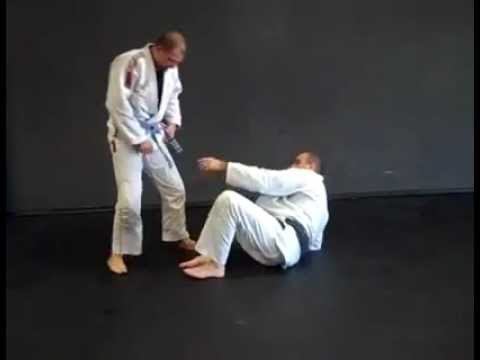
2 Ankle Sweep - Lesson 18
0
Standard Outside Ankle Trip·Tom Dinklage·Added by Admin
Precision MMA in Houston offercs classes in Brazilian Jiu Jitsu, Kickboxing, and Mixed Martial Arts for all ages. Get y…
Translation: standard outside ankle trip
The Standard Outside Ankle Trip executes the fundamental outside ankle hook-and-trip where the attacker hooks or blocks the opponent's outside ankle with their foot while driving the opponent's upper body in the opposite direction with hand control. [1] The attacker typically uses a collar tie or underhook to push the opponent's weight over the target foot, then hooks the outside of that ankle and sweeps or blocks it while continuing the upper body drive. [1],[2] The opponent falls laterally over the trapped ankle. [2] The outside angle makes this trip effective against both forward and backward-weighted opponents, depending on the direction of the upper body drive. [2],[3]
The standard outside ankle trip is the fundamental version of the technique, taught in judo and wrestling programmes. [1]
Regularly seen in judo and wrestling competition. [1]
No images yet for this technique.
Sign in to suggest an image.
Precision MMA in Houston offercs classes in Brazilian Jiu Jitsu, Kickboxing, and Mixed Martial Arts for all ages. Get y…
No instructional courses yet for this technique.
Sign in to suggest a course.
Risk of injury to the person this technique is applied to
O-Soto-Gari style; backward fall with head impact risk
Skill level needed to execute this technique reliably
Whether this technique is allowed under major competition rule sets
Kodokan Judo — Official Nage-waza Classification
Traditional Judo throwing/takedown terminology (Kodokan Institute)
Official Kodokan ground technique classification system
Standard Japanese martial arts terminology (kanji/hiragana)
Established Japanese martial arts naming convention — native Japanese term (和語/漢語)
Traditional Judo throwing/takedown terminology (Kodokan Institute)
timing, balance, upper body control for push-pull
good coordination and sense of opponent's weight distribution
core stabilisers, hip adductors/abductors, calves
Maintaining control of your opponent's head minimizes the space between you and him, which sets up the sweep successfully and prevents him from creating distance to defend.
A common mistake is attempting the sweep when your opponent's feet are sprawled back too far or positioned too wide—for the technique to work, he must be carrying his own weight on his feet within your reach.
After sweeping, use a crab walk to move back rather than going directly on top of your opponent, since his feet may still be flailing or kicking wildly as he falls.
The person being swept should work on a proper breakfall and tuck their chin to avoid injury during the fall.
The Standard Outside Ankle Trip executes the fundamental outside ankle hook-and-trip where the attacker hooks or blocks the opponent's outside ankle with their foot while driving the opponent's upper body in the opposite direction with hand control. The attacker typically uses a collar tie or underhook to push the opponent's weight over the target foot, then hooks the outside of that ankle and sweeps or blocks it while continuing the upper body drive.
The standard outside ankle trip has been a staple takedown in wrestling and combat sports, valued for its versatility from various clinch positions. The technique's effectiveness at close range ensured its inclusion in MMA and self-defence curricula.
IJF: legal — Legal (ashi-waza) — trips executed without grabbing opponent's legs are permi…; IBJJF: legal — Legal at all belt levels, scored as takedown (2 points); UWW: restricted — Legal in freestyle, restricted in Greco-Roman (leg-to-leg contact prohibited); Unified MMA: legal — Legal takedown technique; ADCC: legal — Legal, scored 2-4 points in second half of match; FIAS Sport Sambo: legal — Legal — all takedowns permitted; FIAS Combat Sambo: legal — Legal; NCAA Folkstyle: legal — Legal, scored as takedown (2 points)
Danger rating 5/10. High — O-Soto-Gari style; backward fall with head impact risk
The standard setup chain: Establish Grip → Off-Balance (Kuzushi) → Execute the Reap/Sweep.
Standard counters include: Sprawl — drop hips back and drive weight down to stuff the takedown attempt / Lift the Targeted Leg — raise the foot being attacked to avoid the reap or sweep / Step Over — lift the targeted leg over the sweeping limb to evade / Counter-Throw — use opponent's committed weight shift to execute a counter technique.
Common variants: Standard trip (blocking or sweeping the support leg while driving the up…); Combination trip (chaining an inside trip with an outside trip when the opp…); Counter trip (using the trip as a counter when the opponent attacks); Clinch trip (executing the trip from a tight clinch position).
Regularly seen in judo and wrestling competition.
Top errors to watch for: Hooking and pushing in the same direction — the hook traps the foot behind, the push drives them backward over it / Not driving forward with the body after setting the hook — the hook alone isn't enough / Hooking too high on the leg, giving them room to slip the foot out / Trying the trip from too far away, reaching with the foot instead of stepping in close first.
The Standard Outside Ankle Trip is also known as Sotogake (Ashikubi), Standard Outer Ankle Hook, Outside Heel Trip, Ko Soto Gake Takedown.