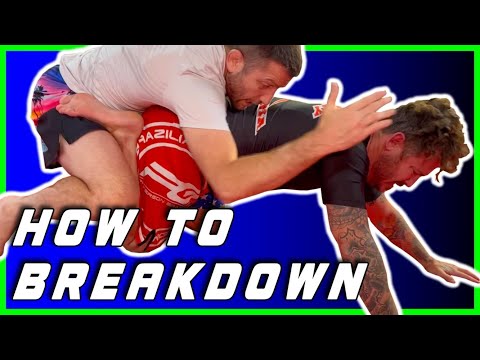
Ankle BREAKDOWN to Control THEM!
0
Outside Ankle Trip·TeachMeGrappling Coach Brian
This video I bring in some wrestling ankle breakdowns into our training and talk a little about the differences in the w…
Translation: outside ankle trip
The Outside Ankle Trip subfamily targets the opponent's ankle from the outside, using the attacker's foot to hook or block the outer ankle while upper body control directs the opponent's fall over the trapped foot. [1] The outside angle provides a natural leverage advantage because the tripping force acts on the widest part of the opponent's base. [1],[2] Outside ankle trips are commonly executed from collar tie positions, underhooks, or body lock clinches where the attacker has access to the outside of the opponent's leg. [2],[3]
The outside ankle trip is scored regularly in judo and MMA competition. [1]
No images yet for this technique.
Sign in to suggest an image.
This video I bring in some wrestling ankle breakdowns into our training and talk a little about the differences in the w…
No instructional courses yet for this technique.
Sign in to suggest a course.
Risk of injury to the person this technique is applied to
O-Soto-Gari style; backward fall with head impact risk
Skill level needed to execute this technique reliably
Whether this technique is allowed under major competition rule sets
Kodokan Judo — Official Nage-waza Classification
Traditional Judo throwing/takedown terminology (Kodokan Institute)
Official Kodokan ground technique classification system
Standard Japanese martial arts terminology (kanji/hiragana)
Established Japanese martial arts naming convention — native Japanese term (和語/漢語)
Traditional Judo throwing/takedown terminology (Kodokan Institute)
upper body squeeze strength, lifting power, hip drive
thick chest and arms for tight lock, strong lower back for lifts
pectorals, biceps, erector spinae, glutes
Every move, in any martial art, shares a few universal traits. Mix and match below to pinpoint the right tool — or compare equivalents across styles.
Coach Brian demonstrates grabbing the opponent's ankle and forcing it toward their butt while pulling and driving forward to break them down so you can cover them on the mat.
Coach Brian cautions that as you get older, be careful with this technique because there's significant pressure on the knee and calf area similar to a calf lock. He recommends being conservative with the pressure applied, especially compared to younger athletes who may be less cautious.
Coach Brian notes there is a contrast between wrestling style and jiu-jitsu applications of the ankle trip, with wrestling having stalling rules that prevent controlling the foot in certain positions where jiu-jitsu practitioners might maintain the grip.
The Outside Ankle Trip subfamily targets the opponent's ankle from the outside, using the attacker's foot to hook or block the outer ankle while upper body control directs the opponent's fall over the trapped foot. The outside angle provides a natural leverage advantage because the tripping force acts on the widest part of the opponent's base.
Outside ankle trips appear in multiple martial arts and wrestling traditions, representing one of the most intuitive and effective close-range takedown methods. The technique has been refined in both judo and wrestling competition over generations.
IJF: legal — Legal (ashi-waza) — trips executed without grabbing opponent's legs are permi…; IBJJF: legal — Legal at all belt levels, scored as takedown (2 points); UWW: restricted — Legal in freestyle, restricted in Greco-Roman (leg-to-leg contact prohibited); Unified MMA: legal — Legal takedown technique; ADCC: legal — Legal, scored 2-4 points in second half of match; FIAS Sport Sambo: legal — Legal — all takedowns permitted; FIAS Combat Sambo: legal — Legal; NCAA Folkstyle: legal — Legal, scored as takedown (2 points)
Danger rating 5/10. High — O-Soto-Gari style; backward fall with head impact risk
The standard setup chain: Establish Grip → Off-Balance (Kuzushi) → Execute the Reap/Sweep.
Standard counters include: Sprawl — drop hips back and drive weight down to stuff the takedown attempt / Lift the Targeted Leg — raise the foot being attacked to avoid the reap or sweep / Step Over — lift the targeted leg over the sweeping limb to evade / Counter-Throw — use opponent's committed weight shift to execute a counter technique.
Common variants: Front body lock (securing the lock face-to-face and driving laterally or b…); Rear body lock (securing from behind for mat returns or lifts); Side body lock (angled body lock for trips and throws); Body lock to trip (combining the lock with a foot trip for the finish).
The outside ankle trip is scored regularly in judo and MMA competition.
Top errors to watch for: Tripping without the upper body push — the ankle hook alone doesn't generate enough force / Standing too far away to effectively reach the outside of their ankle / Hooking too high on the calf instead of at the ankle / Pushing the opponent in the wrong direction — push them over the trapped foot.
The Outside Ankle Trip is also known as Sotogake (Ashikubi), Outside Ankle Hook, Outer Ankle Trip, Ko Soto Gake.