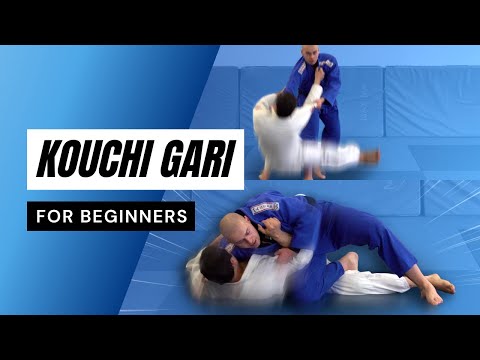
Ko Uchi Gari - Beginners Guide
0
Standard Ko Uchi Gari·Danny Karapanchev·Added by Admin
The secret of successful randori session. My DVD👉 https://dannyjudo.com/ To book personal one in one consultation, ca…
Translation: standard minor inner reap
The Standard Ko Uchi Gari executes the fundamental minor inner reap where the attacker steps inside the opponent's stance, hooks the inside of the opponent's rear heel with the sole of the foot, and reaps it forward while driving the opponent's shoulders backward with hand control. [1] The reaping action lifts the heel off the mat and drives it forward, removing the opponent's rear support while the upper body push ensures backward momentum. [1],[2] The combination produces a sharp backward fall, often landing the opponent directly on their back. [2] The technique is effective from various gripping configurations including collar and sleeve, clinch, and underhook positions. [2],[3]
Ko uchi gari is one of the most versatile judo techniques because it can be used as a primary attack, a combination starter, or a counter. [1] The minor inner reap targets the opponent's supporting foot from the inside, destabilising their base in a direction that is difficult to anticipate. [1] In MMA, ko uchi gari is frequently used in combination with punches from the clinch. [2]
Ko uchi gari is one of the most frequently attempted techniques in international judo competition, used both as a primary attack and as a set-up for major throws such as o uchi gari and uchi mata. [1] In MMA, Karo Parisyan popularised judo trips including ko uchi gari in UFC competition during the mid-2000s. [2]
No images yet for this technique.
Sign in to suggest an image.
The secret of successful randori session. My DVD👉 https://dannyjudo.com/ To book personal one in one consultation, ca…
No instructional courses yet for this technique.
Sign in to suggest a course.
Risk of injury to the person this technique is applied to
Ko-Uchi-Gari style; backward fall risk
Skill level needed to execute this technique reliably
Whether this technique is allowed under major competition rule sets
Kodokan Judo — Official Nage-waza Classification
Traditional Judo throwing/takedown terminology (Kodokan Institute)
Official Kodokan ground technique classification system
Standard Japanese martial arts terminology (kanji/hiragana)
Established Japanese martial arts naming convention — native Japanese term (和語/漢語)
Traditional Judo throwing/takedown terminology (Kodokan Institute)
timing, balance, upper body control for push-pull
good coordination and sense of opponent's weight distribution
core stabilisers, hip adductors/abductors, calves
The Standard Ko Uchi Gari executes the fundamental minor inner reap where the attacker steps inside the opponent's stance, hooks the inside of the opponent's rear heel with the sole of the foot, and reaps it forward while driving the opponent's shoulders backward with hand control. The reaping action lifts the heel off the mat and drives it forward, removing the opponent's rear support while the upper body push ensures backward momentum.
Standard ko uchi gari has been a competition staple in judo since the sport's founding and is one of the most commonly scored techniques in Olympic judo. Its effectiveness in close range made it one of the first judo techniques adopted into MMA and combat sambo.
IJF: legal — Legal (ashi-waza) — trips executed without grabbing opponent's legs are permi…; IBJJF: legal — Legal at all belt levels, scored as takedown (2 points); UWW: restricted — Legal in freestyle, restricted in Greco-Roman (leg-to-leg contact prohibited); Unified MMA: legal — Legal takedown technique; ADCC: legal — Legal, scored 2-4 points in second half of match; FIAS Sport Sambo: legal — Legal — all takedowns permitted; FIAS Combat Sambo: legal — Legal; NCAA Folkstyle: legal — Legal, scored as takedown (2 points)
Danger rating 5/10. High — Ko-Uchi-Gari style; backward fall risk
The standard setup chain: Establish Contact → Create Off-Balance → Execute the Takedown → Follow to Ground.
Standard counters include: Sprawl — drop hips back and drive weight down to stuff the takedown attempt / Underhook — establish inside position to control distance and prevent the takedown entry / Post and Circle — post on the attacker's head and circle away to break their angle / Level Change Defence — recognize the shot early and react with appropriate hip defence.
Common variants: Standard trip (blocking or sweeping the support leg while driving the up…); Combination trip (chaining an inside trip with an outside trip when the opp…); Counter trip (using the trip as a counter when the opponent attacks); Clinch trip (executing the trip from a tight clinch position).
Ko uchi gari is one of the most frequently attempted techniques in international judo competition, used both as a primary attack and as a set-up for major throws such as o uchi gari and uchi mata. In MMA, Karo Parisyan popularised judo trips including ko uchi gari in UFC competition during the mid-2000s.
Top errors to watch for: Reaping with a big, slow wind-up that telegraphs the technique / Not closing the distance before reaping — the foot can't reach from outside range / Pushing the opponent's upper body forward (into you) instead of backward (over their heels) / Reaping the outside of the foot instead of the inside — this is ko uchi (inner), not ko soto (outer).
The Standard Ko Uchi Gari is also known as Ko Uchi Gari, Standard Minor Inner Reap, Ko Uchi Gari Takedown, Inside Heel Reap.