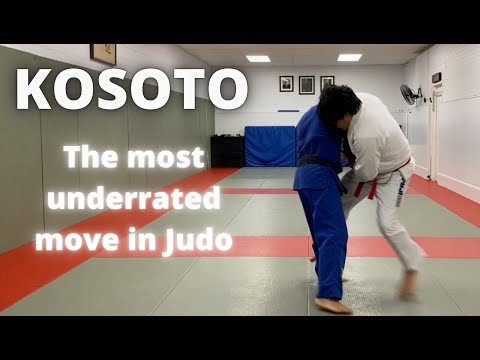
Kosoto gari in depth
0
Standard Ko Soto Gari·Shintaro Higashi·Added by Admin
Kosoto gari https://www.instagram.com/judoshintaronyc/
Translation: standard minor outer reap
The Standard Ko Soto Gari executes the fundamental minor outer reap where the attacker drives the opponent's weight backward over their heels using a push-pull hand action, then reaps the loaded heel with the sole of the foot in a backward-sweeping motion. [1] The attacker steps to the outside of the opponent's foot, places the sweeping foot behind the opponent's ankle, and uses a sharp backward reap while simultaneously pushing the opponent's upper body in the opposite direction. [1],[2] The combination of upper body drive and heel reap creates a rotational fall backward over the reaped foot. [2] The technique is effective from collar tie, lapel grip, or clinch positions. [2],[3]
Ko soto gari is effective as both a primary attack and a combination technique, often used to exploit lateral weight shifts. [1] The minor outer reap targets the opponent's heel from behind, making it difficult to defend when properly timed with hand pulling actions. [1] The technique is particularly effective in close-range clinch exchanges where the short reaping arc can be executed quickly. [2]
The standard ko soto gari is a regular scoring technique in IJF judo competition. [1]
No images yet for this technique.
Sign in to suggest an image.
Kosoto gari https://www.instagram.com/judoshintaronyc/
No instructional courses yet for this technique.
Sign in to suggest a course.
Risk of injury to the person this technique is applied to
Timing-based sweep; lower force than trips
Skill level needed to execute this technique reliably
Whether this technique is allowed under major competition rule sets
Kodokan Judo — Official Nage-waza Classification
Traditional Judo throwing/takedown terminology (Kodokan Institute)
Official Kodokan ground technique classification system
Standard Japanese martial arts terminology (kanji/hiragana)
Established Japanese martial arts naming convention — native Japanese term (和語/漢語)
Traditional Judo throwing/takedown terminology (Kodokan Institute)
timing, balance, upper body control for push-pull
good coordination and sense of opponent's weight distribution
core stabilisers, hip adductors/abductors, calves
Ko Soto Gari involves a sweeping motion, while Ko Soto Harai requires you to open up and physically pull your opponent from one position to another. According to Shintaro Higashi, both are common techniques, and top-level coaches often teach one before the other depending on your grip situation.
You need to pin your opponent's hips and pull your shoulders toward you so he cannot turn. Shintaro Higashi emphasizes crowding him with your hips, keeping your head into his lap, and maintaining a dominant position—if you just reach without controlling his hips, he will turn onto his back.
The Standard Ko Soto Gari executes the fundamental minor outer reap where the attacker drives the opponent's weight backward over their heels using a push-pull hand action, then reaps the loaded heel with the sole of the foot in a backward-sweeping motion. The attacker steps to the outside of the opponent's foot, places the sweeping foot behind the opponent's ankle, and uses a sharp backward reap while simultaneously pushing the opponent's upper body in the opposite direction.
Standard ko soto gari has been taught in judo dojos worldwide since the art's founding and is one of the most commonly used foot techniques in judo competition. Its effectiveness in close quarters made it a valuable addition to MMA striking clinch exchanges.
IJF: legal — Legal (ashi-waza) — trips executed without grabbing opponent's legs are permi…; IBJJF: legal — Legal at all belt levels, scored as takedown (2 points); UWW: restricted — Legal in freestyle, restricted in Greco-Roman (leg-to-leg contact prohibited); Unified MMA: legal — Legal takedown technique; ADCC: legal — Legal, scored 2-4 points in second half of match; FIAS Sport Sambo: legal — Legal — all takedowns permitted; FIAS Combat Sambo: legal — Legal; NCAA Folkstyle: legal — Legal, scored as takedown (2 points)
Danger rating 4/10. Moderate — timing-based sweep; lower force than trips
The standard setup chain: Establish Contact → Create Off-Balance → Execute the Takedown → Follow to Ground.
Standard counters include: Sprawl — drop hips back and drive weight down to stuff the takedown attempt / Underhook — establish inside position to control distance and prevent the takedown entry / Post and Circle — post on the attacker's head and circle away to break their angle / Level Change Defence — recognize the shot early and react with appropriate hip defence.
Common variants: Standard trip (blocking or sweeping the support leg while driving the up…); Combination trip (chaining an inside trip with an outside trip when the opp…); Counter trip (using the trip as a counter when the opponent attacks); Clinch trip (executing the trip from a tight clinch position).
The standard ko soto gari is a regular scoring technique in IJF judo competition.
Top errors to watch for: Not closing the distance first — ko soto gari is a close-range technique / Reaping straight back instead of in a sweeping arc — the arc generates more force / Leaning away from the opponent while reaping, which reduces your driving power / Reaping the wrong foot (the unloaded one) — always reap the foot bearing weight.
The Standard Ko Soto Gari is also known as Ko Soto Gari, Standard Minor Outer Reap, Ko Soto Gari Takedown, Outside Heel Trip.