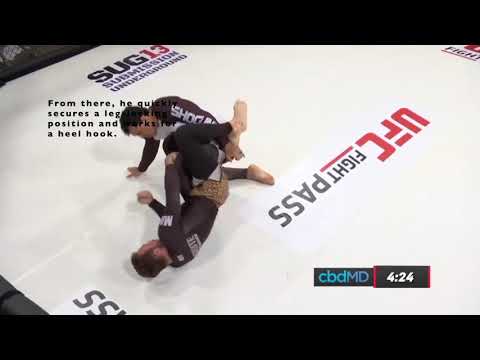
Leg Lock Prevention Part 1: Entries
0
Leg Lock Entry·TheGarageNoGi Jiu-Jitsu
Part one looks at the keys to leg lock entries. Feel free to skip to part 2 if you feel like you have a solid knowledge …
Not yet documented
The Leg Lock Entry family covers techniques for entering leg entanglement positions (ashi garami) from standing — primarily through rolling entries, sit-outs, and guard-pull-to-leg-lock transitions that bypass traditional takedown and guard-pull dynamics entirely. [1] These entries enable a fighter to go directly from standing to an attacking leg lock position, skipping the guard game and positional hierarchy that define traditional BJJ. [1],[2] The Imanari Roll (named after Japanese MMA fighter Masakazu Imanari) is the most famous leg lock entry — a forward shoulder roll that threads the legs around the opponent's lead leg, landing directly in inside sankaku ashi garami for an immediate heel hook. [2],[3] The Danaher Death Squad systematised these entries as part of their comprehensive leg lock game, making them a standard part of elite no-gi competition strategy. [3]
No images yet for this technique.
Sign in to suggest an image.
Part one looks at the keys to leg lock entries. Feel free to skip to part 2 if you feel like you have a solid knowledge …
No instructional courses yet for this technique.
Sign in to suggest a course.
Risk of injury to the person this technique is applied to
High — rolling entries carry impact risk, and failed entries leave the attacker on the ground with the opponent standing; the resulting leg lock position targets the knee (heel hooks can cause ligament damage without pain warning)
Skill level needed to execute this technique reliably
Whether this technique is allowed under major competition rule sets
Leg Lock Anthology (John Danaher, BJJ Fanatics)
Description sources — [1] Imanari fight record [2] Danaher Death Squad competition records [3] Ryan Hall UFC fights
Standard katakana transliteration of Western martial arts terminology (外来語) — used in Japanese MMA, boxing, and BJJ communities
Description sources — [1] Imanari fight record [2] Danaher Death Squad competition records [3] Ryan Hall UFC fights
comfort with rolling, precise distance judgment, quick leg dexterity, leg lock knowledge
flexible athletes, good spatial awareness
shoulders (roll impact), core (roll direction), hip flexors (threading hooks)
Every move, in any martial art, shares a few universal traits. Mix and match below to pinpoint the right tool — or compare equivalents across styles.
The Leg Lock Entry family covers techniques for entering leg entanglement positions (ashi garami) from standing — primarily through rolling entries, sit-outs, and guard-pull-to-leg-lock transitions that bypass traditional takedown and guard-pull dynamics entirely. These entries enable a fighter to go directly from standing to an attacking leg lock position, skipping the guard game and positional hierarchy that define traditional BJJ.
Leg lock entries gained prominence through Masakazu Imanari in Japanese MMA (early 2000s), then were systematised by John Danaher's students (Eddie Cummings, Garry Tonon, 2014-present). Ryan Hall brought the Imanari Roll to mainstream UFC attention.
IJF: legal — Legal takedown technique; IBJJF: legal — Legal at all belt levels, scored as takedown (2 points); UWW: legal — Legal in freestyle, may be restricted in Greco-Roman depending on technique; Unified MMA: legal — Legal takedown technique; ADCC: legal — Legal, scored 2-4 points in second half of match; FIAS Sport Sambo: legal — Legal — all takedowns permitted; FIAS Combat Sambo: legal — Legal; NCAA Folkstyle: legal — Legal, scored as takedown (2 points)
Danger rating 6/10. Moderate-high — rolling entries carry impact risk, and failed entries leave the attacker on the ground with the opponent standing; the resulting leg lock position targets the knee (heel hooks can cause ligament damage without pain warning)
The standard setup chain: Misdirect → Identify Target Leg → Execute Roll → Thread Hooks → Secure Control → Attack Submission.
Standard counters include: Step Over — stepping over the rolling attacker / Sprawl — dropping hips / Backstep — stepping out of range / Knee strike (MMA) — timing a knee to the rolling attacker.
Common variants: Imanari Roll (the signature rolling entry to inside sankaku [1]); Sit-out entry (sitting to single-leg X from standing); Guard pull to 50/50 (pulling guard directly into 50/50 entanglement); Rolling kneebar entry (rolling to kneebar position); Outside ashi entry (stepping across to establish outside ashi garami [2]); Donkey guard (inverting from standing to attack the legs); Ankle pick to ashi garami (combining a takedown attempt with leg entanglement).
Leg lock entries have produced numerous submission victories at EBI, ADCC, and in the UFC.
Top errors to watch for: Rolling without a setup — telegraphed entries are easily defended / Landing in the wrong position — the entry must end in a specific ashi garami / Head-first rolling — roll on the shoulder, not the head / Not controlling the leg immediately after entry.
The Leg Lock Entry is also known as Rolling Leg Lock Entry, Leg Attack Entry, Leg Lock Shoot.