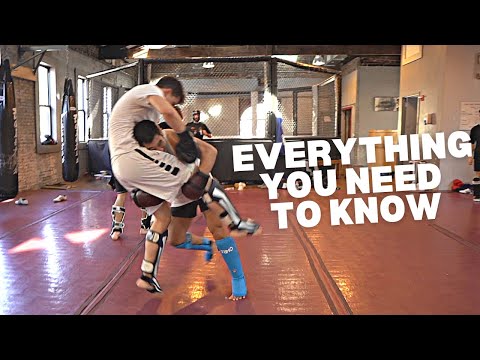
7 Double Leg Takedown Variations (sparring footage)
0
Standard High Double Leg·Jeff Chan MMAShredded ·Added by Admin
0:00 - 1. Head Inside Standing Double Leg 2:17 - 2. Head Inside Knee Drop Double Leg 4:09 - 3. Head Outside Knee Drop to…
Translation: high double leg
The high double leg is the classical form of the double leg takedown where the attacker makes contact at the opponent's waist/hip level rather than the knees, maintaining a straight back with hips underneath and driving the head into the opponent's chest. [1] Distinguished from the low double leg which attacks at or below knee level. Elite wrestlers like Jordan Burroughs and Kyle Dake exemplify the technique. [2] Research by Yamashita et al. (2020) shows elite wrestlers generate greater peak ground reaction force and significantly greater forward velocity during the attack phase.
One of wrestling's oldest and most fundamental techniques, used across all wrestling styles for centuries. [1]
One of the highest-percentage takedowns in wrestling and MMA at all levels of competition. [1]
Fundamental wrestling technique used across all styles for centuries.
Jordan Burroughs: Olympic gold medalist, 4x World Champion. Kyle Dake: 4x NCAA champion. Both known for elite double leg execution.
No images yet for this technique.
Sign in to suggest an image.
0:00 - 1. Head Inside Standing Double Leg 2:17 - 2. Head Inside Knee Drop Double Leg 4:09 - 3. Head Outside Knee Drop to…
No instructional courses yet for this technique.
Sign in to suggest a course.
Risk of injury to the person this technique is applied to
Primarily impact from being taken down onto the mat
Skill level needed to execute this technique reliably
Whether this technique is allowed under major competition rule sets
Yamashita et al. (2020) — Double-Leg Biomechanics, Frontiers in Sports and Active Living
[1] Yamashita et al. 2020 — biomechanical analysis of elite vs non-elite double leg mechanics
Standard katakana transliteration of Western martial arts terminology (外来語) — used in Japanese MMA, boxing, and BJJ communities
[1] Yamashita et al. 2020 — biomechanical analysis of elite vs non-elite double leg mechanics
explosive level change, strong penetration step, driving power
quadriceps, glutes, core, neck
Dropping to your knee allows you to get as low as possible underneath your opponent, which is essential for closing distance and getting underneath them effectively when a standing double leg is difficult to execute.
According to Jeff Chan MMAShredded, the power comes from sweeping your back leg forward after you've grabbed behind your opponent's knees, then pushing off that sweeping leg to stand back up.
The knee drop variation is less powerful than other double leg takedown variations, though it is still effective when you need to get lower underneath your opponent or close distance more quickly.
The high double leg is the classical form of the double leg takedown where the attacker makes contact at the opponent's waist/hip level rather than the knees, maintaining a straight back with hips underneath and driving the head into the opponent's chest. Distinguished from the low double leg which attacks at or below knee level.
One of wrestling's oldest and most fundamental techniques, used across all wrestling styles for centuries.
IJF: banned — Banned since 2010 leg grab prohibition — direct hansoku-make for touching opp…; IBJJF: legal — Legal at all belt levels, scored as takedown (2 points); UWW: restricted — Legal in freestyle (2-4 points), banned in Greco-Roman (no attacks below waist); Unified MMA: legal — Legal takedown technique; ADCC: legal — Legal, scored 2-4 points in second half of match; FIAS Sport Sambo: legal — Legal — all takedowns permitted; FIAS Combat Sambo: legal — Legal; NCAA Folkstyle: legal — Legal, scored as takedown (2 points)
Danger rating 3/10. Low — primarily impact from being taken down onto the mat
The standard setup chain: Establish stance → Setup (jab, snap-down, or feint) → Level change → Penetration step → Head to chest, arms wrap both thighs → Finish: run the pipe, lift and turn, or trip.
Standard counters include: Sprawl — drop hips back to deny the entry / Crossface — push attacker's head to one side / Underhook — win inside position to prevent the wrap / Knee check — drive knee into attacker's shoulder during entry.
Common variants: Run the pipe (drive through after contact to force opponent backward); Lift and turn (lift opponent's hips and rotate them to the mat); Trip finish (use inside trip while maintaining double leg control); Blast double (explosive entry with maximum forward momentum).
Jordan Burroughs: Olympic gold medalist, 4x World Champion. Kyle Dake: 4x NCAA champion.
Top errors to watch for: Head position too low — head must drive into chest, not the belly / Not completing the penetration step — must step deep between opponent's feet / Bending at the waist instead of the knees — level change must come from the legs / Not finishing — must commit to a finish (run the pipe, lift, or trip).
The Standard High Double Leg is also known as Hai Daburu Reggu, High Double Leg, Straight Double Leg, Classical Double Leg.
The high double makes contact at the opponent's waist/hip level with your head on their chest. The low double attacks at or below the knees with your shoulder. The high double requires closer range but offers more control and versatile finishes (run the pipe, lift, trip). The low double can be hit from farther away and transitions well to leg laces in freestyle wrestling.
Three options: (1) Run the pipe — keep driving forward, turn the corner, and use your head on their chest to drive them to the mat. (2) Lift — if you have the grip, pick them up and dump them to the side. (3) Trip — use an inside trip or outside trip while maintaining the body lock. The key is to never stop moving — a stalled double leg gets sprawled on.
Never shoot from too far away — the double leg requires a level change from close range. Best setups: (1) Jab or collar tie snap to distract, then shoot. (2) From an underhook, transition to the double. (3) Use a single leg attempt as bait — when they defend the single, switch to the double. The penetration step must be deep — your knee should land between their feet.