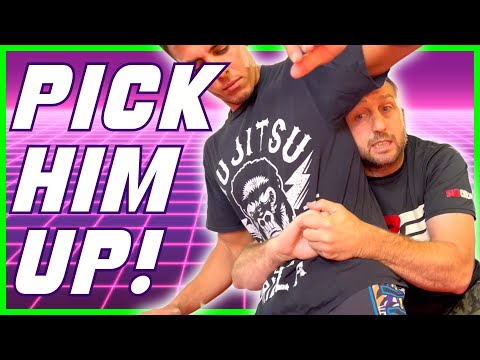
LIFT and Slam SAFELY!
0
Rear Lift·TeachMeGrappling Coach Brian
This video I breakdown a lifting mat return we use in wrestling all the time. Check out the details and you are sure to…
Translation: rear lift (katakana)
The Rear Lift subfamily covers takedowns where the attacker elevates the opponent from behind using a body lock, lifting them off the mat before bringing them down. [1] Rear lifts require significant explosive strength and hip drive, as the attacker must overcome the opponent's entire body weight plus their active resistance. [1],[2] The lift creates a moment of helplessness where the opponent is airborne with no base, allowing the attacker to choose the landing angle and position. [2] Rear lifts are among the most spectacular takedowns in wrestling and MMA, often producing decisive changes in momentum and scoring. [2],[3]
Rear lifts are a hallmark of Greco-Roman wrestling, where lifting techniques from the rear clinch have been signature moves of champion wrestlers for generations. [1] The technique is particularly associated with Eastern European and Central Asian wrestling traditions, where physical strength is heavily emphasised. [2],[3]
No images yet for this technique.
Sign in to suggest an image.
This video I breakdown a lifting mat return we use in wrestling all the time. Check out the details and you are sure to…
No instructional courses yet for this technique.
Sign in to suggest a course.
Risk of injury to the person this technique is applied to
Rear body lock allows mat return/slam; spinal compression risk
Skill level needed to execute this technique reliably
Whether this technique is allowed under major competition rule sets
Japanese amateur wrestling terminology
Japanese amateur wrestling terminology
Standard katakana transliteration of Western martial arts terminology (外来語) — used in Japanese MMA, boxing, and BJJ communities
Standard katakana transliteration used in Japanese wrestling (レスリング)
upper body squeeze strength, lifting power, hip drive
thick chest and arms for tight lock, strong lower back for lifts
pectorals, biceps, erector spinae, glutes
Every move, in any martial art, shares a few universal traits. Mix and match below to pinpoint the right tool — or compare equivalents across styles.
According to Coach Brian at TeachMeGrappling, you need to step perpendicular to your opponent and get your hip connected to their hip, then 'pop' to generate the lift. Your belly button should point toward your opponent, and you should step all the way around to get fully perpendicular to their hips rather than stopping partway.
Coach Brian emphasizes putting on the brakes as you bring your opponent down so they land safely on their hands and knees rather than getting hurt. He stresses the importance of controlling the descent and not slamming them hard, especially since most people don't learn proper falling technique.
Coach Brian notes that when you have a guy doing the elbow, always use a wrist grab—either to the wrist or hand—for the best control during the lift, though the technique can also be performed without the lock by using hip connection alone.
The Rear Lift subfamily covers takedowns where the attacker elevates the opponent from behind using a body lock, lifting them off the mat before bringing them down. Rear lifts require significant explosive strength and hip drive, as the attacker must overcome the opponent's entire body weight plus their active resistance.
Rear lifts are a hallmark of Greco-Roman wrestling, where lifting techniques from the rear clinch have been signature moves of champion wrestlers for generations. The technique is particularly associated with Eastern European and Central Asian wrestling traditions, where physical strength is heavily emphasised.
IJF: legal — Legal takedown technique; IBJJF: legal — Legal at all belt levels, scored as takedown (2 points); UWW: legal — Legal in both freestyle and Greco-Roman; Unified MMA: legal — Legal takedown technique; ADCC: legal — Legal, scored 2-4 points in second half of match; FIAS Sport Sambo: legal — Legal — all takedowns permitted; FIAS Combat Sambo: legal — Legal; NCAA Folkstyle: legal — Legal, scored as takedown (2 points)
Danger rating 6/10. High — rear body lock allows mat return/slam; spinal compression risk
The standard setup chain: Establish Contact → Create Off-Balance → Execute the Takedown → Follow to Ground.
Standard counters include: Sprawl — drop hips back and drive weight down to stuff the takedown attempt / Underhook — establish inside position to control distance and prevent the takedown entry / Post and Circle — post on the attacker's head and circle away to break their angle / Level Change Defence — recognize the shot early and react with appropriate hip defence.
Common variants: Front body lock (securing the lock face-to-face and driving laterally or b…); Rear body lock (securing from behind for mat returns or lifts); Side body lock (angled body lock for trips and throws); Body lock to trip (combining the lock with a foot trip for the finish).
Alexander Karelin won three Olympic gold medals (1988, 1992, 1996) using his signature reverse body lift in Greco-Roman competition. The technique scored maximum points under UWW rules.
Top errors to watch for: Lifting with the lower back instead of hip extension — high injury risk and less power / Holding the opponent in the air too long, burning energy and giving them time to counter / Gripping too high, making the lift mechanically impossible against a heavy opponent / Throwing them straight back over your head (suplex) when a lateral deposit is safer.
The Rear Lift is also known as Ria Rifuto, Rear Waist Lift, Back Lift, Reverse Body Lock Lift, Zakhvat Szadi Podyom.