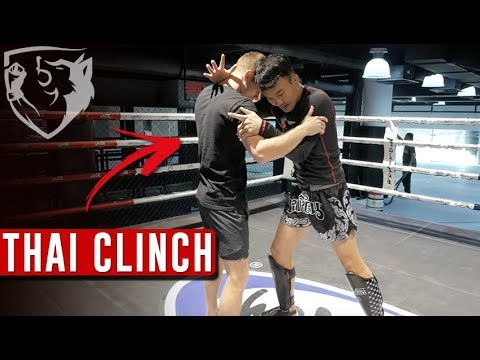
Dominate the Muay Thai Clinch with Petchboonchu
0
From Clinch·fightTIPS
Train with me in Singapore►http://bit.ly/FightTIPSinSingapore I had the honor of taking a private training lesson with P…
Translation: from clinch
Spine compression locks from the clinch apply axial or lateral compression to the spinal column while standing in a clinch position. [1],[2] The attacker uses body lock, overhook, or head control to fold or compress the opponent's torso, loading the spine with forces that exceed its comfortable range. [1] These techniques are typically encountered in wrestling-heavy clinch exchanges where the attacker uses superior positioning to compress the opponent's spine through bear hugs, can openers from standing, or body fold maneuvers. [1] They are dangerous due to the vulnerability of the spinal column. [1],[2]
Clinch submissions exploit the close-range tie-up to attack with standing guillotines, arm-in chokes, and neck cranks. [1]
Clinch submissions derive from judo standing submissions and catch wrestling. [1]
Standing guillotine chokes from the clinch are among the most common submissions in MMA competition. [1]
No images yet for this technique.
Sign in to suggest an image.
Train with me in Singapore►http://bit.ly/FightTIPSinSingapore I had the honor of taking a private training lesson with P…
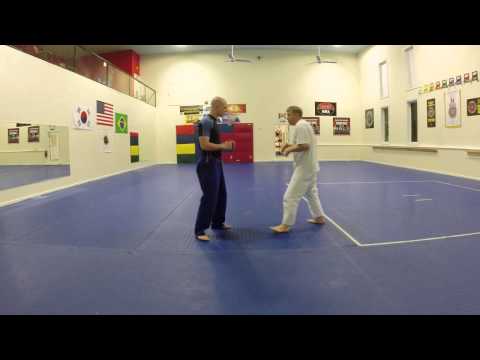
These are two fundamental self defense takedowns from the Clinch
In this video we go through the different clinch positions in EA Sports UFC 5 and how to transition between them. We als…
This video Anton breaks down a 4 takedown series from the over/under that can help you dominate in the clinch. Check ou…
Clinch takedowns executed from standing positions represent a fundamental skill set across combat sports, with instructors emphasizing distinct mechanical principles. Roy Marsh and TeachMeGrappling Coach Brian both stress the critical importance of establishing a complete body connection—line-of-body contact rather than isolated point contact—to prevent opponent escape and generate maximum force transfer. Both detail the over-under clinch position as a primary entry point, with Marsh demonstrating the body fold and leg hook takedowns as complementary techniques that exploit differing postural defenses, while TeachMeGrappling's Anton Calista expands on outside-step rotations that increase rotational angle and follow-up options (seatbelt position, leg drag, or running-the-pipe knee pick). FightTIPS's Petchboonchu instruction focuses on Muay Thai clinch mechanics, emphasizing inside-hand dominance, hip positioning, head positioning relative to elbows, and lateral sweep mechanics using synchronized pulling, pushing, and knee-bump actions. He also details the "plum" position (double collar tie) as the most dominant clinch control and teaches escape mechanics via shoulder-push and arm-swim techniques. All instructors agree that clinch position dominance precedes effective takedown execution, with Marsh and Calista specifically noting that technique selection must respond reactively to opponent posture and defensive movement rather than forced application. IC4Games provides video-game mechanics reference that mirrors real-world principles: clinch transitions, positional awareness, and the sequencing of strikes before takedown attempts.
Synthesized from 4 instructors
No instructional courses yet for this technique.
Sign in to suggest a course.
Risk of injury to the person this technique is applied to
Spinal compression locks apply axial force to the vertebral column
Skill level needed to execute this technique reliably
Whether this technique is allowed under major competition rule sets
Japanese BJJ community standard katakana transliteration
Japanese BJJ community standard katakana transliteration
Standard katakana transliteration of Western martial arts terminology (外来語) — used in Japanese MMA, boxing, and BJJ communities
Japanese terminology sourced from Japanese BJJ community standard katakana transliteration
grip strength, joint isolation ability, positional control
strong forearms and stable base
forearm flexors, core stabilisers, hip muscles for base
Roy Marsh emphasizes that you want a complete line of contact from your shoulder down to your hip rather than isolated points of contact. A single point of contact is easy for your opponent to break, especially if they back their hips away, whereas full body connection makes you much stronger and harder to escape.
Roy Marsh recommends positioning at about a three-quarter angle to the side rather than directly in front or way off to the side. This positioning helps you protect your face while maintaining control, and allows you to stay connected to your opponent no matter where they move.
According to Roy Marsh, maintaining the clinch is the most critical aspect—having great clinch entries means nothing if your opponent can break out immediately. You must practice both getting the clinch and holding it securely.
No—Roy Marsh cautions that pushing only with your head is a common mistake that leaves your opponent positioned to the side where they can escape. Instead, you need to both pull with your arms and drive with your head simultaneously, and control where they land so you can follow them down.
Spine compression locks from the clinch apply axial or lateral compression to the spinal column while standing in a clinch position. The attacker uses body lock, overhook, or head control to fold or compress the opponent's torso, loading the spine with forces that exceed its comfortable range.
Spine compression from the clinch has roots in wrestling and folk grappling traditions where body locks and bear hugs were used to break an opponent's posture. The submission application — forcing a tap from spinal pressure alone — is recognized in catch wrestling and MMA.
IBJJF: legal — Legal at all belt levels; IJF: banned — Only elbow joint locks (kansetsu-waza) permitted in judo — all other joint lo…; ADCC: legal — Legal — all submissions legal in ADCC; Unified MMA: legal — Legal submission technique; FIAS Sport Sambo: legal — Legal; FIAS Combat Sambo: legal — Legal
Danger rating 9/10. Spinal compression locks apply axial force to the vertebral column
The standard setup chain: Establish Position → Create the Threat → Secure the Hold → Finish.
Standard counters include: Early Recognition — identify the submission attempt early and begin defence immediately / Posture and Base — maintain strong posture and base to prevent submission setups / Grip Fight — deny the attacker their preferred gripping configuration.
Common variants: Standard variation (primary grip configuration and finishing angle); Gi variation (using the gi material for grip assistance and control); No-gi variation (adapted grips for submission grappling without the gi); Transition variation (applied during a positional change or scramble).
Standing guillotine chokes from the clinch are among the most common submissions in MMA competition.
Top errors to watch for: Using pain compliance from clinch without a takedown or transition plan — the pain should create openings for the nex… / Leaning your weight into the opponent without maintaining base — you become vulnerable to counter-throws and trips / Applying trachea pressure in training — throat strikes and pressure are dangerous and should only be simulated lightl… / Using clinch pain compliance as stalling — referees may break the clinch if no technique follows the control.
The From Clinch is also known as Kurinchi kara, Clinch Spine Lock, Standing Spinal Compression.