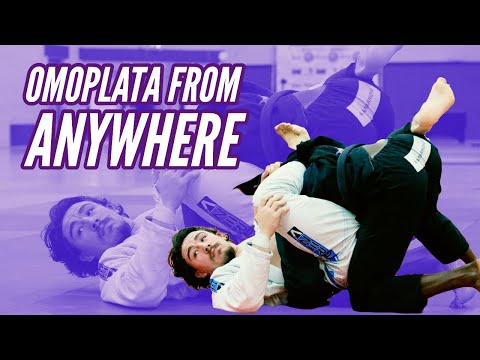
Catch this Shoulder Lock from ANYWHERE
0
Shoulder Lock·Bradley Hill
#BHTuition 🎉 OMOPLATA’S OUT OF NOWHERE 🥳 Learn from me with my newest FREE instructional - Omoplata Man Returns... Th…
Translation: shoulder joint technique
Shoulder locks are submissions that attack the glenohumeral joint (shoulder socket) by forcing the arm into extreme internal rotation, external rotation, or abduction. [1],[2] The shoulder is the most mobile joint in the body, which makes it vulnerable to rotational attacks from multiple angles. Primary shoulder locks include the kimura (ude-garami with inward rotation), the Americana (ude-garami with outward rotation), the omoplata (using the legs to rotate the shoulder), and various hammerlock and chicken wing variations. [1] Shoulder locks are effective from virtually every grappling position — mount, guard, side control, back control, half guard, and standing. [3],[4] They also serve as powerful positional tools: a threatened kimura grip can be used to sweep, take the back, or transition to other submissions even when the lock itself doesn't finish.
Ude-garami (腕絡み, arm entanglement) is classified in Kodokan Judo's kansetsu-waza division. [2] The technique became famous as 'kimura' after Masahiko Kimura defeated Helio Gracie in 1951 using gyaku-ude-garami (reverse arm entanglement) to break Gracie's arm. [1] The Americana — named for its association with American catch wrestling techniques introduced to Brazil — uses the opposite rotational direction (outward rotation). The omoplata, which uses the legs to apply shoulder rotation while controlling the opponent's posture, was developed primarily in Brazilian Jiu-Jitsu, with Nino Schembri being one of its most famous innovators. [3],[4]
Shoulder locks attack the glenohumeral joint, which has the greatest range of motion of any joint in the body but is correspondingly vulnerable when forced beyond its natural limits. [1] The Kimura, Americana, and omoplata are the primary shoulder lock variations, targeting internal rotation, external rotation, and extension respectively. [1],[2]
Shoulder locks are part of Kodokan Judo's kansetsu-waza (though judo competition now only permits elbow locks), sambo's leg and arm lock curriculum, and catch wrestling. [1],[2] The Gracie family integrated all three major shoulder lock variations into the BJJ guard and top-position attack systems. [3]
No images yet for this technique.
Sign in to suggest an image.
#BHTuition 🎉 OMOPLATA’S OUT OF NOWHERE 🥳 Learn from me with my newest FREE instructional - Omoplata Man Returns... Th…
No instructional courses yet for this technique.
Sign in to suggest a course.
Risk of injury to the person this technique is applied to
Shoulder locks attack the rotator cuff complex; kimura and americana are the primary variants
Skill level needed to execute this technique reliably
Whether this technique is allowed under major competition rule sets
Kodokan Judo — Official Katame-waza Classification
Traditional Judo ground technique terminology (Kodokan Institute)
Standard Japanese martial arts terminology (kanji/hiragana)
Established Japanese martial arts naming convention — native Japanese term (和語/漢語)
Traditional Judo ground technique terminology (Kodokan Institute)
grip strength, rotational power, shoulder/core stability
strong forearms and thick wrists
forearm flexors, rotator cuff, core rotators, deltoids
Every move, in any martial art, shares a few universal traits. Mix and match below to pinpoint the right tool — or compare equivalents across styles.
The Kimura lock (gyaku-ude-garami / double wristlock) is a shoulder lock where the attacker grips the opponent's wrist with one hand, threads the other arm under the opponent's elbow, and clasps a figure-four grip to rotate the shoulder joint behind the opponent's back. [1,2] The figure-four configuration provides enormous leverage against the shoulder's rotational limits. [1] The Kimura is applicable from guard, mount, side control, north-south, and half guard, and serves both as a submission and as a powerful positional control tool for sweeps and transitions. [1,3]
The Monoplata is a shoulder lock submission similar to the omoplata but using only one leg to control the opponent's arm — applied from mount, side control, or back control rather than from guard. [1] While less common than the omoplata, the monoplata provides a shoulder lock option from top positions where the omoplata's guard-based entry is not available. [1,2]
The Omoplata (Portuguese for 'shoulder blade') is a shoulder lock submission applied from the guard where the attacker uses their legs to isolate the opponent's arm and rotate the shoulder beyond its normal range — one of the three fundamental guard submissions alongside the armbar and triangle choke. [1] The technique works by trapping the opponent's arm between the attacker's legs in a figure-four configuration, then sitting up and leaning forward to create a rotational force on the opponent's shoulder (internal rotation), similar to a kimura but executed with the legs instead of the arms. [1,2] The omoplata was popularised in BJJ competition by Nino Schembri (whose creative omoplata attacks from various positions earned him the nickname 'Elvis') and has since become a fundamental technique taught at every BJJ academy. [2,3] Beyond its submission value, the omoplata is one of the most versatile positions in BJJ — it serves as a sweep, a back take setup, and a controlling position even when the submission itself is defended. [3]
The Kimura (ude-garami) and Americana (gyaku-ude-garami) are the two primary shoulder lock directions — internal rotation (Kimura) and external rotation (Americana). (Gracie & Danaher, Mastering Jujitsu)
Bradley Hill teaches that you can hunt the shoulder lock from various positions by using hip escapes—both short and long versions—to close distance and create the shoulder hole. Once the shoulder hole is created, you can either post and roll forward or continue to reposition yourself to catch underneath the shoulder in a traditional shoulder lock.
Bradley Hill emphasizes backing step positioning—almost like wanting to sit on your opponent's head—which immediately creates the shoulder hole needed for the submission. From this position, you can then post and roll forward or continue maneuvering to secure the lock underneath the shoulder.
Shoulder locks are submissions that attack the glenohumeral joint (shoulder socket) by forcing the arm into extreme internal rotation, external rotation, or abduction. The shoulder is the most mobile joint in the body, which makes it vulnerable to rotational attacks from multiple angles.
Ude-garami (腕絡み, arm entanglement) is classified in Kodokan Judo's kansetsu-waza division. The technique became famous as 'kimura' after Masahiko Kimura defeated Helio Gracie in 1951 using gyaku-ude-garami (reverse arm entanglement) to break Gracie's arm.
IBJJF: legal — Legal at all belt levels; IJF: banned — Only elbow joint locks (kansetsu-waza) permitted in judo — all other joint lo…; ADCC: legal — Legal — all submissions legal in ADCC; Unified MMA: legal — Legal submission technique; FIAS Sport Sambo: legal — Legal; FIAS Combat Sambo: legal — Legal
Danger rating 7/10. Shoulder locks attack the rotator cuff complex; kimura and americana are the primary variants
The standard setup chain: Control Position → Isolate the Arm → Lock the Figure-Four → Apply Rotation.
Standard counters include: Straighten the Arm — extend the arm to break the figure-four grip angle / Roll Toward — roll in the direction of the lock to relieve rotational pressure / Grip the Belt/Shorts — anchor the hand to prevent the arm from being isolated.
Common variants: Standard kimura (figure-four grip rotating the shoulder from guard, side c…); Kimura trap (using the kimura grip as a controlling position to chain …); Standing kimura (applied during a clinch or takedown exchange); Reverse kimura (attacking from the opposite rotation angle (Americana dir…).
Shoulder locks (kimura, Americana, omoplata) are among the most commonly attempted submissions in BJJ and MMA competition. The kimura is one of the top 10 most common UFC submissions.
Top errors to watch for: Not fixing the elbow to the body — the elbow must be controlled close to the torso; a free elbow allows the opponent … / Rotating without controlling the shoulder — pin the opponent's shoulder to the ground or mat; a free shoulder absorbs… / Using arm strength to torque the shoulder — body weight and positional leverage create the rotation; arms alone are i… / Applying both kimura and Americana the same way — kimura rotates internally (hand toward the back), Americana rotates….
The Shoulder Lock is also known as Kata Kansetsu-waza, Kata-waza, Shoulder Joint Lock, Shoulder Submission.