Strike & defenceLocksClose rangeFighting multiple people
Distance
CloseMiddleLong
Body target
Upper bodyMiddle bodyLower body
Overview
Hara-gatame from standing is a standing armbar where the attacker uses their stomach or abdomen as the fulcrum against which the opponent's arm is hyperextended. [1],[2] The attacker grabs the opponent's wrist with both hands and pulls the arm straight, pressing the elbow joint against the abdomen while leaning back to generate extension force. [1] The stomach provides a broad, stable fulcrum that distributes the pressure across the back of the elbow, making it effective even against partially bent arms. [1],[2]
Hara-gatame (腹固, stomach hold) is a Kodokan judo kansetsu-waza that uses the abdomen as a lever point for standing arm locks. [1],[2] The technique is documented in classical judo instruction manuals and was transmitted through traditional jujutsu lineages that emphasized standing joint manipulation. [1] In self-defense contexts, hara-gatame provides a practical method for controlling a standing attacker with an extended arm, using body weight rather than complex grip configurations. [1],[2]
Ude Gatame [Arm Lock] Jujitsu Takedowns For Combat - TRITAC-Jitsu
0
Hara-Gatame From Standing·TRITAC Martial Arts
The Ude Gatame is one of the most powerful controls, submissions and breaks in all of Jiu-Jitsu. It is a Japanese Jujit…
2 videos
What Instructors Say
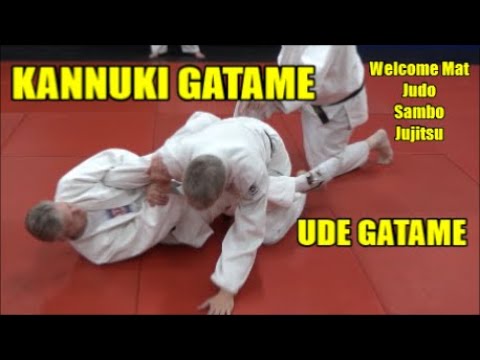
Hara-gatame from standing, also known as kannuki gatame or ude gatame, is a figure-four armlock executed from a standing clinch position. Both welcomematstevescott and TRITAC Martial Arts emphasize the critical importance of establishing structural control before attempting the lock. welcomematstevescott demonstrates the technique primarily from guard but notes its standing application, stressing that the forearm must sit directly under the opponent's elbow to create the fulcrum, with the attacking arm wrapped tightly against the body to prevent escape. TRITAC Martial Arts provides detailed standing mechanics, emphasizing that the defender must first create a frame against the opponent's neck using an underhook, then backstep to spread distance and create off-balance pressure. Both instructors agree that hand positioning is crucial: a gable grip or cross-grip on the wrist/arm is essential. TRITAC uniquely details escape routes and counters, noting that opponents may attempt to turn their elbow down or rotate out, and that maintaining pressure with the shoulder and head-control prevents these escapes. welcomematstevescott adds that knee placement on the opponent's shoulder can increase torque during finishing. TRITAC emphasizes keeping the rear leg positioned to maintain leverage and prevent the opponent from extending the arm laterally. Both agree the technique works through simultaneous elbow and shoulder pressure rather than isolated arm hyperextension.
Synthesized from 2 instructors
welcomematstevescott — KANNUKI GATAME (UDE GATAME) Latch or Crossbar Armlock (Also Called Straight Armlock): Demonstrates classical figure-four structure with emphasis on forearm positioning under the elbow as the fulcrum, body tightness to prevent arm withdrawal, and knee placement for torque during finishing. Notes historical naming (Uli Gattami, Kanuki Gattami) and cross-disciplinary application in wrestling and judo.
TRITAC Martial Arts — Ude Gatame [Arm Lock] Jujitsu Takedowns For Combat - TRITAC-Jitsu: Provides detailed standing mechanics including initial neck frame creation with underhook, backstep distancing, movement-based application to keep opponent off-balance, gable grip maintenance, and systematic escape counter-strategies. Emphasizes rear leg positioning for leverage maintenance and shoulder pressure to control opponent orientation.
Learn This Technique
No instructional courses yet for this technique.
Sign in to suggest a course.
Ratings
Danger Rating
Risk of injury to the person this technique is applied to
7
Very High7/10
Hara-gatame (stomach armlock) uses the abdomen as a fulcrum to hyperextend the elbow
Difficulty
Skill level needed to execute this technique reliably
Advanced
Competition Legality
Whether this technique is allowed under major competition rule sets
✓The standing hara-gatame catches the opponent's extended arm during standup grappling — wrapping it around the hip and driving forward to hyperextend the elbow (Kashiwazaki, Osaekomi, 1997)
✓Common entries: the opponent pushes with a straight arm, reaches for a collar grip, or extends during a failed throw — the extended arm is caught and wrapped
✓Standing hara-gatame is a favourite technique in judo competition: it transitions smoothly from tachi-waza (standing) to ne-waza (ground)
✓The key to the standing entry: catch the wrist, step the hip into the elbow crease, and drive forward — all in one fluid motion
✓Standing hara-gatame can force a takedown and submission simultaneously: as the arm hyperextends, the opponent is driven to the ground
✓The technique works best when the opponent is moving forward: their momentum adds to the hyperextension when the arm is caught
✓Standing hara-gatame is lower risk than flying submissions: the attacker maintains base throughout and only commits when the arm is secured
Common Mistakes
!Attempting without catching the wrist first — the wrist must be controlled before stepping the hip into position
!Moving the hip too slowly — the step into position must be fast; the opponent will retract the arm if given time
!Not driving forward after positioning — the hip drive creates the extension; simply wrapping the arm around the hip without driving forward is insufficient
!Losing balance during the entry — maintain your base; the technique should enhance your position, not compromise it
!Attempting when the opponent's arm is bent — hara-gatame requires an extended arm; don't try to straighten it against resistance
!Not following to the ground — if the opponent drops but doesn't tap, follow to the ground and finish from there
!Releasing the wrist during the transition — maintain wrist control from standing through the ground finish
Standard Japanese martial arts terminology (kanji/hiragana)
3OtherJapanese Martial Arts Standard Terminology (武道用語)
Established Japanese martial arts naming convention — native Japanese term (和語/漢語)
4CitationKodokan Judo — Official Katame-waza Classification
Kodokan hara-gatame + positional modifier
Community
Athletics
Requires
hip flexibility, hip bridge power, leg clamping strength
Favours
long legs for controlling the opponent's torso
Key muscles
hip extensors (glutes), adductors, quadriceps, hamstrings
Notes
Standing hara gatame applies the stomach arm lock while both fighters are on their feet — the attacker presses their abdomen against the opponent's elbow to hyperextend it. Requires the opponent's arm to be caught in extension. (Kano, Kodokan Judo)
Frequently Asked Questions
How do I keep my opponent's arm trapped and prevent them from pulling it back?
Pull the arm tight against your body to keep it trapped so your opponent can't pull it back. This is a key fundamental that prevents escape.
What's the key to maintaining control when finishing the armlock from standing?
Create a lever feeling where you keep your opponent down and your pressure up, then control their head by making them look at their opposite foot as you position your body weight over their arm. This prevents them from escaping as you sink your weight.
Can I finish an armlock while staying standing, or do I have to go to the ground?
You have the opportunity to stay standing and finish an armbar while maintaining a good counterbalance position, though you can also finish from the ground depending on the situation.
How do I add more torque to the finish?
Pop forward and add rotational torque by rolling in the direction that extends the arm further, and you can also push your opponent back and pop them again to increase the stretch even more.
How does the Hara-Gatame From Standing work?
Hara-gatame from standing is a standing armbar where the attacker uses their stomach or abdomen as the fulcrum against which the opponent's arm is hyperextended. The attacker grabs the opponent's wrist with both hands and pulls the arm straight, pressing the elbow joint against the abdomen while leaning back to generate extension force.
Where does the Hara-Gatame From Standing come from?
Hara-gatame (腹固, stomach hold) is a Kodokan judo kansetsu-waza that uses the abdomen as a lever point for standing arm locks. The technique is documented in classical judo instruction manuals and was transmitted through traditional jujutsu lineages that emphasized standing joint manipulation.
Is the Hara-Gatame From Standing legal in competition?
IBJJF: legal — Legal at all belt levels; IJF: banned — Only elbow joint locks (kansetsu-waza) permitted in judo — all other joint lo…; ADCC: legal — Legal — all submissions legal in ADCC; Unified MMA: legal — Legal submission technique; FIAS Sport Sambo: legal — Legal; FIAS Combat Sambo: legal — Legal
How dangerous is the Hara-Gatame From Standing?
Danger rating 7/10. Hara-gatame (stomach armlock) uses the abdomen as a fulcrum to hyperextend the elbow
How do I set up the Hara-Gatame From Standing?
The standard setup chain: Control the Arm → Position the Hips → Pinch Knees → Extend for the Finish.
How do I defend against the Hara-Gatame From Standing?
Standard counters include: Clasp Hands — grip own wrist to prevent arm extension / Stack — drive forward to compress the attacker and relieve elbow pressure / Hitchhiker Escape — rotate the thumb toward the mat and roll to extract the arm.
What are the variants of the Hara-Gatame From Standing?
Common variants: Standard armbar (hips drive upward against the extended arm with legs clam…); Belly-down armbar (rolling to face the mat to prevent the opponent from stac…); S-mount armbar (transitioned from S-mount position for tighter control be…); Spinning armbar (rapid pivot from guard or side to catch the arm during tr…).
How effective is the Hara-Gatame From Standing in competition?
Standing hara-gatame occasionally appears in judo competition.
What are common mistakes when doing the Hara-Gatame From Standing?
Top errors to watch for: Attempting without catching the wrist first — the wrist must be controlled before stepping the hip into position / Moving the hip too slowly — the step into position must be fast; the opponent will retract the arm if given time / Not driving forward after positioning — the hip drive creates the extension; simply wrapping the arm around the hip w… / Losing balance during the entry — maintain your base; the technique should enhance your position, not compromise it.
What are other names for the Hara-Gatame From Standing?
The Hara-Gatame From Standing is also known as Hara-gatame (Tachi kara), Standing Hara-Gatame, Standing Stomach Armlock.
![Ude Gatame [Arm Lock] Jujitsu Takedowns For Combat - TRITAC-Jitsu](https://img.youtube.com/vi/dniIEavO1q8/hqdefault.jpg)