Armbar from Closed Guard
The armbar is one of jiu-jitsu's most fundamental and reliable submissions. From closed guard, the practitioner grabs the opponent's neck, steps on their hip, and pinches the knee against their shoulder to prevent arm extraction. The bottom leg crosses their shoulders as the body rotates perpendicular, then the top leg hooks over their head with the foot curled down to prevent stacking. The submission is finished by securing both hands on the wrist with the thumb pointing upward, maintaining a smooth angle to eliminate escape opportunities.
Armbar from Mount and Side Control
The armbar remains effective from dominant positions. From high mount, the practitioner maintains top weight while isolating the opponent's arm for the submission. From side control, sliding the leg over the opponent's bottom arm and utilizing an underhook transitions smoothly into the spinning armbar, effectively catching the opponent off-guard and demonstrating the submission's versatility across multiple positions.
Americana (Keylock) Fundamentals
The Americana is an essential submission for white belts learning to capitalize on pressure-based positions. When the opponent frames on the neck, the practitioner grabs the shoulder, uses an underhook to displace the arm, then secures the wrist and underhooks their own wrist. The key to preventing escape is placing the elbow on the mat beside the opponent's neck, eliminating space for defensive rotation. The submission finishes by drawing the elbow closer to the hip while rotating the grip.
Kamora Trap Setup and Transitions
The Kamora resembles the Americana but excels in half-guard scenarios when opponents attempt underhook pummeling. The practitioner shifts hips onto the opponent's underhook, uses their elbow to pry the wrist groundward, then creates a figure-four grip while sliding the knee to the armpit. Success depends on keeping the opponent's wrist away from their body and rotating the grip as if moving their hand in a clock motion above their head. As practitioners advance, mastering the Kamora trap allows execution from virtually any position.
Triangle Choke from Guard
The triangle represents one of jiu-jitsu's most versatile submissions, effective across all belt levels. From closed guard, the practitioner breaks the opponent's posture by gripping their neck, then shoves their wrist to their chest before throwing the top leg across their shoulder and securing a figure-four leg lock. Finishing requires either walking the shoulders back while pulling the head down or rotating perpendicular to the opponent while squeezing. Critical details include stepping on the hip, maintaining tight knee pressure, and keeping the opponent's posture broken throughout.
Darce Choke (Front Headlock)
The Darce choke is a high-percentage submission executed from front headlock position. The practitioner slides their arm under the opponent's armpits across their neck, clasps hands with the thumb positioned between the fingers, then drives their shoulder into the opponent's chest to rotate them sideways. The submission finishes by sliding the hand down to the figure-four position, squeezing forcefully, and sprawling backward. Placing the lower hand as close to the shoulder as possible maximizes compression, with stepping to mount position providing even greater finishing pressure.
Bow and Arrow Choke from Back Control
The bow and arrow choke is a fundamental collar choke executed from back control. The practitioner grabs the opponent's collar with the top arm while reaching for their knee with the bottom arm, using the leg to pull it toward themselves while cutting an angle. The legs cross over the opponent's shoulder and ankles lock for the finish, with proper shoulder placement behind the opponent's neck preventing rollout escapes. This submission remains effective even when the opponent attempts to walk over the practitioner, provided the grip remains secure and shoulder positioning is maintained.
The First 10 Bjj Submissions You Should Learn
Key Takeaways
- •Armbar from Closed Guard
- •Armbar from Mount and Side Control
- •Americana (Keylock) Fundamentals
- •Kamora Trap Setup and Transitions
In today’s video I’ll be giving you the 10 first bjj submissions that every white belt should learn. These are the submissions which are the easiest to learn and start seeing success with. Add me on the gram; https://www.instagram.com/jedi_himself/ #bjjsubmissions #bjjwhitebelt #armbar
Related Techniques
Frequently Asked Questions
What does this video teach about armbar?
This video covers armbar from closed guard, armbar from mount and side control, americana (keylock) fundamentals. It provides detailed instruction from Jedi Does Jiujitsu.
How long does it take to learn armbar?
The basic mechanics can be understood in a single session, but developing reliable execution requires consistent drilling over weeks of practice. This 7-part breakdown helps structure your training by isolating each phase of the technique.
What are the key details for finishing armbar?
The Darce choke is a high-percentage submission executed from front headlock position. The practitioner slides their arm under the opponent's armpits across their neck, clasps hands with the thumb positioned between the fingers, then drives their shoulder into the opponent's chest to rotate them sideways. The submission finishes by sliding the hand down to the figure-four position, squeezing forcefully, and sprawling backward. Placing the lower hand as close to the shoulder as possible maximizes compression, with stepping to mount position providing even greater finishing pressure.
Related videos
Fundamental Armbar from Full Guard for Beginners in BJJ
Chewjitsu
How To Do the Armbar From Mount in Jiu Jitsu | Jiu Jitsu Tutorial
Matt Arroyo Jiu Jitsu
Katame Waza || Grappling Techniques - 32 Holds, Strangles/Chokes and Armlocks
The Judo Way of Life
Waki Gatame - when and how to use it.
Robert Silas (Aiki_and_Jiu)
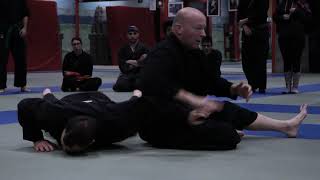
Waki Gatame into Ura Oni Kudaki - Yossi Sheriff in Madrid
AKBAN Ninjutsu – Yossi Sheriff