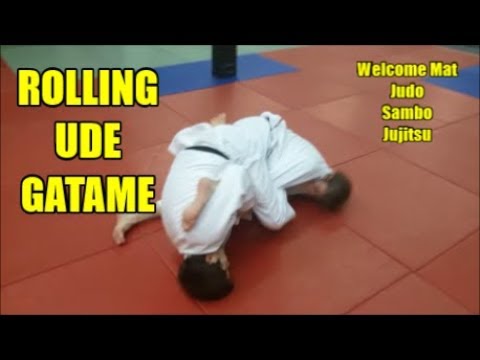
ROLLING UDE GATAME
0
Ude Gatame·welcomematstevescott
This video takes a look at a unique way to apply Ude Gatame (Straight Armlock). Thanks to Derrick Darling and Aric Weave…
Translation: arm hold/lock
Ude Gatame is a straight arm lock in judo and jujutsu where the attacker controls the opponent's arm in an extended position and applies pressure against the elbow joint using the hands, forearms, or body. [1] Unlike juji gatame (cross arm lock) which uses the hips, ude gatame applies pressure primarily with the arms and upper body against the hyperextended elbow. [1] It is one of the nine officially recognized kansetsu waza (joint techniques) in Kodokan judo and is classified as ude-hishigi-ude-gatame (arm crush arm hold) in the formal nomenclature. [1] The technique can be applied from standing, guard, mount, or side control positions. [2]
Kodokan judo lineage: Jigoro Kano (1860–1938) systematized this technique as part of the Kodokan judo curriculum. Transmitted through the Kodokan instructor system to judo federations worldwide. Adopted into BJJ through Mitsuyo Maeda → Carlos Gracie → the Gracie family lineage. [1]
Recognized Kodokan judo technique. Used in IJF World Championships and Olympic judo competition. Frequency varies by weight class and era. [1]
No images yet for this technique.
Sign in to suggest an image.
This video takes a look at a unique way to apply Ude Gatame (Straight Armlock). Thanks to Derrick Darling and Aric Weave…
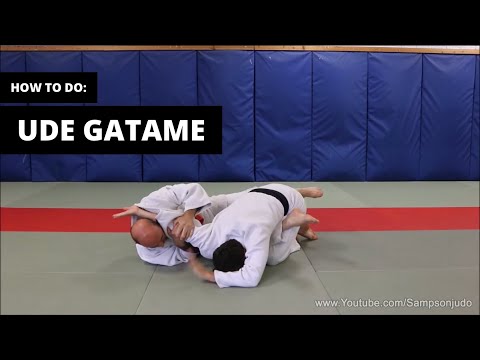
How to do Ude Gatame - In this tutorial I am showing you how to do Ude Gatame when Uke is attacking you from between the…
No instructional courses yet for this technique.
Sign in to suggest a course.
Risk of injury to the person this technique is applied to
Elbow hyperextension can cause ligament tears and dislocation.
Skill level needed to execute this technique reliably
Whether this technique is allowed under major competition rule sets
Kano, J. Kodokan Judo. Kodansha International.
[1] Kano, Kodokan Judo, Katame-waza chapter
[2] Otaki & Draeger, Judo Formal Techniques
Official Kodokan ground technique classification system
Standard Japanese martial arts terminology (kanji/hiragana)
Established Japanese martial arts naming convention — native Japanese term (和語/漢語)
[1] Kano, Kodokan Judo, Katame-waza chapter
[2] Otaki & Draeger, Judo Formal Techniques
grip strength for wrist control, body positioning for leverage
forearms (grip), shoulders, core
Ude gatame (arm hold/lock) appears referenced as one of the nine officially recognized kansetsu-waza in Kodokan judo. Its formal name is ude-hishigi-ude-gatame (arm crush arm hold). A straight armlock applied primarily with arm and upper body pressure against the hyperextended elbow. (Kano, Kodokan Judo)
According to Sampson Judo, you must twist the arm so the thumb points to the ground and fingers point toward the ceiling. If you fail to rotate the arm into this position, the technique will not be effective.
Sampson Judo emphasizes that you must trap the arm with your head and neck—if you stay relaxed, your opponent can easily pull the arm out, but by trapping it firmly with your neck, it becomes impossible to escape.
Sampson Judo stresses that just grabbing and pulling won't be as effective—instead, you should come over the top with your hand as deep as possible behind the elbow and use your whole body movement to attack the arm, not just your hands.
According to Sampson Judo, do not let go of the arm or separate your hands—your right hand controls the elbow while your other hand assists by pushing down, and this coordinated hand movement combined with body leverage makes the technique come on very quickly and effectively.
Ude Gatame is a straight arm lock in judo and jujutsu where the attacker controls the opponent's arm in an extended position and applies pressure against the elbow joint using the hands, forearms, or body. Unlike juji gatame (cross arm lock) which uses the hips, ude gatame applies pressure primarily with the arms and upper body against the hyperextended elbow.
Ude Gatame is one of the nine officially recognized kansetsu waza (joint techniques) in Kodokan judo. Its formal name is ude-hishigi-ude-gatame (arm crush arm hold).
IJF Judo: Legal: legal — classified as kansetsu waza; IBJJF: Legal at all belt levels {src:IBJJF Rules Book v6.0, June 2024|/sources/IBJJF: legal — Rules-v6.0-June-2024.pdf}; Unified MMA: Legal {src:Unified Rules of MMA, August 2025|/sources/Unified: legal — MMA-Rules-August-2025.pdf}; ADCC: Legal {src:ADCC Submission Fighting Rules|/sources/ADCC: legal — Rules-2025.pdf}; FIAS Sport Sambo: Legal {src:FIAS International Sambo Competition Rules|/sources/FIAS: legal — Sambo-Rules.pdf}
Danger rating 6/10. High — elbow hyperextension can cause ligament tears and dislocation.
The standard setup chain: From mount: isolate arm → extend → apply pressure → Catch a jab → control wrist → straighten arm → ude gatame → Failed juji gatame → switch to ude gatame on same arm.
Standard counters include: Bend the elbow before pressure is applied / Rotate the arm inward — changes the pressure angle / Bridge and roll — use hips to escape the position.
Common variants: From mount (pressing down on the straightened arm); From guard (pulling the arm into extension); Standing ude gatame (arm bar from a caught punch); Ude-hishigi-ude-gatame (formal Kodokan variation).
Recognized Kodokan judo technique. Used in IJF World Championships and Olympic judo competition.
Top errors to watch for: Applying pressure before fully extending the arm / Not controlling the wrist — allows rotation escape / Applying too much force too quickly in training / Relying on arm strength alone — use body weight.
The Ude Gatame is also known as Ude Gatame, Ude-Gatame, Ude-Hishigi-Ude-Gatame, Straight Arm Lock, Arm Crush.