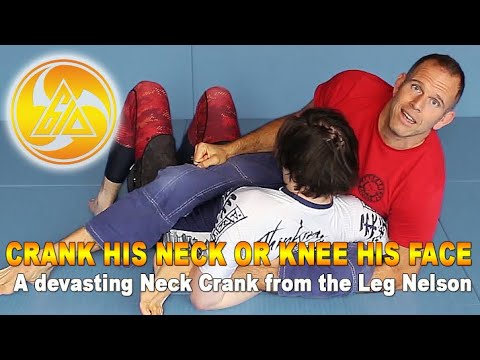
Crank his neck or knee his face - A devasting Neck Crank from the Leg Nelson
0
Nelson Neck Crank·EffortlessJiuJitsu
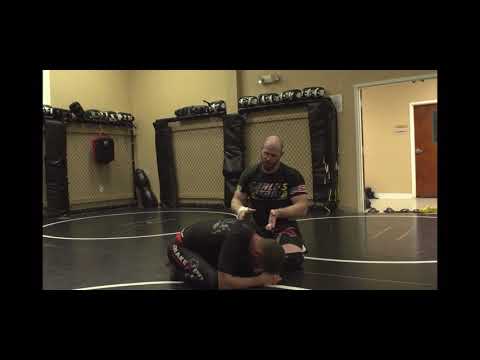
In this video BJJ Blackbelt Björn Friedrich shows a very effective combination of Leg Nelson and a powerful Neck Crank. …
Translation: Nelson Neck Wrench
The Nelson neck crank uses a half-nelson or full-nelson position to drive the opponent's chin toward their chest (flexion) or force the head sideways, creating cervical spine pressure. [1],[2] In the full nelson, both arms thread under the opponent's armpits and lock behind the head, then push the head forward and down. [1] The half-nelson uses one arm behind the head while the other controls the body. [1],[3] Nelson cranks are common in wrestling and are applied from back control, side control, or during turtle attacks. [1]
The Nelson hold is one of the oldest wrestling techniques, named after Horatio Nelson according to folk tradition, though the connection is apocryphal. [1],[2] Full and half-nelsons have been fundamental wrestling controls for centuries, and the cranking application was a natural extension of the pinning mechanic. [1],[3]
The Nelson neck crank (full nelson, half nelson) uses arm control behind the head to apply cervical flexion pressure. [1]
Nelson holds originated in wrestling as pinning techniques and were adapted for cranks in catch wrestling and MMA. [1]
Nelson cranks are used in wrestling (as pins) and occasionally as submissions in MMA. [1]
No images yet for this technique.
Sign in to suggest an image.
In this video BJJ Blackbelt Björn Friedrich shows a very effective combination of Leg Nelson and a powerful Neck Crank. …
Snake Pit U.S.A. Founder/Head Coach, Joel Bane demonstrates a 3/4 Nelson to Chancery Neck Crank. Please keep in mind the…
Discover the evolution of neck cranks from wrestling pins to advanced Jiu-Jitsu submissions. Learn techniques like the R…
The Nelson neck crank is a submission technique rooted in catch wrestling and grappling traditions, with distinct variations based on how many cervical gaps are controlled. Scientific Wrestling traces the technique's lineage through multiple lineages: from wrestling in the 1970s through figures like Larry Hartzell, Dan Ennisano, Carl Gotch, and submission wizard Yuri Nakamura, who developed numerous variations. Snake Pit U.S.A. Original No-Gi provides systematic classification of Nelson variants—quarter, half, three-quarter, and full—determined by the number of gaps controlled, with the three-quarter Nelson being a primary entry point. The three-quarter Nelson transitions into a chancery neck crank by controlling the head with proper hand positioning (deep wave-to-mom grip alignment), then using scissored elbows and body weight on the opponent's shoulder to execute cervical extension and rotation. EffortlessJiuJitsu demonstrates a leg-Nelson variant emphasizing body mechanics: the crank leverages the deadlift motion—one of the body's strongest movements—against the cervical spine, requiring careful control to avoid injury. All instructors stress the importance of controlled application in training contexts. Scientific Wrestling emphasizes the Protect Your Partner Program philosophy, applying submissions with control rather than maximal force. Snake Pit and EffortlessJiuJitsu both warn of the technique's danger and recommend careful partner selection and measured application during rolling.
Synthesized from 3 instructors
No instructional courses yet for this technique.
Sign in to suggest a course.
Risk of injury to the person this technique is applied to
Cervical extension cranks force the head backward, risking vertebral disc injury and nerve damage
Skill level needed to execute this technique reliably
Whether this technique is allowed under major competition rule sets
Japanese catch wrestling — Karl Gotch lineage / UWF
Japanese terminology sourced from Japanese catch wrestling — Karl Gotch lineage / UWF
Mixed Japanese-Western terminology — combines traditional Japanese terms with katakana loanwords
Japanese terminology sourced from Japanese catch wrestling — Karl Gotch lineage / UWF
grip or squeeze strength, positional control
strong upper body for sustained compression
forearms, biceps, pectorals, core stabilisers
Every move, in any martial art, shares a few universal traits. Mix and match below to pinpoint the right tool — or compare equivalents across styles.
The nelson neck crank from front headlock is applied by threading one or both hands behind the opponent's neck from the front headlock position and driving the head downward into cervical flexion while controlling the upper body. [1,2] From the front headlock, the attacker transitions to a half-nelson or full-nelson grip configuration and uses chest pressure combined with arm leverage to crank the neck forward and downward. [1] The front headlock provides initial head control that facilitates the transition to the nelson grip positioning. [1,2]
The nelson neck crank from turtle is applied against a turtled opponent by the attacker threading a half-nelson or full-nelson grip behind the opponent's neck and cranking the head forward while maintaining top control over the shell. [1,2] The turtle position makes the back of the neck accessible, allowing the attacker to slide the arms under the chin or behind the head and apply downward cranking force. [1] The attacker uses chest pressure on the back to anchor the opponent while the nelson grip levers the cervical spine into flexion. [1,2]
The neck crank is extremely dangerous when cranked with full power—the person receiving it might require surgery. EffortlessJiuJitsu emphasizes that you only have one spine and should be careful if you want to do jiu-jitsu for a long time.
The neck crank works by using perfect body mechanics—specifically the deadlift motion, one of the strongest movements the human body can produce, applied directly against the spine, one of the most fragile targets. EffortlessJiuJitsu explains it's not about arm strength or squeezing, but about leveraging the strongest part of your body against a vulnerable target.
Apply the neck crank with slow, controlled pressure rather than jerking or cranking hard. Scientific Wrestling notes that good practitioners can make a submission hurt with good control in slow motion, and this approach keeps training partners willing to roll with you regularly.
From the leg nelson position, once both of the opponent's arms are trapped and you control the head and neck positioning, they have no way to run or escape. Snake Pit U.S.A. emphasizes maintaining complete control of the head and neck by avoiding letting the opponent go flat on their back.
The Nelson neck crank uses a half-nelson or full-nelson position to drive the opponent's chin toward their chest (flexion) or force the head sideways, creating cervical spine pressure. In the full nelson, both arms thread under the opponent's armpits and lock behind the head, then push the head forward and down.
The Nelson hold is one of the oldest wrestling techniques, named after Horatio Nelson according to folk tradition, though the connection is apocryphal. Full and half-nelsons have been fundamental wrestling controls for centuries, and the cranking application was a natural extension of the pinning mechanic.
IBJJF: banned — Neck cranks and spinal locks prohibited at all belt levels; IJF: banned — Neck cranks prohibited; ADCC: legal — Legal; Unified MMA: legal — Legal — choke submissions are among the most common finishes in MMA; FIAS Sport Sambo: banned — All chokes prohibited in Sport Sambo; FIAS Combat Sambo: legal — Legal
Danger rating 9/10. Cervical extension cranks force the head backward, risking vertebral disc injury and nerve damage
The standard setup chain: Establish Position → Create the Threat → Secure the Hold → Finish.
Standard counters include: Early Recognition — identify the submission attempt early and begin defence immediately / Posture and Base — maintain strong posture and base to prevent submission setups / Grip Fight — deny the attacker their preferred gripping configuration.
Common variants: Standard grip variation (primary hand configuration for maximum choking pressure); Gi variation (uses the lapel or collar as an anchor for additional fric…); No-gi variation (adapted grip and positioning for submission grappling wit…); Transition finish (applied during a positional change to catch the opponent …).
Nelson cranks are used in wrestling (as pins) and occasionally as submissions in MMA.
Top errors to watch for: Applying the full Nelson explosively — the cervical spine in flexion is extremely vulnerable; apply progressively to … / Using the Nelson in wrestling competition — the full Nelson is illegal in most wrestling rule sets; verify legality b… / Not controlling the opponent's body — the Nelson requires the torso to be stabilised so the cranking force focuses on… / Cranking from a weak position — the Nelson requires superior position (back, mount, or top half) to be effective; fro….
The Nelson Neck Crank is also known as Neruson Kubi Kujiki, Nelson Hold, Full Nelson Crank, Half Nelson Crank.