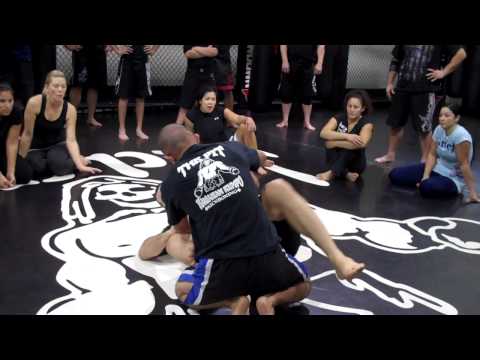
Brazilian Jiu-Jitsu: Open Guard Triangle Choke Submission
0
Open Guard Triangle·PitBlackBelt
Brazilian Jiu-Jitsu: Open Guard Triangle Choke Submission 3rd degree black belt Luigi Mondelli, visits his friends at T…
Translation: Triangle Strangle — From Open Guard
The open guard triangle applies the triangle choke from open guard positions such as spider guard, lasso guard, or de la Riva guard, where the attacker's legs are actively engaged with the opponent's arms and posture. [1] The attacker uses open guard grips and leg placement to off-balance the opponent and create the arm isolation necessary for the triangle entry, then quickly closes the triangle around the neck and one arm. [1],[2] Open guard triangles require more dynamic hip movement and timing than closed guard versions because the attacker lacks the closed guard's inherent postural control. [2] These entries are often set up through sweeps, grip breaks, or intentional arm drags that create the momentary arm isolation window. [2],[3]
Open guard triangle entries developed as BJJ's guard game evolved beyond basic closed guard in the late 1990s and 2000s. [1] Innovative guard players like Cobrinha and the Miyao brothers demonstrated triangle entries from various open guard configurations at the highest levels of competition. [2],[3]
The open guard triangle attacks with the triangle choke from various open guard configurations, using leg flexibility and hip movement. [1]
Open guard triangles expanded the triangle choke beyond closed guard in modern BJJ competition. [1]
Open guard triangles are common in IBJJF and ADCC competition, where open guard play is prevalent. [1]
No images yet for this technique.
Sign in to suggest an image.
Brazilian Jiu-Jitsu: Open Guard Triangle Choke Submission 3rd degree black belt Luigi Mondelli, visits his friends at T…
No instructional courses yet for this technique.
Sign in to suggest a course.
Risk of injury to the person this technique is applied to
Triangle chokes compress the carotid arteries using the legs; loss of consciousness in 8-12 seconds
Skill level needed to execute this technique reliably
Whether this technique is allowed under major competition rule sets
Kodokan Judo — Sankaku-jime
Japanese terminology sourced from Kodokan Judo — Sankaku-jime
Official Kodokan ground technique classification system
Standard Japanese martial arts terminology (kanji/hiragana)
Established Japanese martial arts naming convention — native Japanese term (和語/漢語)
Japanese terminology sourced from Kodokan Judo — Sankaku-jime
hip flexibility, long legs relative to torso
longer limbs for easier figure-four lock around head and arm
hip adductors, hamstrings, quadriceps
Keep your knee up at shoulder level, not lower or by the chest where your opponent can easily swatch your legs to escape. PitBlackBelt emphasizes neutral containment with the knee positioned high so it can retract quickly if needed.
The pressure of your calf behind your opponent's head is critical—if you're facing someone who knows what they're doing, calf pressure is what will finish the choke rather than relying on arm strength alone.
Hinge your knees together rather than pulling with your foot, and lock your calf over the glute area to maximize pressure. PitBlackBelt notes that locking on the bone alone won't give you enough pressure, but bringing your calf over the glute step creates significantly more finishing power.
Block your opponent's forearm with your own forearm rather than trying to drag their elbow onto your stomach, which gives them an easy angle to stack and escape.
The open guard triangle applies the triangle choke from open guard positions such as spider guard, lasso guard, or de la Riva guard, where the attacker's legs are actively engaged with the opponent's arms and posture. The attacker uses open guard grips and leg placement to off-balance the opponent and create the arm isolation necessary for the triangle entry, then quickly closes the triangle around the neck and one arm.
Open guard triangle entries developed as BJJ's guard game evolved beyond basic closed guard in the late 1990s and 2000s. Innovative guard players like Cobrinha and the Miyao brothers demonstrated triangle entries from various open guard configurations at the highest levels of competition.
IBJJF: legal — Legal at all belt levels, gi and no-gi — chokes are the safest submission cat…; IJF: legal — Legal (shime-waza) — strangulation techniques are one of three permitted subm…; ADCC: legal — Legal; Unified MMA: legal — Legal — choke submissions are among the most common finishes in MMA; FIAS Sport Sambo: banned — All chokes prohibited in Sport Sambo; FIAS Combat Sambo: legal — Legal
Danger rating 8/10. Triangle chokes compress the carotid arteries using the legs; loss of consciousness in 8-12 seconds
The standard setup chain: Achieve Controlling Position → Isolate the Neck → Set the Grip → Apply Pressure.
Standard counters include: Tuck Chin — protect the neck by lowering the chin to prevent the choke from sinking / Two-on-One Grip Fight — use both hands to strip the choking grip before it locks / Turn Into — rotate toward the choking arm to relieve carotid pressure / Posture Up — straighten the spine and create distance to break the choking angle.
Common variants: Standard triangle (classic figure-four leg lock around the head and one arm …); Reverse triangle (legs locked from behind or inverted angle for different a…); Mounted triangle (applied from mount position with gravity assisting the sq…); No-arm triangle (both arms excluded, legs-only compression on the neck).
Open guard triangles are common in IBJJF and ADCC competition, where open guard play is prevalent.
Top errors to watch for: Shooting the leg without arm control — open guard triangles require at least one arm to be controlled or isolated; sh… / Not using the open guard grips to break posture — spider, lasso, and DLR grips must first compromise the opponent's p… / Attempting from too far away — while open guard extends range, the opponent must be close enough for the leg to reach… / Not transitioning to closed guard or a lock after shooting — once the leg is over the shoulder, immediately lock the ….
The Open Guard Triangle is also known as Sankaku-jime — From Open Guard, Open Guard Sankaku, Spider Triangle.