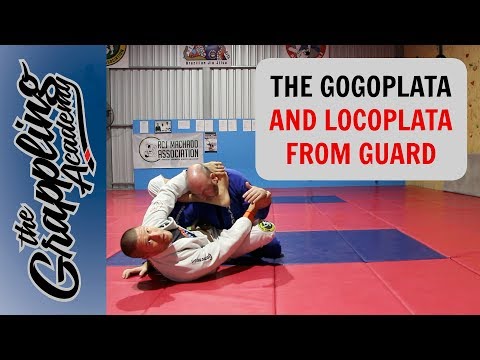
Gogoplata And Locoplata - From Closed Guard!
0
Gogoplata Standard·The Grappling Academy
SALE SALE SALE OVER 50% OFF – BOX SET – ALL 4 COURSES 50% OFF CLICK HERE – https://bit.ly/2lAOHmp • The Blue Belt Sup…
Translation: Gogoplata (katakana loanword)
The standard gogoplata from closed guard is a shin-across-throat choke where the attacker places the shin of one leg across the opponent's throat from a bottom guard position, then pulls the head down onto the shin using both hands. [1] The attacker opens the guard, inserts one leg between the bodies, and hooks the shin over the opponent's neck while controlling the head with an overhook or both hands grabbing behind the skull. [1],[2] Pulling the head downward drives the trachea and carotid arteries onto the sharp edge of the tibia, creating intense compression. [2] The gogoplata requires exceptional hip flexibility and is considered one of the most spectacular submissions in grappling due to its unusual mechanics and difficulty of execution. [2],[3]
A spectacular but low-to-moderate percentage submission; requires exceptional hip flexibility and precise shin placement across the throat. When locked, extremely effective — the shin creates a powerful fulcrum [1]
Popularized in MMA by Nick Diaz (who finished it in UFC) and in BJJ by Nino Schembri. Roots in traditional Japanese jujutsu (kagato-jime). The name 'gogoplata' comes from Japanese 'gogo' (throat) [1]
Nick Diaz's gogoplata finish over Takanori Gomi (2007) remains the most famous example. Rare at elite grappling competition due to flexibility requirements, but attempted more frequently in MMA where strikes create openings [1]
No images yet for this technique.
Sign in to suggest an image.
SALE SALE SALE OVER 50% OFF – BOX SET – ALL 4 COURSES 50% OFF CLICK HERE – https://bit.ly/2lAOHmp • The Blue Belt Sup…
No instructional courses yet for this technique.
Sign in to suggest a course.
Risk of injury to the person this technique is applied to
Shin-on-neck chokes use the shin bone as a pressure bar against the throat
Skill level needed to execute this technique reliably
Whether this technique is allowed under major competition rule sets
Japanese BJJ community; JBJJF competition usage
Official Japanese BJJ federation — competition rules and terminology
Standard katakana transliteration of Western martial arts terminology (外来語) — used in Japanese MMA, boxing, and BJJ communities
Japanese terminology sourced from Japanese BJJ community; JBJJF competition usage
exceptional hip flexibility, long legs
extreme lower body flexibility (rubber guard practitioners)
hip flexors, hamstrings, adductors
First, break your opponent's posture, then get an overhook. Place your foot on their hip and come out, bringing your leg up. From there you have multiple options including transitioning to Williams Guard.
Grab past the toe knuckle and onto your foot to prevent pulling your toes off during the submission. Then use your other hand like a waiter to go underneath your heel.
Pull with one hand and push with the other hand (underneath the heel), which creates torque and typically results in a quick tap.
The standard gogoplata from closed guard is a shin-across-throat choke where the attacker places the shin of one leg across the opponent's throat from a bottom guard position, then pulls the head down onto the shin using both hands. The attacker opens the guard, inserts one leg between the bodies, and hooks the shin over the opponent's neck while controlling the head with an overhook or both hands grabbing behind the skull.
The gogoplata gained global attention when Shinya Aoki and Nick Diaz successfully applied it in professional MMA bouts during the mid-2000s. The technique has roots in rubber guard systems and was systematised by practitioners exploring unorthodox leg-based attacks from guard.
IBJJF: legal — Legal at all belt levels, gi and no-gi — chokes are the safest submission cat…; IJF: legal — Legal (shime-waza) — strangulation techniques are one of three permitted subm…; ADCC: legal — Legal; Unified MMA: legal — Legal — choke submissions are among the most common finishes in MMA; FIAS Sport Sambo: banned — All chokes prohibited in Sport Sambo; FIAS Combat Sambo: legal — Legal
Danger rating 8/10. Shin-on-neck chokes use the shin bone as a pressure bar against the throat
The standard setup chain: Achieve Controlling Position → Isolate the Neck → Set the Grip → Apply Pressure.
Standard counters include: Tuck Chin — protect the neck by lowering the chin to prevent the choke from sinking / Two-on-One Grip Fight — use both hands to strip the choking grip before it locks / Turn Into — rotate toward the choking arm to relieve carotid pressure / Posture Up — straighten the spine and create distance to break the choking angle.
Common variants: Standard gogoplata (shin placed across the throat from rubber guard or high g…); Mounted gogoplata (applied from mount position, shin across the throat); Reverse gogoplata (applied from behind or inverted position).
Nick Diaz's gogoplata finish over Takanori Gomi (2007) remains the most famous example.
Top errors to watch for: Attempting without sufficient flexibility — the shin must comfortably reach across the neck; forcing the position ris… / Not pulling the head down — the shin alone doesn't create enough pressure; both hands must pull the head into the shi… / Using the calf instead of the shin — the bony shin creates the focal pressure; the soft calf muscle disperses force / Not establishing rubber guard control first — the transition from mission control to gogoplata is safer than jumping ….
The Gogoplata Standard is also known as Gogopuratta, Standard Gogoplata, Classic Shin-Over-Neck Choke.