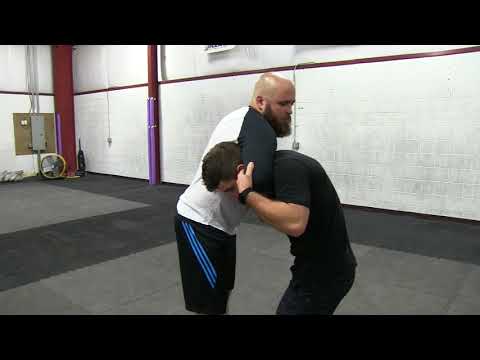
Front Headlock Defense
0
Two-on-One Choke From Front Headlock Short-Lever Clamp·Endeavor Defense & Fitness
Taking a look at the front headlock (standing guillotine) and a few options for defending it. The goal is always to get …
Translation: Two-on-One Choke (katakana loanword)
The two-on-one choke from front headlock with short-lever clamp uses both hands to grip the opponent's wrist and clamp the arm tightly against the throat at short range. [1] Unlike the long-lever pull that extends the arm fully, the short-lever clamp keeps the opponent's arm bent, pressing the forearm directly into the neck at close quarters. [1],[2] The clamp action drives the opponent's own forearm bone into the carotid arteries, using the attacker's two-hand grip to generate compression without needing full arm extension. [2] This variant is faster to establish and harder to defend because the arm travels a shorter distance to achieve choking contact. [2],[3]
More effective than the long lever version — the short lever creates tighter compression and is harder to defend through posture; works well in combination with guillotine threats [1]
Refined by catch wrestling practitioners and adapted into modern no-gi grappling; the short lever concept emphasized by Neil Melanson in his front headlock system [1]
Occasionally finished at regional and national no-gi events; used more as a control position to set up higher-percentage submissions [1]
No images yet for this technique.
Sign in to suggest an image.
Taking a look at the front headlock (standing guillotine) and a few options for defending it. The goal is always to get …
No instructional courses yet for this technique.
Sign in to suggest a course.
Risk of injury to the person this technique is applied to
Wrist-control chokes use grip manipulation to create front headlock strangles
Skill level needed to execute this technique reliably
Whether this technique is allowed under major competition rule sets
Japanese BJJ community standard katakana transliteration
Japanese BJJ community standard katakana transliteration
Standard katakana transliteration of Western martial arts terminology (外来語) — used in Japanese MMA, boxing, and BJJ communities
Japanese terminology sourced from Japanese BJJ community standard katakana transliteration
grip or squeeze strength, positional control
strong upper body for sustained compression
forearms, biceps, pectorals, core stabilisers
Start hand fighting immediately—engage with your hands to break your opponent's grips or control their arm rather than trying to rip away. Endeavor Defense & Fitness emphasizes that hand fighting is your first priority when any choke comes to your throat.
Get a hold near the elbow to control the arm and pop your head out. While being close to the fist gives the most mechanical advantage for breaking the grip, the most important thing is preventing them from applying really solid pressure in the first place.
From a controlled position with a two-on-one grip on the arm, you can either maintain that control or disengage and create space to strike. Work in a confined space and stay close rather than stepping wide and ripping away.
The two-on-one choke from front headlock with short-lever clamp uses both hands to grip the opponent's wrist and clamp the arm tightly against the throat at short range. Unlike the long-lever pull that extends the arm fully, the short-lever clamp keeps the opponent's arm bent, pressing the forearm directly into the neck at close quarters.
Short-lever clamping techniques were favoured in military combatives and self-defence systems where rapid application from close range was essential. The front headlock short-lever clamp was systematised in modern submission grappling as a complement to the long-lever variant.
IBJJF: legal — Legal at all belt levels, gi and no-gi — chokes are the safest submission cat…; IJF: legal — Legal (shime-waza) — strangulation techniques are one of three permitted subm…; ADCC: legal — Legal; Unified MMA: legal — Legal — choke submissions are among the most common finishes in MMA; FIAS Sport Sambo: banned — All chokes prohibited in Sport Sambo; FIAS Combat Sambo: legal — Legal
Danger rating 8/10. Wrist-control chokes use grip manipulation to create front headlock strangles
The standard setup chain: Achieve Controlling Position → Isolate the Neck → Set the Grip → Apply Pressure.
Standard counters include: Tuck Chin — protect the neck by lowering the chin to prevent the choke from sinking / Two-on-One Grip Fight — use both hands to strip the choking grip before it locks / Turn Into — rotate toward the choking arm to relieve carotid pressure / Posture Up — straighten the spine and create distance to break the choking angle.
Common variants: Standard grip variation (primary hand configuration for maximum choking pressure); Gi variation (uses the lapel or collar as an anchor for additional fric…); No-gi variation (adapted grip and positioning for submission grappling wit…); Transition finish (applied during a positional change to catch the opponent …).
Occasionally finished at regional and national no-gi events; used more as a control position to set up higher-percentage submissions
Top errors to watch for: Keeping the elbows too wide — the clamp requires the elbows to drive together; wide elbows create no compression / Trying to pull from distance (long-lever style) — the short clamp works through close-range clamping, not pulling; us… / Not maintaining chest-to-head contact — the short clamp needs the opponent's head close; distance reduces the clampin… / Clamping without the forearm on the artery — the forearm must be correctly positioned on the carotid before clamping;….
The Two-on-One Choke From Front Headlock Short-Lever Clamp is also known as Tsū On Wan Chōku, Short-Lever Two-on-One, Close-Grip Two-on-One Choke.