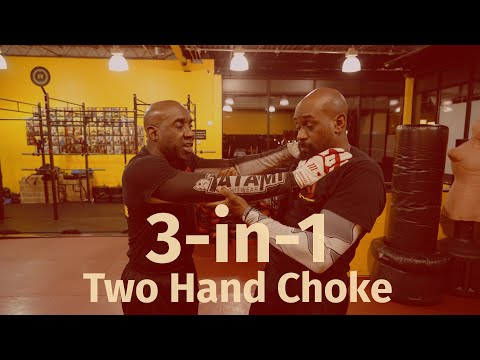
3-in1 - Two Hand Choke
0
Two-on-One Choke·Vee AJ Jitsu·Added by Admin
Join this channel to get access to perks: https://www.youtube.com/channel/UC5UHXD7eSL8MGe06z-_dtYw/join 👊 Self Defense…
Translation: Two-On-One (katakana loanword); wrist lock grip variant
The two-on-one choke from the front headlock uses both hands controlling the same side of the opponent's neck to concentrate the choking force. [1],[2] The attacker wraps the neck from a front headlock and uses a two-on-one wrist grip — both hands stacked on the same wrist — to direct all compression into one precise point on the carotid. [1] This grip configuration sacrifices breadth of control for concentrated pressure, making it effective when the opponent has a strong chin-tuck defense. [1],[3]
Two-on-one grip concepts originated in wrestling and judo as methods to overcome grip-fighting defenses. [1],[2] Applied to front headlock chokes, the two-on-one wrist control became a specialized finishing technique in BJJ and submission grappling when standard guillotine grips were insufficient. [1],[3]
The two-on-one choke uses both hands controlling one side of the collar to create an asymmetric strangle. [1]
Two-on-one collar configurations were developed in BJJ as variations of standard collar chokes. [1]
Two-on-one chokes appear in gi BJJ competition. [1]
No images yet for this technique.
Sign in to suggest an image.
Join this channel to get access to perks: https://www.youtube.com/channel/UC5UHXD7eSL8MGe06z-_dtYw/join 👊 Self Defense…
No instructional courses yet for this technique.
Sign in to suggest a course.
Risk of injury to the person this technique is applied to
Two-on-one front headlock choke uses both hands controlling the wrist to create a tight strangle
Skill level needed to execute this technique reliably
Whether this technique is allowed under major competition rule sets
Japanese wrestling/BJJ standard terminology
Japanese wrestling/BJJ standard terminology
Standard katakana transliteration of Western martial arts terminology (外来語) — used in Japanese MMA, boxing, and BJJ communities
Japanese terminology sourced from Japanese wrestling/BJJ standard terminology
grip or squeeze strength, positional control
strong upper body for sustained compression
forearms, biceps, pectorals, core stabilisers
Every move, in any martial art, shares a few universal traits. Mix and match below to pinpoint the right tool — or compare equivalents across styles.
Chion Kenny emphasizes that self-offense is more important than self-defense—the moment your hands come up to initiate the technique, your opponent should immediately understand the threat and be unable to defend himself effectively.
Never telegraph your intentions by hesitating or showing off; you should execute the technique decisively and prevent your opponent from ever getting the opportunity to counter, whether with strikes or other defenses.
The two-on-one choke from the front headlock uses both hands controlling the same side of the opponent's neck to concentrate the choking force. The attacker wraps the neck from a front headlock and uses a two-on-one wrist grip — both hands stacked on the same wrist — to direct all compression into one precise point on the carotid.
Two-on-one grip concepts originated in wrestling and judo as methods to overcome grip-fighting defenses. Applied to front headlock chokes, the two-on-one wrist control became a specialized finishing technique in BJJ and submission grappling when standard guillotine grips were insufficient.
IBJJF: legal — Legal at all belt levels, gi and no-gi — chokes are the safest submission cat…; IJF: legal — Legal (shime-waza) — strangulation techniques are one of three permitted subm…; ADCC: legal — Legal; Unified MMA: legal — Legal — choke submissions are among the most common finishes in MMA; FIAS Sport Sambo: banned — All chokes prohibited in Sport Sambo; FIAS Combat Sambo: legal — Legal
Danger rating 8/10. Two-on-one front headlock choke uses both hands controlling the wrist to create a tight strangle
The standard setup chain: Achieve Controlling Position → Isolate the Neck → Set the Grip → Apply Pressure.
Standard counters include: Tuck Chin — protect the neck by lowering the chin to prevent the choke from sinking / Two-on-One Grip Fight — use both hands to strip the choking grip before it locks / Turn Into — rotate toward the choking arm to relieve carotid pressure / Posture Up — straighten the spine and create distance to break the choking angle.
Common variants: Standard grip variation (primary hand configuration for maximum choking pressure); Gi variation (uses the lapel or collar as an anchor for additional fric…); No-gi variation (adapted grip and positioning for submission grappling wit…); Transition finish (applied during a positional change to catch the opponent …).
Two-on-one chokes appear in gi BJJ competition.
Top errors to watch for: Gripping the wrist too far from the forearm — grip close to the wrist joint for maximum control of the forearm angle / Not controlling the opponent's head — without head control, they posture up and the forearm loses contact with the neck / Pressing the forearm into the trachea — angle the forearm to the lateral neck; tracheal pressure is painful but not a… / Attempting from a loose front headlock — the choke requires tight head-and-arm control; a loose headlock allows the o….
The Two-on-One Choke is also known as Tsū On Wan, Two-on-One Front Choke, Double Wrist Control Choke.