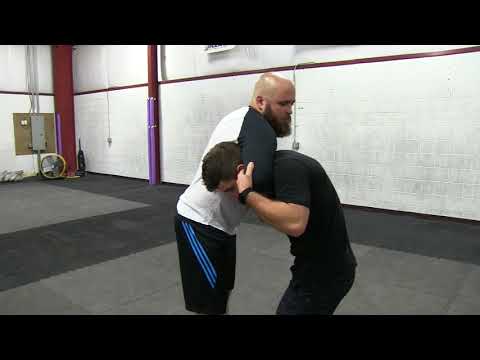
Front Headlock Defense
0
Two-on-One Choke From Front Headlock Long-Lever Pull·Endeavor Defense & Fitness
Taking a look at the front headlock (standing guillotine) and a few options for defending it. The goal is always to get …
Translation: Two-on-One Choke (katakana loanword)
The two-on-one choke from front headlock with long-lever pull uses both hands to grip the opponent's wrist and pull the arm across the throat in an extended, long-range lever action. [1] From front headlock, the attacker controls one of the opponent's arms with both hands and pulls it across the opponent's own neck, using the forearm as a choking surface while the opponent's own arm becomes the weapon. [1],[2] The 'long lever' designation means the pull extends the arm fully, maximising the distance over which force is applied and creating significant rotational torque on the neck. [2] This variant generates powerful compression but requires space and control time to fully extend the lever. [2],[3]
Effective against smaller or less experienced opponents but difficult to finish against elite grapplers who understand posture recovery; the long lever creates distance that can be exploited [1]
A traditional grappling technique found in catch wrestling and early no-holds-barred fighting; adapted to modern no-gi by front headlock specialists [1]
Rare at elite competition levels; occasionally seen in regional no-gi events and MMA [1]
No images yet for this technique.
Sign in to suggest an image.
Taking a look at the front headlock (standing guillotine) and a few options for defending it. The goal is always to get …
No instructional courses yet for this technique.
Sign in to suggest a course.
Risk of injury to the person this technique is applied to
Wrist-control chokes use grip manipulation to create front headlock strangles
Skill level needed to execute this technique reliably
Whether this technique is allowed under major competition rule sets
Japanese BJJ community standard katakana transliteration
Japanese BJJ community standard katakana transliteration
Standard katakana transliteration of Western martial arts terminology (外来語) — used in Japanese MMA, boxing, and BJJ communities
Japanese terminology sourced from Japanese BJJ community standard katakana transliteration
grip or squeeze strength, positional control
strong upper body for sustained compression
forearms, biceps, pectorals, core stabilisers
Start hand fighting right away—get your hands involved to break the opponent's grip or control their arm. According to Endeavor Defense & Fitness, the key is to hand fight first before attempting to escape or strike from the position.
Get a hold near the elbow and try to be as close to the fist as possible, since that gives you the most mechanical advantage to break their grip. Endeavor Defense & Fitness emphasizes that while being close to the fist is ideal, the most important thing is preventing them from applying solid pressure in the first place.
Once you've established the two-on-one grip near the elbow, you can either maintain that control or 'suck off' and open up space to strike. Endeavor Defense & Fitness notes that the key is working in a confined space rather than trying to step out wide.
The two-on-one choke from front headlock with long-lever pull uses both hands to grip the opponent's wrist and pull the arm across the throat in an extended, long-range lever action. From front headlock, the attacker controls one of the opponent's arms with both hands and pulls it across the opponent's own neck, using the forearm as a choking surface while the opponent's own arm becomes the weapon.
Two-on-one wrist control chokes have roots in catch wrestling and sambo, where using the opponent's own limbs as choking instruments was a standard technique. The long-lever variant was distinguished from the short-lever clamp as instructors formalised the different finishing mechanics.
IBJJF: legal — Legal at all belt levels, gi and no-gi — chokes are the safest submission cat…; IJF: legal — Legal (shime-waza) — strangulation techniques are one of three permitted subm…; ADCC: legal — Legal; Unified MMA: legal — Legal — choke submissions are among the most common finishes in MMA; FIAS Sport Sambo: banned — All chokes prohibited in Sport Sambo; FIAS Combat Sambo: legal — Legal
Danger rating 8/10. Wrist-control chokes use grip manipulation to create front headlock strangles
The standard setup chain: Achieve Controlling Position → Isolate the Neck → Set the Grip → Apply Pressure.
Standard counters include: Tuck Chin — protect the neck by lowering the chin to prevent the choke from sinking / Two-on-One Grip Fight — use both hands to strip the choking grip before it locks / Turn Into — rotate toward the choking arm to relieve carotid pressure / Posture Up — straighten the spine and create distance to break the choking angle.
Common variants: Standard grip variation (primary hand configuration for maximum choking pressure); Gi variation (uses the lapel or collar as an anchor for additional fric…); No-gi variation (adapted grip and positioning for submission grappling wit…); Transition finish (applied during a positional change to catch the opponent …).
Rare at elite competition levels; occasionally seen in regional no-gi events and MMA
Top errors to watch for: Not extending the arms enough — the long-lever advantage requires full arm extension; bent arms reduce the lever arm … / Pulling upward instead of downward and toward you — the pull should be down and back, driving the forearm into the ne… / Losing the front headlock while extending — maintain head control with the forearm; extending the arms can shift the … / Attempting the long-lever pull without the forearm on the neck — the forearm must be correctly positioned before pull….
The Two-on-One Choke From Front Headlock Long-Lever Pull is also known as Tsū On Wan Chōku, Long-Lever Two-on-One, Extended Pull Two-on-One Choke.