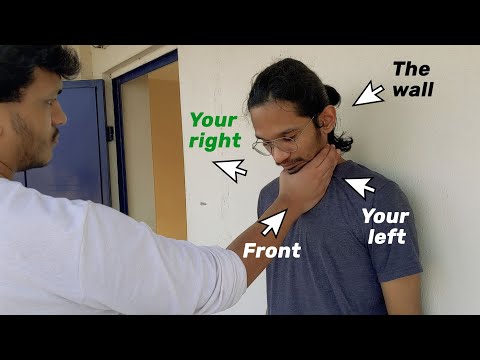
Self-Defense #101 Episode 3: Front chokes
0
Wrist Choke (Front)·Faheem Fathah·Added by Admin
Hello Everyone! In this video, we'll be discussing about how to tackle chokes from the front. Apologies for the weird …
Translation: Wrist Choke (katakana loanword)
The wrist choke from the front headlock uses the bony edge of the wrist as the primary compression point against the throat or carotid from a front headlock position. [1],[2] The attacker establishes a front headlock and positions the wrist blade directly against the target vessel, then uses the opposite hand to reinforce the wrist and drive it inward. [1] Unlike guillotines that wrap around the neck, the wrist choke focuses pressure through a narrow point, functioning similarly to a forearm choke but with the distal wrist. [1],[3]
Wrist-based chokes from the front headlock evolved from catch wrestling and self-defense systems where targeted pressure with bony prominences was emphasized. [1],[2] In BJJ, the wrist choke from front headlock became a niche technique used when the standard guillotine grip was not available. [1],[3]
Low-to-moderate effectiveness as a standalone choke; the wrist-based choking mechanic provides less compression than forearm-based chokes but can catch opponents off guard [1]
Found in traditional Japanese jujutsu and catch wrestling; adapted to modern grappling primarily by Neil Melanson and other catch-influenced instructors [1]
Rare at major competition; occasionally seen in MMA where gloves change grip dynamics and wrist-based chokes become more viable [1]
No images yet for this technique.
Sign in to suggest an image.
Hello Everyone! In this video, we'll be discussing about how to tackle chokes from the front. Apologies for the weird …
No instructional courses yet for this technique.
Sign in to suggest a course.
Risk of injury to the person this technique is applied to
Wrist-control chokes use grip manipulation to create front headlock strangles
Skill level needed to execute this technique reliably
Whether this technique is allowed under major competition rule sets
Japanese BJJ community standard katakana transliteration
Japanese BJJ community standard katakana transliteration
Standard katakana transliteration of Western martial arts terminology (外来語) — used in Japanese MMA, boxing, and BJJ communities
Japanese terminology sourced from Japanese BJJ community standard katakana transliteration
forearm and grip strength, hip flexibility for guard retention
longer arms for deeper chin-strap wrap
forearm flexors, biceps, hip flexors
Every move, in any martial art, shares a few universal traits. Mix and match below to pinpoint the right tool — or compare equivalents across styles.
Lower your head right away so they cannot get a strong grip around your neck. This allows you to avoid fighting for your breath while you prepare to escape, according to Faheem Fathah.
Remember to lower your head first as a default move, then immediately shove and push their hands away and escape. You can also land a punch if the opportunity presents itself, per Faheem Fathah.
Speed is crucial because you may only have a few seconds before losing consciousness from the choke. An attacker typically targets someone they perceive as weak and won't expect a fast counterattack, so using speed compensates for any strength difference, as Faheem Fathah emphasizes.
The wrist choke from the front headlock uses the bony edge of the wrist as the primary compression point against the throat or carotid from a front headlock position. The attacker establishes a front headlock and positions the wrist blade directly against the target vessel, then uses the opposite hand to reinforce the wrist and drive it inward.
Wrist-based chokes from the front headlock evolved from catch wrestling and self-defense systems where targeted pressure with bony prominences was emphasized. In BJJ, the wrist choke from front headlock became a niche technique used when the standard guillotine grip was not available.
IBJJF: legal — Legal at all belt levels, gi and no-gi — chokes are the safest submission cat…; IJF: legal — Legal (shime-waza) — strangulation techniques are one of three permitted subm…; ADCC: legal — Legal; Unified MMA: legal — Legal — choke submissions are among the most common finishes in MMA; FIAS Sport Sambo: banned — All chokes prohibited in Sport Sambo; FIAS Combat Sambo: legal — Legal
Danger rating 8/10. Wrist-control chokes use grip manipulation to create front headlock strangles
The standard setup chain: Achieve Controlling Position → Isolate the Neck → Set the Grip → Apply Pressure.
Standard counters include: Tuck Chin — protect the neck by lowering the chin to prevent the choke from sinking / Two-on-One Grip Fight — use both hands to strip the choking grip before it locks / Turn Into — rotate toward the choking arm to relieve carotid pressure / Posture Up — straighten the spine and create distance to break the choking angle.
Common variants: Arm-in guillotine (traps the opponent's arm inside the choke for additional …); High-elbow guillotine (Marcelotine) (elevates the elbow above the head for stronger carotid co…); Standing guillotine (finished from the feet without pulling guard); Power guillotine (chin-strap grip with a rear-naked-choke-style finish for …).
Rare at major competition; occasionally seen in MMA where gloves change grip dynamics and wrist-based chokes become more viable
Top errors to watch for: Using the flat of the forearm instead of the wrist bone — the focal pressure comes from the bony wrist prominence; fl… / Pressing on the trachea exclusively — while the trachea is a target, the carotid provides faster results with less pa… / Not using the second hand for reinforcement — one wrist alone may not generate sufficient pressure; the other hand sh… / Attempting without head control — the head must be immobilised for the wrist to maintain artery contact; an uncontrol….
The Wrist Choke (Front) is also known as Risuto Chōku, Front Wrist Choke, Wrist-Bone Headlock Choke.