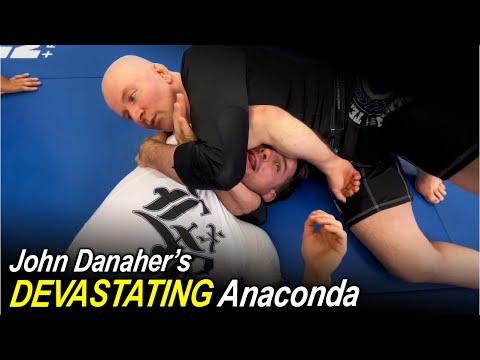
John Danaher's Devastating Anaconda
0
Anaconda Choke From Front Headlock Sit-Through Finish·Bernardo Faria BJJ Fanatics
John Danaher's Best Jiu Jitsu Anaconda Secrets - John Danaher shows his secrets to perfect the Jiu Jitsu Anaconda, in th…
Translation: Anaconda Choke (katakana loanword)
The anaconda choke from front headlock with sit-through finish uses a sit-through motion to transition the attacker from a sprawl or kneeling position to a seated position beside the opponent, tightening the choke during the transition. [1] After locking the anaconda grip, the attacker swings one leg through and sits to the hip on the choking side, which changes the angle of pressure from vertical to lateral. [1],[2] The sit-through creates a powerful rotational force on the choke as the attacker's body weight shifts, and the seated position provides a stable platform for sustained squeezing. [2] This finish is effective when the opponent resists the gator roll by posting with their free arm. [2],[3]
The sit-through finishing mechanic for the anaconda was developed by competition grapplers seeking reliable alternatives when opponents successfully defended the standard gator roll. [1] This variant became a common secondary finish in the anaconda choke toolkit during the 2010s no-gi competition era. [2],[3]
The anaconda choke uses an arm-in front headlock configuration combined with a rolling motion to trap and strangle the opponent. [1]
The anaconda choke was popularised in MMA and no-gi grappling as a front headlock submission alternative to the d'arce choke. [1]
The anaconda choke has been finished multiple times in UFC competition, notably by Nogueira brothers and Fabricio Werdum. [1]
No images yet for this technique.
Sign in to suggest an image.
John Danaher's Best Jiu Jitsu Anaconda Secrets - John Danaher shows his secrets to perfect the Jiu Jitsu Anaconda, in th…
No instructional courses yet for this technique.
Sign in to suggest a course.
Risk of injury to the person this technique is applied to
Anaconda choke with sit-through creates a tight arm-in strangle; gator roll tightens the squeeze
Skill level needed to execute this technique reliably
Whether this technique is allowed under major competition rule sets
Tri-force BJJ Academy (triforce-bjj.com); Tri-force Shiki BJJ (tfshiki-bjj.com); Aoki Shinya (note.com/a_ok_i)
Japan's largest BJJ academy chain — Japanese technique terminology
Japanese BJJ technique naming conventions article (2019)
Top Japanese MMA fighter — BJJ technique terminology
Standard katakana transliteration of Western martial arts terminology (外来語) — used in Japanese MMA, boxing, and BJJ communities
Japanese terminology sourced from Tri-force BJJ Academy (triforce-bjj.com); Tri-force Shiki BJJ (tfshiki-bjj.com); Aoki Shinya (note.com/a_ok_i)
long arms for head-and-arm wrap, core strength for gator roll
longer limbs, athletic build
biceps, deltoids, core rotators, hip flexors
Most practitioners prefer the figure-four grip over palm-to-palm in the anaconda position. According to Bernardo Faria's breakdown of John Danaher's system, the figure-four grip is the standard choice for this choke.
If you cannot achieve the T position, you can switch to finishing with what Danaher calls the 'God position' instead. This gives you an alternative finish when the standard T position isn't available.
Position determines your attack choice: the further back the opponent's head is positioned, the more you should target gear jings; the further forward and across, adjust your attack accordingly. Mastering the T position is essential for becoming effective with anaconda variations.
The anaconda choke from front headlock with sit-through finish uses a sit-through motion to transition the attacker from a sprawl or kneeling position to a seated position beside the opponent, tightening the choke during the transition. After locking the anaconda grip, the attacker swings one leg through and sits to the hip on the choking side, which changes the angle of pressure from vertical to lateral.
The sit-through finishing mechanic for the anaconda was developed by competition grapplers seeking reliable alternatives when opponents successfully defended the standard gator roll. This variant became a common secondary finish in the anaconda choke toolkit during the 2010s no-gi competition era.
IBJJF: legal — Legal at all belt levels, gi and no-gi — chokes are the safest submission cat…; IJF: legal — Legal (shime-waza) — strangulation techniques are one of three permitted subm…; ADCC: legal — Legal; Unified MMA: legal — Legal — choke submissions are among the most common finishes in MMA; FIAS Sport Sambo: banned — All chokes prohibited in Sport Sambo; FIAS Combat Sambo: legal — Legal
Danger rating 9/10. Anaconda choke with sit-through creates a tight arm-in strangle; gator roll tightens the squeeze
The standard setup chain: Achieve Controlling Position → Isolate the Neck → Set the Grip → Apply Pressure.
Standard counters include: Tuck Chin — protect the neck by lowering the chin to prevent the choke from sinking / Two-on-One Grip Fight — use both hands to strip the choking grip before it locks / Turn Into — rotate toward the choking arm to relieve carotid pressure / Posture Up — straighten the spine and create distance to break the choking angle.
Common variants: Standard anaconda (arm threaded under the neck and over the far arm, finishe…); No-roll anaconda (finished in place without the gator roll by sprawling and…); Anaconda from guard (applied from bottom position when the opponent's head is low).
The anaconda choke has been finished multiple times in UFC competition, notably by Nogueira brothers and Fabricio Werdum.
Top errors to watch for: Not including the far arm in the choking loop — the anaconda specifically requires the arm trapped inside; without it… / Threading too shallow — the choking arm must pass deep enough around the neck and arm to connect the hands; shallow t… / Sitting through to the wrong side — sit through toward the side of the choking arm; sitting opposite loosens the wrap / Not completing the full roll — the sit-through must roll the opponent onto their side; stopping halfway leaves the ch….
The Anaconda Choke From Front Headlock Sit-Through Finish is also known as Anakonda Chōku, Sit-Through Anaconda, Sit-Through Finish Anaconda.