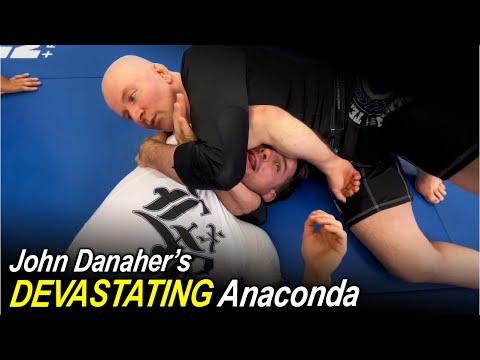
John Danaher's Devastating Anaconda
0
Anaconda Choke From Front Headlock Hip-Walk Finish·Bernardo Faria BJJ Fanatics
John Danaher's Best Jiu Jitsu Anaconda Secrets - John Danaher shows his secrets to perfect the Jiu Jitsu Anaconda, in th…
Translation: Anaconda Choke (katakana loanword)
The anaconda choke from front headlock with hip-walk finish uses a slow, grinding hip-walking motion to tighten the strangle rather than a rolling transition. [1] After establishing the anaconda arm wrap from front headlock, the attacker walks the hips in small increments toward the opponent's head, progressively tightening the compression loop with each step. [1],[2] The hip-walk method provides more control than the gator roll, as the attacker maintains a stable base throughout the finishing sequence. [2] This variant is preferred when the opponent is too heavy to roll or when the attacker wants to methodically increase pressure while monitoring the opponent's response. [2],[3]
The hip-walk finish is a controlled alternative to the gator roll — each step incrementally tightens the choke irreversibly. More stable than rolling, ideal when the opponent bases wide to prevent the roll. [1]
Developed as a complement to the gator roll finish. The hip-walk provides a methodical tightening approach that emerged from systematic front headlock training. [1]
Used when the gator roll is defended — competitors who base wide to prevent rolling are vulnerable to the lateral hip walk. Seen at advanced no-gi competition. [1]
No images yet for this technique.
Sign in to suggest an image.
John Danaher's Best Jiu Jitsu Anaconda Secrets - John Danaher shows his secrets to perfect the Jiu Jitsu Anaconda, in th…
No instructional courses yet for this technique.
Sign in to suggest a course.
Risk of injury to the person this technique is applied to
Anaconda/gator-roll chokes use a rolling motion to tighten the arm-in head-and-arm strangle
Skill level needed to execute this technique reliably
Whether this technique is allowed under major competition rule sets
Tri-force BJJ Academy (triforce-bjj.com); Tri-force Shiki BJJ (tfshiki-bjj.com); Aoki Shinya (note.com/a_ok_i)
Japan's largest BJJ academy chain — Japanese technique terminology
Japanese BJJ technique naming conventions article (2019)
Top Japanese MMA fighter — BJJ technique terminology
Standard katakana transliteration of Western martial arts terminology (外来語) — used in Japanese MMA, boxing, and BJJ communities
Japanese terminology sourced from Tri-force BJJ Academy (triforce-bjj.com); Tri-force Shiki BJJ (tfshiki-bjj.com); Aoki Shinya (note.com/a_ok_i)
long arms for head-and-arm wrap, core strength for gator roll
longer limbs, athletic build
biceps, deltoids, core rotators, hip flexors
While both can work from the front headlock position, instructors prefer the figure-four grip for the anaconda. The figure-four variation is a simple adjustment—instead of locking palm to palm, you use the figure-four grip to set up the same choke.
If you can't get to the T position, you can transition to finishing from the god position instead. Once you've locked the figure-four grip with your training partner, you can throw your legs around them and come up into a standing position to finish the choke.
The T position plays a crucial role in executing the anaconda choke effectively. Developing a strong understanding of what makes the T position work will significantly improve your effectiveness with this technique.
The anaconda choke from front headlock with hip-walk finish uses a slow, grinding hip-walking motion to tighten the strangle rather than a rolling transition. After establishing the anaconda arm wrap from front headlock, the attacker walks the hips in small increments toward the opponent's head, progressively tightening the compression loop with each step.
The hip-walk finishing method developed as an alternative to the gator roll for heavier practitioners who found rolling mechanics impractical. Competition grapplers in the 2010s refined the hip-walk into a precise pressure-escalation system for front headlock strangles.
IBJJF: legal — Legal at all belt levels, gi and no-gi — chokes are the safest submission cat…; IJF: legal — Legal (shime-waza) — strangulation techniques are one of three permitted subm…; ADCC: legal — Legal; Unified MMA: legal — Legal — choke submissions are among the most common finishes in MMA; FIAS Sport Sambo: banned — All chokes prohibited in Sport Sambo; FIAS Combat Sambo: legal — Legal
Danger rating 9/10. Anaconda/gator-roll chokes use a rolling motion to tighten the arm-in head-and-arm strangle
The standard setup chain: Achieve Controlling Position → Isolate the Neck → Set the Grip → Apply Pressure.
Standard counters include: Tuck Chin — protect the neck by lowering the chin to prevent the choke from sinking / Two-on-One Grip Fight — use both hands to strip the choking grip before it locks / Turn Into — rotate toward the choking arm to relieve carotid pressure / Posture Up — straighten the spine and create distance to break the choking angle.
Common variants: Standard anaconda (arm threaded under the neck and over the far arm, finishe…); No-roll anaconda (finished in place without the gator roll by sprawling and…); Anaconda from guard (applied from bottom position when the opponent's head is low).
Used when the gator roll is defended — competitors who base wide to prevent rolling are vulnerable to the lateral hip walk. Seen at advanced no-gi competition.
Top errors to watch for: Walking the hips in the wrong direction — walk toward the choking arm side; walking opposite loosens the grip / Taking too few steps — the hip walk requires patience; 2-3 steps rarely finish; commit to walking until the choke is … / Not maintaining the grip during the walk — each step shifts the body; ensure the hands stay connected throughout / Walking too fast and losing the grip — controlled, deliberate steps are more effective than rushing.
The Anaconda Choke From Front Headlock Hip-Walk Finish is also known as Anakonda Chōku, Hip-Walk Anaconda from Headlock, Walk-Around Headlock Anaconda.