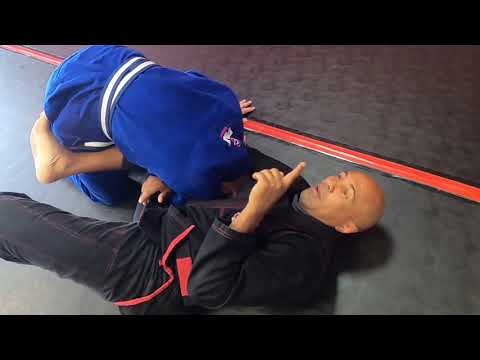
Snap Down to Guillotine/Clock Choke
0
Guillotine Choke From Standing Snap-Down Arm-In·Trillo Jiujitsu Academy
Checkout this Snap Down to Turtle. From there, we can attack the Guillotine, Back Takes etc with any number of attacks. …
Translation: Guillotine Choke (katakana loanword); also フロントチョーク
The arm-in guillotine from standing snap-down captures the opponent's neck and one arm simultaneously as the attacker snaps the opponent's head downward from a standing clinch or collar tie. [1] The snap-down motion breaks the opponent's posture and drives their head into the attacker's armpit, where the guillotine wrap is immediately applied around both the neck and the near arm. [1],[2] From standing, the attacker can choose to finish while standing by squeezing and lifting, or pull guard to use leg control as additional leverage. [2] The snap-down entry is one of the fastest guillotine setups because the opponent's momentum carries them directly into the choke. [2],[3]
Snap-down to guillotine combinations originated in wrestling-to-submission grappling transitions, where the snap-down was already a fundamental wrestling technique. [1] The standing arm-in variant became prominent in MMA and no-gi competition as a high-speed counter-offense against forward-pressuring opponents. [2],[3]
Effective proactive guillotine entry — the snap-down creates the bent-over posture while the arm-in trap catches the posting arm. The arm-in variation is more secure than arm-out from this entry. [1]
Combines the wrestling collar-tie snap-down with the BJJ arm-in guillotine. The snap-down is a fundamental wrestling technique adapted for submission entry by BJJ and MMA practitioners. [1]
Seen in MMA and no-gi competition as a proactive attack from the clinch. Used by fighters who prefer to initiate the guillotine rather than counter-wrestling. [1]
No images yet for this technique.
Sign in to suggest an image.
Checkout this Snap Down to Turtle. From there, we can attack the Guillotine, Back Takes etc with any number of attacks. …
No instructional courses yet for this technique.
Sign in to suggest a course.
Risk of injury to the person this technique is applied to
Guillotine variants compress the trachea and carotids from front headlock control
Skill level needed to execute this technique reliably
Whether this technique is allowed under major competition rule sets
柔術B (jiujitsu-b.com); gentle-world.tech; Yahoo知恵袋; Wikipedia ja (フロントチョーク)
Major Japanese BJJ publication — comprehensive technique lists
Japanese BJJ submission guide
Japanese Q&A community — BJJ technique name verification
Japanese Wikipedia — martial arts technique articles
Standard katakana transliteration of Western martial arts terminology (外来語) — used in Japanese MMA, boxing, and BJJ communities
Japanese terminology sourced from 柔術B (jiujitsu-b.com); gentle-world.tech; Yahoo知恵袋; Wikipedia ja (フロントチョーク)
forearm and grip strength, hip flexibility for guard retention
longer arms for deeper chin-strap wrap
forearm flexors, biceps, hip flexors
Make sure you don't cross your feet and keep your knees slightly bent as your opponent walks towards you. This stable base allows you to guide them effectively for the snap-down.
Keep a grip on the arm while maintaining heavy shoulder pressure on the back of the neck. This positioning allows you to control the opponent before driving the arm in for the choke.
Once you have a solid grip, sit your opponent up and bring your knee in tight to complete the choke setup. From there you can transition to back control if needed by driving your knee inside.
The arm-in guillotine from standing snap-down captures the opponent's neck and one arm simultaneously as the attacker snaps the opponent's head downward from a standing clinch or collar tie. The snap-down motion breaks the opponent's posture and drives their head into the attacker's armpit, where the guillotine wrap is immediately applied around both the neck and the near arm.
Snap-down to guillotine combinations originated in wrestling-to-submission grappling transitions, where the snap-down was already a fundamental wrestling technique. The standing arm-in variant became prominent in MMA and no-gi competition as a high-speed counter-offense against forward-pressuring opponents.
IBJJF: legal — Legal at all belt levels, gi and no-gi — chokes are the safest submission cat…; IJF: legal — Legal (shime-waza) — strangulation techniques are one of three permitted subm…; ADCC: legal — Legal; Unified MMA: legal — Legal — choke submissions are among the most common finishes in MMA; FIAS Sport Sambo: banned — All chokes prohibited in Sport Sambo; FIAS Combat Sambo: legal — Legal
Danger rating 9/10. Guillotine variants compress the trachea and carotids from front headlock control
The standard setup chain: Achieve Controlling Position → Isolate the Neck → Set the Grip → Apply Pressure.
Standard counters include: Tuck Chin — protect the neck by lowering the chin to prevent the choke from sinking / Two-on-One Grip Fight — use both hands to strip the choking grip before it locks / Turn Into — rotate toward the choking arm to relieve carotid pressure / Posture Up — straighten the spine and create distance to break the choking angle.
Common variants: Arm-in guillotine (traps the opponent's arm inside the choke for additional …); High-elbow guillotine (Marcelotine) (elevates the elbow above the head for stronger carotid co…); Standing guillotine (finished from the feet without pulling guard); Power guillotine (chin-strap grip with a rear-naked-choke-style finish for …).
Seen in MMA and no-gi competition as a proactive attack from the clinch. Used by fighters who prefer to initiate the guillotine rather than counter-wrestling.
Top errors to watch for: Snapping down without immediately wrapping — the window after a snap-down is brief; if the wrap isn't instant, the op… / Not trapping the arm — the arm-in version requires the near arm inside; snapping down and wrapping only the neck crea… / Pulling guard before the wrap is secure — ensure the guillotine grip is locked before sitting back; a loose wrap duri… / Not committing to the snap — a half-hearted snap-down doesn't bring the head low enough for the guillotine; snap expl….
The Guillotine Choke From Standing Snap-Down Arm-In is also known as Girochin Chōku, Snap-Down Arm-In Guillotine, Standing Arm-In Front Choke.