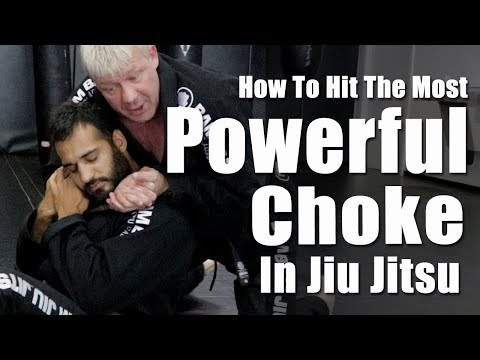
How To Hit The Most Powerful Choke In Jiu Jitsu
0
Thrust Lapel Choke Technique·Bam Bam Martial Arts Houston·Added by Admin
FOR A FREE CLASS VISIT: http://www.BamBamMartialArtsHouston.com 713-307-5375 Bam Bam Martial Arts 4007 Bellaire Blvd. ii…
Translation: Thrust Strangle
The thrust lapel choke drives the fist, knuckles, or forearm into the opponent's throat using the collar as a grip anchor. [1],[2] The attacker grips the collar with one or both hands and thrusts forward, pressing the bony structures of the hand directly into the trachea or carotid arteries. [1],[3] Unlike most collar chokes that rely on fabric compression, the thrust variation uses the collar grip primarily for leverage while the striking surface of the hand delivers the choking pressure. [1],[4] These techniques produce significant discomfort and can function as both air chokes and blood chokes. [1],[5]
Thrust-style lapel chokes have roots in judo's tsukkomi-jime (突込絞め, 'thrust strangle'), a recognized Kodokan shime-waza where one hand thrusts into the throat using the collar for leverage. [2],[3] The technique was adopted in Brazilian Jiu-Jitsu but is less commonly seen in competition than cross-collar chokes due to its reliance on painful pressure rather than clean blood restriction. [1],[4],[5]
The thrust lapel choke uses a pushing/thrusting motion with a collar grip to compress the throat. [1]
Thrust collar chokes are part of judo's shimewaza, particularly the okuri-eri-jime family. [1]
Thrust lapel chokes are used in gi BJJ and judo competition. [1]
No images yet for this technique.
Sign in to suggest an image.
FOR A FREE CLASS VISIT: http://www.BamBamMartialArtsHouston.com 713-307-5375 Bam Bam Martial Arts 4007 Bellaire Blvd. ii…
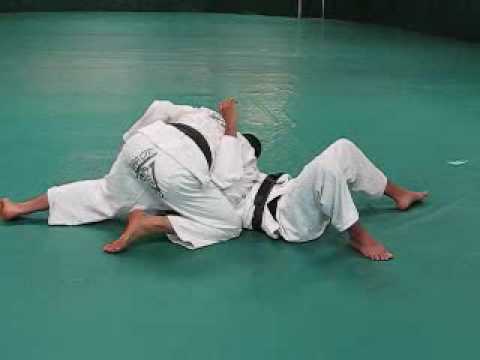
http://www.GracieAcademy.com Rener Gracie, head instructor of the world famous Gracie Academy in Torrance, CA, teaches…
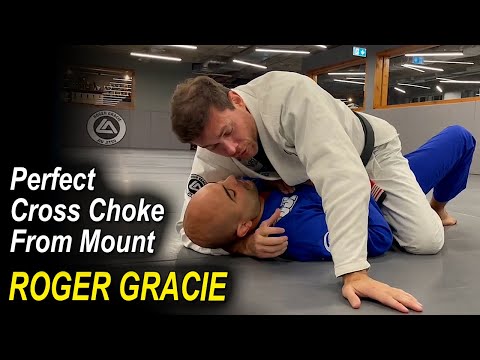
Roger Gracie Explains How To Do the Perfect Cross Choke From Mount - Roger Gracie teaches How To Do the Cross Choke From…
The thrust lapel choke technique, also known as the 'choke from Hades' or hadaka jime in classical judo terminology, represents a high-leverage forearm-and-collar submission designed for situations where a standard lapel choke is only partially established. Bam Bam Martial Arts Houston emphasizes this technique's application when the opponent has defended by tucking their chin or inserting their fingers into the choke, creating a stalemate where direct pressure yields only discomfort rather than a successful submission. The distinguishing feature of the thrust lapel choke involves transitioning from a mounted or rear-control position by releasing hooks, rolling to the side, moving to the stomach, and then elevating the opponent onto their buttocks while applying downward pressure—a mechanical shift that dramatically increases choking efficiency even from a compromised initial grip. Gracie Jiu-Jitsu Academy's underhook lapel variation contextualizes the technique within side mount, emphasizing precise arm trapping, knee placement through the opponent's elbow, and front-door neck approach to prevent chin defense. Both instructors stress controlling the opponent's arm before final choke application and maintaining a stable base throughout. The technique's effectiveness stems not from initial grip depth but from leveraging body position and weight distribution after the repositioning phase, making it particularly valuable in gi competition where lapel control is fundamental.
Synthesized from 3 instructors
No instructional courses yet for this technique.
Sign in to suggest a course.
Risk of injury to the person this technique is applied to
Thrust chokes use a pushing motion of the fist into the neck combined with lapel tension
Skill level needed to execute this technique reliably
Whether this technique is allowed under major competition rule sets
Kodokan Judo — Official Shime-waza #11
Japanese terminology sourced from Kodokan Judo — Official Shime-waza #11
Official Kodokan ground technique classification system
Standard Japanese martial arts terminology (kanji/hiragana)
Established Japanese martial arts naming convention — native Japanese term (和語/漢語)
Japanese terminology sourced from Kodokan Judo — Official Shime-waza #11
grip or squeeze strength, positional control
strong upper body for sustained compression
forearms, biceps, pectorals, core stabilisers
Every move, in any martial art, shares a few universal traits. Mix and match below to pinpoint the right tool — or compare equivalents across styles.
According to Roger Gracie, you should get your whole arm through first before worrying about the grip. Instead of grabbing and then trying to slide the grip in, get your entire arm through so you feel your wrist and forearm on the opponent's neck, and only then establish the grip.
Once you have one arm through the opponent's defense, they must use both of their arms to defend that side, forcing them to fight your one hand with two hands—which is very difficult for them to manage effectively.
Body positioning is critical—you must maintain a high, tight position on the opponent to prevent them from bringing their elbows in or bridging you off. Stay tall and deep to control their ability to escape, then drop your body down low only when you're ready to apply the choke.
Mastery comes through years of practicing the mounted position itself, combined with specific escape training where you start already caught in the submission and work on defensive options.
The thrust lapel choke drives the fist, knuckles, or forearm into the opponent's throat using the collar as a grip anchor. The attacker grips the collar with one or both hands and thrusts forward, pressing the bony structures of the hand directly into the trachea or carotid arteries.
Thrust-style lapel chokes have roots in judo's tsukkomi-jime (突込絞め, 'thrust strangle'), a recognized Kodokan shime-waza where one hand thrusts into the throat using the collar for leverage. The technique was adopted in Brazilian Jiu-Jitsu but is less commonly seen in competition than cross-collar chokes due to its reliance on painful pressure rather than clean blood restriction.
IBJJF: legal — Legal at all belt levels, gi and no-gi — chokes are the safest submission cat…; IJF: legal — Legal (shime-waza) — strangulation techniques are one of three permitted subm…; ADCC: restricted — N/A (no-gi competition only — technique requires gi); Unified MMA: restricted — N/A (technique requires gi — not applicable in MMA); FIAS Sport Sambo: banned — All chokes prohibited in Sport Sambo; FIAS Combat Sambo: legal — Legal
Danger rating 7/10. Thrust chokes use a pushing motion of the fist into the neck combined with lapel tension
The standard setup chain: Achieve Controlling Position → Isolate the Neck → Set the Grip → Apply Pressure.
Standard counters include: Tuck Chin — protect the neck by lowering the chin to prevent the choke from sinking / Two-on-One Grip Fight — use both hands to strip the choking grip before it locks / Turn Into — rotate toward the choking arm to relieve carotid pressure / Posture Up — straighten the spine and create distance to break the choking angle.
Common variants: Standard grip variation (primary hand configuration for maximum choking pressure); Gi variation (uses the lapel or collar as an anchor for additional fric…); No-gi variation (adapted grip and positioning for submission grappling wit…); Transition finish (applied during a positional change to catch the opponent …).
Thrust lapel chokes are used in gi BJJ and judo competition.
Top errors to watch for: Thrusting into the trachea — aim for the lateral neck where the carotid artery runs; centre-throat thrusts are painfu… / Using a loose grip on the lapel — the lapel must be bunched tight in the fist to create a solid striking surface / Thrusting without body weight — drive from the hips and shoulders, not just the arm; the thrust needs mass behind it / Attempting without positional control — the thrust requires a stable base; without mount or guard control, the oppone….
The Thrust Lapel Choke Technique is also known as Thrust Lapel Choke, Tsukkomi-jime, Push Choke, Lapel Thrust Strangle.