Introduction to the Cross Choke from Mount
The instructor introduces a detailed breakdown of the cross choke, one of the most fundamental submissions in Brazilian Jiu-Jitsu. This technique requires precision in positioning and grip placement to execute effectively against a resisting opponent.
Establishing High Mount Position
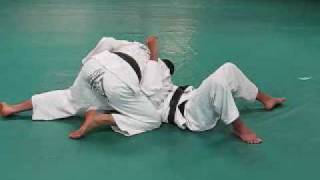
The instructor emphasizes maintaining a high mount position to prevent the opponent from inserting their elbows for escape. By staying elevated on the hips, the instructor eliminates the opponent's ability to execute an elbow escape and regain guard position. This positioning is critical before initiating any choking sequence.
First Arm Insertion Technique
Rather than securing a grip before insertion, the instructor threads the entire arm through the opponent's neck first. Once the wrist and forearm are in contact with the neck, grip placement becomes significantly easier. This method prevents the common mistake of attempting to slide a pre-formed grip through the opponent's defense.
Body Positioning During First Grip
As the instructor secures the first arm grip, the body must shift slightly to the opposite side to counter the opponent's bridging escape. This lateral weight distribution prevents the opponent from successfully bridging the hips and dislodging the top position. The side with the secured arm becomes the primary concern for maintaining control.
Lowering Position for Second Arm
To insert the second arm, the instructor must drop lower into the mount, positioning the forehead on the mat as a base point. This lower position elevates the hips higher, reducing leverage available to the opponent for bridge escapes. The forehead acts as an additional contact point that prevents rotational escape attempts.
Defending Against Bridge Escapes
The instructor blocks the opponent's bridge escape by using the forehead as a contact point on the mat. If the opponent attempts to rotate under this pressure, they will give up their back position. Maintaining this low, compact structure is essential for successfully completing the second arm insertion.
Securing the Second Arm Grip
The opponent will defend the second arm insertion with both hands, making four-finger collar grip entry extremely difficult. The correct angle requires approaching from above the opponent's hand placement rather than underneath. The thumb placement behind the ear offers an alternative grip pathway that bypasses the opponent's primary hand defense.
Thumb Placement and Collar Control
Placing the thumb deep behind the opponent's ear targets the collar at a depth difficult to defend with the hands. When the opponent attempts to defend deep collar grips, they must expose their elbow, creating vulnerability to arm attacks. This strategic placement forces a choice between defending the collar or protecting the arms.
Wrist Positioning Through Hand Defense
The key to completing the grip is positioning the wrist at the end of the opponent's fingertips, allowing rotation to cleanly pass their defensive hands. If the wrist remains over the opponent's hands during rotation, their grip remains intact and blocks the choke. Precise wrist placement ensures that rotational pressure cleanly slides past all defensive barriers.
ROGER GRACIE Shows How To Do the Perfect Cross Choke From Mount
Key Takeaways
- •Introduction to the Cross Choke from Mount
- •Establishing High Mount Position
- •First Arm Insertion Technique
- •Body Positioning During First Grip
Roger Gracie Explains How To Do the Perfect Cross Choke From Mount - Roger Gracie teaches How To Do the Cross Choke From Mount, in this Jiu-Jitsu training video. - Click Here To Check Out Roger Gracie's Instructional Videos - https://bjjfanatics.com/products/the-roger-gracie-mount-system-by-roger-gracie For all your BJJ Gear and Apparel Needs Visit - https://store.bjjfanatics.com/ Are you a BJJ Fanatics Insider? If not, you are missing out! Join now at: https://bjjfanatics.com/products/insiders-club - Bernardo Faria is a 5x World Champion. Bernardo started training Brazilian Jiu-Jitsu in Juiz de Fora - MG, Brazil at the age of 14 in 2001. After receiving the Black Belt from his first instructor Ricardo Marques in 2008, He moved to Sao Paulo to join BJJ legend Fabio Gurgel and his Alliance team. After many years of training and winning many major titles, Bernardo moved to NYC in 2013 to train and teach at Marcelo Garcia Academy. In 2015 Bernardo achieved his dream of winning the IBJJF World Championship Open class title and his division, doing the double Gold and becoming the 1st in the IBJJF Ranking and also chosen as the best athlete of 2015. Bernardo Faria has now taken on the mission to share some of the lessons, techniques, experiences and more that he has learned along in his 16 years and counting as a BJJ student, teacher and world class competitor. Subscribe to his channel, and join him in this amazing BJJ Journey. We promise that you will also improve your BJJ with his awesome Video Lessons, Episodes of his "5 Minutes BJJ Talk" and more... www.fujisports.com - 15% OFF Coupon Code: FARIA15 www.bjjfanatics.com - 10% OFF Coupon Code: YOUTUBEFARIA www.fujimats.com - 10% OFF Coupon Code: FARIAMAT10 http://bernardofaria.com https://www.facebook.com/bernardofariabjj/ https://www.instagram.com/bernardofariabjj/ https://twitter.com/bernardofariajj . For the best fightwear, check out https://www.kojofightwear.com/ and use code " YTD15 " to get 15% off your first order.
Frequently Asked Questions
What does this video teach about thrust lapel choke technique?
This video covers introduction to the cross choke from mount, establishing high mount position, first arm insertion technique. It provides detailed instruction from Bernardo Faria BJJ Fanatics.
How long does it take to learn thrust lapel choke technique?
The basic mechanics can be understood in a single session, but developing reliable execution requires consistent drilling over weeks of practice. This 9-part breakdown helps structure your training by isolating each phase of the technique.
What are the key details for finishing thrust lapel choke technique?
Placing the thumb deep behind the opponent's ear targets the collar at a depth difficult to defend with the hands. When the opponent attempts to defend deep collar grips, they must expose their elbow, creating vulnerability to arm attacks. This strategic placement forces a choice between defending the collar or protecting the arms.