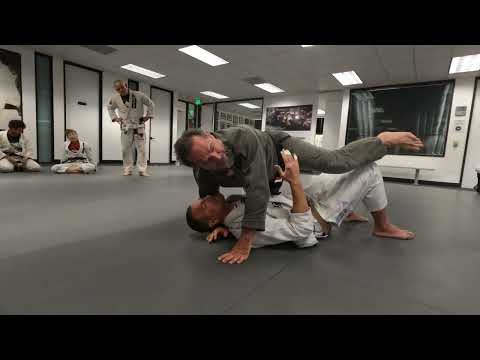
Sneaky No Gi Ezekiel & Darce Choke for BJJ from a Wrestling Cradle
0
Ezekiel Choke·Chewjitsu·Added by Admin
We got a question about an ole wrestling move called the cradle today in this one. Our friend who goes by the name "Le…
Translation: Sleeve Wheel Strangle
The Ezekiel choke (sode-guruma-jime) uses the attacker's own gi sleeve as a fulcrum: one arm threads behind the opponent's head, the opposite hand feeds through the sleeve of the first arm, and the fist or forearm drives into the throat while the sleeve-arm provides counter-pressure behind the neck. [1],[2],[3] The sleeve acts as an anchor that prevents the choking arm from slipping and distributes force. [1] The Ezekiel can be applied from mount, side control, inside closed guard, and even from bottom position, making it one of the most versatile gi chokes. [1],[4]
Sode-guruma-jime (袖車絞め, 'sleeve wheel strangle') is a classical Kodokan Judo shime-waza. [2],[3] The technique's common name 'Ezekiel choke' honors Ezequiel Paraguassú, a Brazilian judoka who famously used it while training at BJJ academies in the 1990s, submitting numerous BJJ black belts from inside their guard. [1] The technique became a staple of both judo and BJJ competition worldwide. [1],[4],[5]
The Ezekiel choke (sode-guruma-jime) uses the sleeve of the gi (or the fist in no-gi) to create a crushing choke from inside the opponent's guard or from mount. [1] It is one of the few submissions regularly applied from inside an opponent's closed guard, making it a valuable counter-attack. [1],[2]
Sode-guruma-jime (袖車絞め) is a Kodokan Judo technique from the shime-waza curriculum. [1] It became known as the 'Ezekiel choke' in BJJ after Ezequiel Paraguassu, a Brazilian judoka who trained at Carlson Gracie Academy in the 1990s and repeatedly submitted BJJ black belts with this technique from inside their guard. [2]
No images yet for this technique.
Sign in to suggest an image.
We got a question about an ole wrestling move called the cradle today in this one. Our friend who goes by the name "Le…
#submissions #jeanjacquesmachado #bjj ----- One of the pioneers of the art of Brazilian Jiu-Jitsu and one of its grea…
SALE SALE SALE OVER 50% OFF – BOX SET – ALL 4 COURSES 50% OFF CLICK HERE – https://bit.ly/2lAOHmp • The Blue Belt Sup…
The Ezekiel choke is a forearm-and-collar strangle executed from dominant positions such as mount or front headlock control, with variations applicable in both gi and no-gi settings. Chewjitsu emphasizes the no-gi Ezekiel from a wrestling cradle position, using a chin-strap grip to control the neck before sliding the attacking forearm across the carotid with the pinky leading, then securing with the opposite hand and flexing to compress the neck. JeanJacquesMachado teaches the technique primarily from mount, stressing the critical importance of initial cross-face control and armpit grip to bring the opponent close; he describes shooting the hand through like a gun with tightened knuckles across the jawline to block one carotid, then lifting the elbow to block the opposite side, emphasizing that 70% of the choke's effectiveness comes from the initial control hand. The Grappling Academy similarly teaches from mount, adding the crucial tactical detail of pinning the opponent's hands before attacking the neck to neutralize defensive framing, and underscores that finishing power derives primarily from body weight placement—specifically positioning the belly button over the wrist—rather than arm strength. All three instructors agree on the fundamental mechanics of the choke itself (forearm across the neck with hand reinforcement), but they differ in their primary setup positions and entrance strategies, with Chewjitsu favoring the cradle transition, while JeanJacquesMachado and The Grappling Academy focus on mount control.
Synthesized from 3 instructors
No instructional courses yet for this technique.
Sign in to suggest a course.
Risk of injury to the person this technique is applied to
The Ezekiel choke can be applied from mount, guard, or back — versatile and fast-finishing
Skill level needed to execute this technique reliably
Whether this technique is allowed under major competition rule sets
Kodokan Judo — Official Shime-waza #10
Japanese terminology sourced from Kodokan Judo — Official Shime-waza #10
Alias sources — [1] Kodokan Judo (Kano, 1986) [2] Brazilian Portuguese BJJ terminology [3] Brazilian Portuguese BJJ terminology
Official Kodokan ground technique classification system
Standard Japanese martial arts terminology (kanji/hiragana)
Established Japanese martial arts naming convention — native Japanese term (和語/漢語)
Japanese terminology sourced from Kodokan Judo — Official Shime-waza #10
Alias sources — [1] Kodokan Judo (Kano, 1986) [2] Brazilian Portuguese BJJ terminology [3] Brazilian Portuguese BJJ terminology
forearm strength, wrist control, top position stability
thick forearms for pressure across the throat
forearm flexors, wrist extensors, core
Every move, in any martial art, shares a few universal traits. Mix and match below to pinpoint the right tool — or compare equivalents across styles.
The Ezekiel choke from guard is applied by the bottom player who threads one hand inside their own sleeve and wraps it around the opponent's neck, then uses the forearm of the other arm to press across the throat and complete the strangle. [1,2] From closed guard, the attacker pulls the opponent's posture down and secures the sleeve grip behind the head before positioning the choking forearm. [1] This is an unorthodox guard attack that catches opponents off-guard because the Ezekiel is more commonly expected from top positions. [1,2]
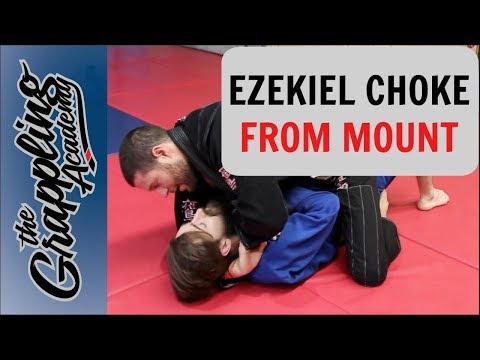
The Ezekiel choke from mount uses the sleeve of the gi to create a forearm strangle while the attacker maintains the dominant mounted position. [1,2] The attacker threads one hand through their own sleeve and wraps it behind the opponent's neck, then drives the blade of the opposite forearm across the throat to complete the choke. [1] The mount provides the stability and downward pressure needed to prevent the opponent from creating space, making this one of the highest-percentage positions for the Ezekiel finish. [1,2]
The Ezekiel choke appears in 8 passages across 3 books, including Carlson Gracie's 'BJJ for Experts Only' which documents the choke from rear mount, side control, and mount. Named after Brazilian judoka Ezequiel Paraguassu who submitted Carlson Gracie Academy students with it while training for the 1988 Seoul Olympics. (Carlson Gracie & Fernandez, BJJ for Experts Only)
Start with a chin strap grip, placing your hand directly on your opponent's chin. This initial grip allows you to control the head and set up the choke.
Let them bring their arm down, then block that side of their head to lock in the choke. According to Jean Jacques Machado, controlling the head is critical—if you control the head, you control the rest of the body.
The cross face is essential for establishing control before the choke. Grab the armpit (or gi if available) and bring your opponent toward you to secure the position before attacking the neck.
Keep your head down and your shoulder positioned into their jaw—this prevents them from rolling you to that side, since head position controls body position. Once you commit your arm, you become vulnerable to rolls, so shoulder control is critical.
The Ezekiel choke (sode-guruma-jime) uses the attacker's own gi sleeve as a fulcrum: one arm threads behind the opponent's head, the opposite hand feeds through the sleeve of the first arm, and the fist or forearm drives into the throat while the sleeve-arm provides counter-pressure behind the neck. The sleeve acts as an anchor that prevents the choking arm from slipping and distributes force.
Sode-guruma-jime (袖車絞め, 'sleeve wheel strangle') is a classical Kodokan Judo shime-waza. The technique's common name 'Ezekiel choke' honors Ezequiel Paraguassú, a Brazilian judoka who famously used it while training at BJJ academies in the 1990s, submitting numerous BJJ black belts from inside their guard.
IBJJF: legal — Legal at all belt levels, gi and no-gi — chokes are the safest submission cat…; IJF: legal — Legal (shime-waza) — strangulation techniques are one of three permitted subm…; ADCC: restricted — N/A (no-gi competition only — technique requires gi); Unified MMA: restricted — N/A (technique requires gi — not applicable in MMA); FIAS Sport Sambo: banned — All chokes prohibited in Sport Sambo; FIAS Combat Sambo: legal — Legal
Danger rating 8/10. The Ezekiel choke can be applied from mount, guard, or back — versatile and fast-finishing
The standard setup chain: Achieve Controlling Position → Isolate the Neck → Set the Grip → Apply Pressure.
Standard counters include: Tuck Chin — protect the neck by lowering the chin to prevent the choke from sinking / Two-on-One Grip Fight — use both hands to strip the choking grip before it locks / Turn Into — rotate toward the choking arm to relieve carotid pressure / Posture Up — straighten the spine and create distance to break the choking angle.
Common variants: Gi Ezekiel (uses the sleeve for the choking grip, traditional technique); No-gi Ezekiel (uses the fist or forearm across the throat without sleeve…); Reverse Ezekiel (applied from the bottom position when opponent is in your…).
Aleksei Oleinik holds the record for most Ezekiel choke finishes in UFC/MMA history with multiple wins using the technique. The technique remains common in judo ne-waza competition at IJF events.
Top errors to watch for: Not threading deep enough into the sleeve — the gripping hand must go deep enough to create a rigid forearm structure… / Attempting without the head positioned behind the opponent's head — the sleeve arm must be behind the head to create … / Using the fist as the primary choking surface — the fist assists, but the main pressure comes from the forearm of the… / Telegraphing by adjusting the sleeve grip — establish the sleeve grip subtly during scrambles or transitions.
The Ezekiel Choke is also known as Sode-guruma-jime, Estrangulamento de Ezequiel, Sleeve Wheel Choke.