Strike & defenceLocksClose rangeFighting multiple people
Distance
CloseMiddleLong
Body target
Upper bodyMiddle bodyLower body
Overview
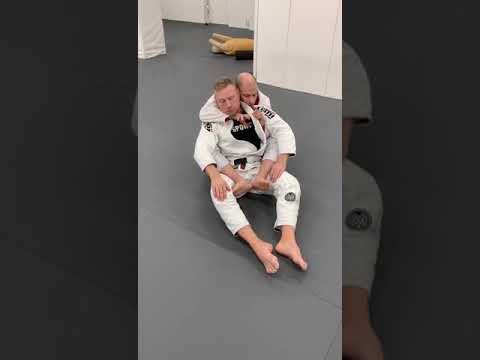
The sliding collar choke from back control involves gripping the opponent's collar and progressively walking or sliding the grip across the neck to remove slack and increase pressure. [1],[2] Rather than establishing a fixed cross-grip, the attacker starts with one deep collar grip and incrementally slides it to the opposite side while the second hand controls or assists. [1],[3] Each incremental advance tightens the collar against the carotid arteries, allowing the attacker to build the choke against an opponent actively defending. [1] This makes it effective against opponents who use hand-fighting to prevent sudden deep grip insertion. [2],[4]
The sliding collar choke derives from judo's okuri-eri-jime (送襟絞め, 'sliding collar strangle'), one of the original Kodokan shime-waza where the collar is progressively advanced across the throat. [2],[3] In BJJ, the sliding approach was refined for back mount and body triangle positions where the attacker has extended time to work the collar incrementally past defenses. [1],[4]
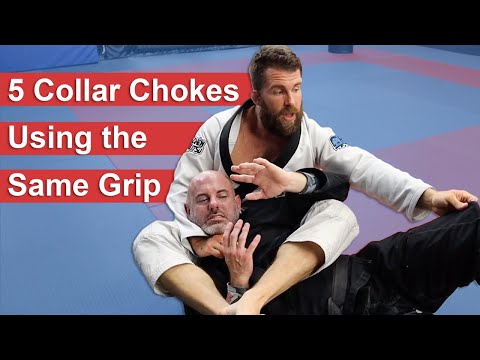
5 Different Collar Chokes from Back Mount Using The Same Grip
0
Sliding Collar-Choke·Chewjitsu
In today's BJJ technique video I share 5 different collar chokes you can use in BJJ using the same grip on the lapel. I'…
1 / 2
3 videos
What Instructors Say
The sliding collar choke is a gi-based rear control submission that leverages lapel and collar grips to compress the carotid arteries. All three instructors emphasize the critical importance of proper wrist positioning—the sharp bone of the wrist must cut into the neck rather than lying flat—and agree that taking slack out of the collar before applying pressure is essential. Spy Choke instructor highlights the foundational mechanics: hiding the choking hand to prevent thumb grabbing, passing the collar to remove slack, and using bodyweight via a reclined position rather than arm strength to finish. Stephan Kesting advocates for an exceptionally tight first collar grip with the second grip optionally sourced from the opponent's shoulder material, and stresses that wrist mechanics and chest-to-chest finishing (rather than arms open) maximize choke efficacy. Chewjitsu offers a practical grip enhancement—flipping the lapel outward to engage four fingers plus thumb for stronger hand utilization—and presents five distinct finishing variations from the same lapel grip, all sharing wrist flexion as the mechanical constant. Where Spy Choke prioritizes perpendicular body rotation for advanced applications, Kesting and Chewjitsu focus on grip depth and positional control without necessarily rotating. All three agree that maintaining grip integrity while threatening secondary attacks (triangles, armbars) forces defensive errors that expose the choke's finishing moment.
Synthesized from 3 instructors
Spy Choke — BJJ Basics - Two-Collar Choke: Foundational mechanics: hiding the choking hand, passing the collar to remove slack, using bodyweight recline rather than arm strength, and perpendicular body rotation as an advanced finishing method to maximize pressure.
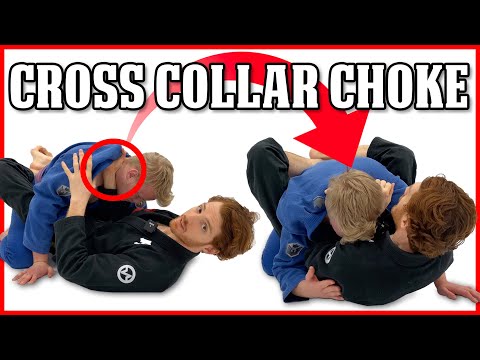
Stephan Kesting — How to Actually FINISH The Cross Collar Choke from Guard: Emphasis on an extremely tight initial collar grip with sharp wrist bone cutting into the neck, optional second grip from shoulder material, and chest-to-chest finishing posture; strategic use of multiple attack threats to force the opponent into choke exposure.
Chewjitsu — 5 Different Collar Chokes from Back Mount Using The Same Grip: Practical grip optimization by flipping the lapel to enable four-finger engagement, five distinct finishing variations (double lapel, under-arm pin, half Nelson, sit-up, bow-and-arrow) from a single lapel grip, and emphasis on wrist flexion as the universal mechanical principle across all collar choke finishes.
Learn This Technique
No instructional courses yet for this technique.
Sign in to suggest a course.
Ratings
Danger Rating
Risk of injury to the person this technique is applied to
8
Very High8/10
Sliding collar choke uses a pulling-and-sliding motion to tighten the collar against the neck
Difficulty
Skill level needed to execute this technique reliably
Advanced
Competition Legality
Whether this technique is allowed under major competition rule sets
Illegal
— FIAS Sport Sambo — All chokes prohibited in Sport Sambo
✓The sliding collar choke uses a cross-collar grip that slides along the collar to tighten the strangle — the sliding motion creates progressive compression as the hand travels deeper (Gracie & Gracie, Brazilian Jiu-Jitsu: Theory and Technique, 2001)
✓The grip starts shallow in the collar, then slides toward the back of the neck during the choke — the sliding action cinches the fabric against the carotid arteries
✓From mount: establish a four-finger-in cross-collar grip, then slide the hand toward the base of the skull while the other hand grips the opposite collar and pulls
✓The sliding motion is what distinguishes this from a static cross-collar choke: the hand actively travels, creating a dynamic tightening effect like pulling a drawstring
✓The choke works from mount, side control, and closed guard — any position where both collar grips can be established and the sliding motion executed
✓The collar fabric acts as a force multiplier: as the hand slides, the stiff collar transmits pressure around the circumference of the neck to both arteries
✓Roger Gracie's famous cross-collar choke from mount uses this sliding principle — his hand travels deep behind the neck to maximise collar tension
Common Mistakes
!Starting with too shallow a grip — the initial grip must be deep enough to allow the hand to slide further; starting at the edge of the collar limits travel
!Sliding without pulling with the opposite hand — both hands must work together; one slides while the other pulls the opposite collar to create counter-tension
!Attempting the slide against a dry, stiff collar — the collar must have some give; on very stiff gis, soften the collar by working the grip first
!Not committing body weight over the choke — from mount, lean forward and drive weight through the arms into the collar grips
!Sliding too quickly — the slide should be progressive and controlled; a rapid yank may lose the grip
!Keeping the elbows wide during the finish — bring the elbows to your chest as you slide; wide elbows reduce compression
!Not angling the body — turning slightly to the choking side increases the sliding distance and tightens the collar further
Standard Japanese martial arts terminology (kanji/hiragana)
3OtherJapanese Martial Arts Standard Terminology (武道用語)
Established Japanese martial arts naming convention — native Japanese term (和語/漢語)
4CitationKodokan Judo — Official Katame-waza Classification
Kodokan — Okuri-eri-jime (送り襟絞め) official classification
Community
Athletics
Requires
grip or squeeze strength, positional control
Favours
strong upper body for sustained compression
Key muscles
forearms, biceps, pectorals, core stabilisers
Frequently Asked Questions
How should I position my wrist when doing a collar choke to make it effective?
Stephan Kesting emphasizes that you need to use the sharp part of your wrist to cut into the neck rather than a flat part. Angle your wrist so it creates a cutting edge, and avoid keeping it flat, as this reduces choking pressure.
What's the proper body mechanics for finishing a collar choke from guard?
Stephan Kesting teaches that you should keep your elbows tight, pull inward while expanding your chest open, and use the same posture-breaking mechanic—coming up and pulling rather than relying only on arm strength. Avoid opening your elbows.
When should I actually commit to the collar choke rather than pulling hard early?
Stephan Kesting warns not to overexert when you don't have the choke locked in, as this wastes energy. You should only commit fully and pull tight when you feel you're actually going to get the submission.
What's the key rule for gripping the collar effectively?
According to BJJ Basics instructor, you should never just grab the collar—always pass it first to remove slack. The underhook grabs and pulls out first, then the thumb goes up high, ensuring the collar is tight before you apply pressure.
Should I use my arms or my body weight to finish a collar choke?
BJJ Basics emphasizes using your back rather than just your arms, especially against larger opponents. Lie back and let both arms go straight so your body weight finishes the choke rather than muscular arm strength.
How does the Sliding Collar-Choke work?
The sliding collar choke from back control involves gripping the opponent's collar and progressively walking or sliding the grip across the neck to remove slack and increase pressure. Rather than establishing a fixed cross-grip, the attacker starts with one deep collar grip and incrementally slides it to the opposite side while the second hand controls or assists.
Where does the Sliding Collar-Choke come from?
The sliding collar choke derives from judo's okuri-eri-jime (送襟絞め, 'sliding collar strangle'), one of the original Kodokan shime-waza where the collar is progressively advanced across the throat. In BJJ, the sliding approach was refined for back mount and body triangle positions where the attacker has extended time to work the collar incrementally past defenses.
Is the Sliding Collar-Choke legal in competition?
IBJJF: legal — Legal at all belt levels, gi and no-gi — chokes are the safest submission cat…; IJF: legal — Legal (shime-waza) — strangulation techniques are one of three permitted subm…; ADCC: restricted — N/A (no-gi competition only — technique requires gi); Unified MMA: restricted — N/A (technique requires gi — not applicable in MMA); FIAS Sport Sambo: banned — All chokes prohibited in Sport Sambo; FIAS Combat Sambo: legal — Legal
How dangerous is the Sliding Collar-Choke?
Danger rating 8/10. Sliding collar choke uses a pulling-and-sliding motion to tighten the collar against the neck
How do I set up the Sliding Collar-Choke?
The standard setup chain: Achieve Controlling Position → Isolate the Neck → Set the Grip → Apply Pressure.
How do I defend against the Sliding Collar-Choke?
Standard counters include: Tuck Chin — protect the neck by lowering the chin to prevent the choke from sinking / Two-on-One Grip Fight — use both hands to strip the choking grip before it locks / Turn Into — rotate toward the choking arm to relieve carotid pressure / Posture Up — straighten the spine and create distance to break the choking angle.
What are the variants of the Sliding Collar-Choke?
Common variants: Standard grip variation (primary hand configuration for maximum choking pressure); Gi variation (uses the lapel or collar as an anchor for additional fric…); No-gi variation (adapted grip and positioning for submission grappling wit…); Transition finish (applied during a positional change to catch the opponent …).
How effective is the Sliding Collar-Choke in competition?
Sliding collar chokes are a standard gi submission in IBJJF competition.
What are common mistakes when doing the Sliding Collar-Choke?
Top errors to watch for: Starting with too shallow a grip — the initial grip must be deep enough to allow the hand to slide further; starting … / Sliding without pulling with the opposite hand — both hands must work together; one slides while the other pulls the … / Attempting the slide against a dry, stiff collar — the collar must have some give; on very stiff gis, soften the coll… / Not committing body weight over the choke — from mount, lean forward and drive weight through the arms into the colla….
What are other names for the Sliding Collar-Choke?
The Sliding Collar-Choke is also known as Okuri-eri-jime, Sliding Collar Strangle, Clock Choke.