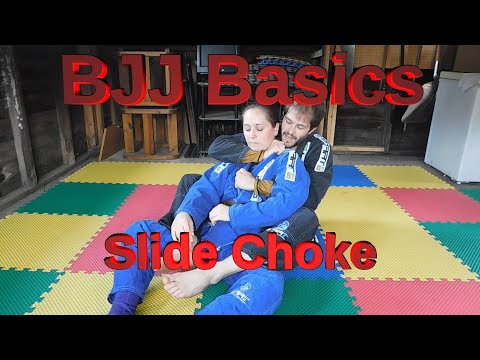
BJJ Basics: Slide Choke (Lapel Choke/Zipper Choke)
0
Sliding Lapel Rear Choke·Kayfabe Jiu-Jitsu
A great finishing option from the back, particularly if you cannot free the bottom arm to assist with a two handed choke…
Translation: sliding lapel rear strangle
Sliding lapel rear chokes involve gripping the opponent's collar from back control and sliding the hand across the neck to tighten the strangle progressively. [1],[2] The sliding collar choke is the primary technique: the attacker establishes a deep collar grip on one side, then slides or walks the grip across to the opposite side of the neck while maintaining back hooks. [1],[3] The sliding motion creates increasing pressure against the carotid arteries as the fabric tightens around the circumference of the neck. [1] Unlike static cross-collar grips, the sliding action allows the attacker to gradually overcome the opponent's defensive hand-fighting by incrementally advancing the choke. [2],[4]
Sliding collar chokes from behind evolved from judo's okuri-eri-jime (送襟絞め, sliding collar strangle), a Kodokan shime-waza where the collar is progressively slid across the throat. [2],[3] Okuri-eri-jime was one of the original techniques codified in Kodokan Judo's ground fighting curriculum. [2] In Brazilian Jiu-Jitsu, the sliding motion was refined for back mount and body triangle positions, where the attacker has extended control time to work the choke incrementally. [1],[4]
The sliding lapel rear choke slides the grip along the collar from behind to tighten the strangle progressively. [1]
Sliding lapel chokes from rear control are part of judo's shimewaza curriculum adopted in BJJ. [1]
Sliding lapel rear chokes are used as finishing details in gi competition from back control. [1]
No images yet for this technique.
Sign in to suggest an image.
A great finishing option from the back, particularly if you cannot free the bottom arm to assist with a two handed choke…
No instructional courses yet for this technique.
Sign in to suggest a course.
Risk of injury to the person this technique is applied to
Sliding collar grip allows the choking hand to adjust depth dynamically for optimal compression
Skill level needed to execute this technique reliably
Whether this technique is allowed under major competition rule sets
Kodokan Judo — Official Katame-waza Classification
Kodokan — Okuri-eri-jime (送り襟絞め) classification
Standard Japanese martial arts terminology (kanji/hiragana)
Established Japanese martial arts naming convention — native Japanese term (和語/漢語)
Kodokan — Okuri-eri-jime (送り襟絞め) classification
grip or squeeze strength, positional control
strong upper body for sustained compression
forearms, biceps, pectorals, core stabilisers
Every move, in any martial art, shares a few universal traits. Mix and match below to pinpoint the right tool — or compare equivalents across styles.
Insert your thumb into the collar with your top hand while keeping it under the throat, and use your fingers to help secure the grip on the lapel. According to Kayfabe Jiu-Jitsu, turning your wrist down adds significant control once you have this initial position.
You can finish by making space and straightening both arms to pull the choke in, or alternatively pull tightly around the shoulder and pull back—both methods are effective according to Kayfabe Jiu-Jitsu.
Yes, Kayfabe Jiu-Jitsu demonstrates that once you have a good grip on the first collar, you reach to find and secure the other collar to complete the technique.
Sliding lapel rear chokes involve gripping the opponent's collar from back control and sliding the hand across the neck to tighten the strangle progressively. The sliding collar choke is the primary technique: the attacker establishes a deep collar grip on one side, then slides or walks the grip across to the opposite side of the neck while maintaining back hooks.
Sliding collar chokes from behind evolved from judo's okuri-eri-jime (送襟絞め, sliding collar strangle), a Kodokan shime-waza where the collar is progressively slid across the throat. Okuri-eri-jime was one of the original techniques codified in Kodokan Judo's ground fighting curriculum.
IBJJF: legal — Legal at all belt levels, gi and no-gi — chokes are the safest submission cat…; IJF: legal — Legal (shime-waza) — strangulation techniques are one of three permitted subm…; ADCC: restricted — N/A (no-gi competition only — technique requires gi); Unified MMA: restricted — N/A (technique requires gi — not applicable in MMA); FIAS Sport Sambo: banned — All chokes prohibited in Sport Sambo; FIAS Combat Sambo: legal — Legal
Danger rating 8/10. Sliding collar grip allows the choking hand to adjust depth dynamically for optimal compression
The standard setup chain: Achieve Controlling Position → Isolate the Neck → Set the Grip → Apply Pressure.
Standard counters include: Tuck Chin — protect the neck by lowering the chin to prevent the choke from sinking / Two-on-One Grip Fight — use both hands to strip the choking grip before it locks / Turn Into — rotate toward the choking arm to relieve carotid pressure / Posture Up — straighten the spine and create distance to break the choking angle.
Common variants: Standard grip variation (primary hand configuration for maximum choking pressure); Gi variation (uses the lapel or collar as an anchor for additional fric…); No-gi variation (adapted grip and positioning for submission grappling wit…); Transition finish (applied during a positional change to catch the opponent …).
Sliding lapel rear chokes are used as finishing details in gi competition from back control.
Top errors to watch for: Not penetrating deep enough with the initial collar grip — the hand must start at least at the centre line to have ro… / Neglecting the opposite lapel grip — without counter-tension from the second hand, the sliding motion doesn't create … / Losing back hooks during the collar insertion — maintain hooks and body triangle throughout; collar work requires a s… / Sliding the hand outward instead of along the collar line — the hand must follow the collar's path around the neck, n….
The Sliding Lapel Rear Choke is also known as Okuri Eri Ushiro-jime, Okuri-eri-jime, Sliding Collar Strangle.