Introduction to the Sliding Collar Choke
The sliding collar choke is a fundamental gi-based submission that leverages the collar to create effective pressure. This technique is applicable to both beginners mastering the basics and advanced practitioners refining their mechanics.
Positioning and Hand Concealment
Proper positioning requires pulling the opponent backward so the instructor's chin remains in front. The choking hand must be hidden to prevent the opponent from grabbing the thumb and disrupting the submission attempt.
Collar Control Fundamentals
When securing the collar with an underhook grip, the instructor must always pass the collar to remove slack rather than simply grabbing it. The thumb is then driven high while the collar is folded to create a gripping surface for the fingers.
Basic Choke Finish
The second collar is secured with the opposite hand to eliminate additional slack. The finish is executed by lying back and extending both arms straight, using body weight and leverage rather than arm strength to complete the submission.
Grip Mechanics and Wrist Position
The choking hand requires a distinctive V-shaped contour formed by bending the wrist backward. Only two fingers grip the folded collar, allowing precise pressure application against the opponent's throat.
The Spy Choke Alternative
When the second collar is unavailable, the spy choke provides an effective option using a slice grip down the opponent's arm and tricep. This technique works particularly well against jacketed opponents and requires only one hand to generate sufficient pressure.
Advanced Positioning: Perpendicular Rotation
To maximize choke pressure when standard collar access is limited, the instructor steps across the opponent's knee and rotates perpendicular to them. This positional shift automatically tightens the initial grip without requiring additional slack removal.
Leg Control and Crossing Mechanics
Controlling the opponent's knee prevents them from escaping by bringing the knee to the chest. When crossing the ankles, the top ankle must be positioned on the opponent's shoulder to prevent their hand from clearing the leg lock and escaping the submission.
BJJ Basics - Two-Collar Choke, Spy Choke and Bow and Arrow Choke From Back Control
Key Takeaways
- •Introduction to the Sliding Collar Choke
- •Positioning and Hand Concealment
- •Collar Control Fundamentals
- •Basic Choke Finish
Here's another video shot at my friend Jon Thomas' school, Valhalla BJJ in Sweden - http://www.valhallajj.se/ In this follow up, we look at the basic two-collar choke, the spy choke and the basics of the bow and arrow choke. _________ If you would like to learn Jiu-Jitsu, I have created two video courses - the Beginner's Guide to Brazilian Jiu-Jitsu, and The BJJ Blue Belt Curriculum. You can pick them both up at BJJ101.tv.
Frequently Asked Questions
What does this video teach about sliding collar-choke?
This video covers introduction to the sliding collar choke, positioning and hand concealment, collar control fundamentals. It provides detailed instruction from Elliott Bayev.
How long does it take to learn sliding collar-choke?
The basic mechanics can be understood in a single session, but developing reliable execution requires consistent drilling over weeks of practice. This 8-part breakdown helps structure your training by isolating each phase of the technique.
What are the key details for finishing sliding collar-choke?
To maximize choke pressure when standard collar access is limited, the instructor steps across the opponent's knee and rotates perpendicular to them. This positional shift automatically tightens the initial grip without requiring additional slack removal.
Related videos

5 Different Collar Chokes from Back Mount Using The Same Grip
Chewjitsu
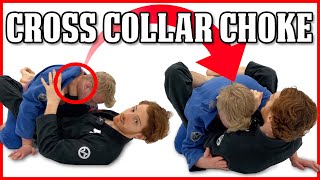
How to Actually FINISH The Cross Collar Choke from Guard
Stephan Kesting
Head And Arm Rear Naked Choke by Heath Pedigo
BJJ Fanatics
Sode Guruma Jime || Sleeve Wheel Choke
The Judo Way of Life
Fundamentals: Gable Grip Choke from the Back
Bellingham BJJ