Brazilian Jiu Jitsu - Rear Naked Choke and The Short Choke
0
Short Choke·Jordan Squires·Added by Admin
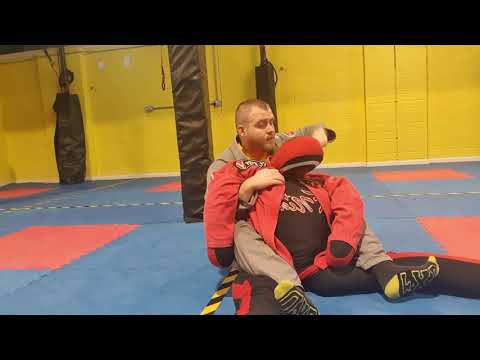
Another basic BJJ video explaining how to use the rear naked choke and short choke!
Translation: Short Choke (katakana loanword)
The short choke is a compact rear strangle variation where the attacker uses a shallow grip — often just the forearm across the side of the neck targeting the carotid, with a palm-to-palm or fist grip — rather than the deep figure-four of the standard RNC. [1],[2] The 'short' refers to the abbreviated grip configuration that requires less arm length threaded around the neck. [1] This makes it effective for attackers with shorter arms or when the opponent's chin defense prevents deep arm insertion. [1],[3]
The short choke emerged in competitive grappling as a pragmatic solution to modern chin-tuck defenses against the standard RNC. [1],[2] While abbreviated rear strangles existed in judo and catch wrestling, [2] the systematized 'short choke' became prominent in no-gi competition during the 2010s, particularly in ADCC and EBI formats. [1],[3]
The short choke is effective as a quick-attack option when the full RNC wrap is prevented. Direct forearm-to-carotid pressure can produce rapid unconsciousness but requires precise bone-on-artery placement. [1]
Traditional catch wrestling technique — direct forearm pressure chokes predate the modern figure-four RNC. Also found in military combatives and sambo. [1]
Appears in MMA and submission wrestling when the standard RNC wrap is defended. Less common in gi competition where collar chokes are preferred from the back. [1]
No images yet for this technique.
Sign in to suggest an image.
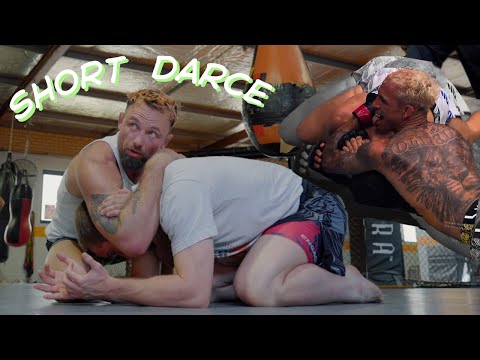
Another basic BJJ video explaining how to use the rear naked choke and short choke!
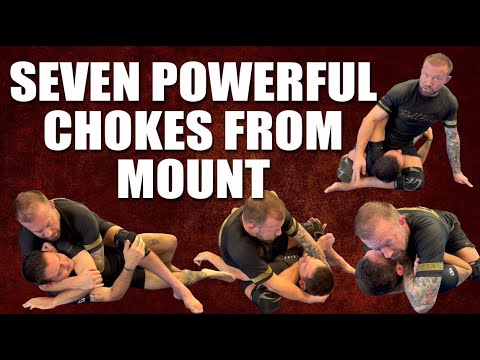
These are seven highly effective chokes from Mount in no gi jiu-jitsu / submission grappling. Why are they so effective?…
Support Brandon Buckingham's recovery - https://www.gofundme.com/f/support-brandon-buckinghams-medical-recovery ● Lear…
The short choke is a back-control submission executed from a dominant rear position with hooks and seat-belt grip control. Jordan Squires demonstrates the foundational mechanics: from rear control, the top hand runs fingers along the opponent's jawline while tilting the forearm underneath the neck to grip the far shoulder, then the bottom hand is withdrawn and the same shoulder is pushed forward to deepen arm penetration. The hands then establish a palm-to-palm grip (top hand palm-down, bottom hand palm-up) with the goal of positioning the elbow in the center of the opponent's back. Squires emphasizes a critical detail credited to Professor Rick Young: clamping the elbow downward toward the opponent's chest as if driving through it, combined with head pressure and leg kicks, significantly increases choke effectiveness. Squires notes the short choke transitions seamlessly to the rear naked choke (which uses a bicep-and-hand-behind-head grip instead) and vice versa—if the rear naked choke is defended or the top arm is controlled, the practitioner can revert to the short choke. The Knight Jiu-Jitsu and B-Team transcripts address mounted and leg-lock-adjacent submissions respectively, rather than back-control short chokes, and do not directly contribute technical details about the short choke itself.
Synthesized from 3 instructors
No instructional courses yet for this technique.
Sign in to suggest a course.
Risk of injury to the person this technique is applied to
Compact rear strangle with rapid unconsciousness onset
Skill level needed to execute this technique reliably
Whether this technique is allowed under major competition rule sets
Japanese BJJ community standard katakana transliteration
Japanese BJJ community standard katakana transliteration
Standard katakana transliteration of Western martial arts terminology (外来語) — used in Japanese MMA, boxing, and BJJ communities
Japanese terminology sourced from Japanese BJJ community standard katakana transliteration
grip or squeeze strength, positional control
strong upper body for sustained compression
forearms, biceps, pectorals, core stabilisers
Every move, in any martial art, shares a few universal traits. Mix and match below to pinpoint the right tool — or compare equivalents across styles.
According to Jordan Squires, bend your top hand fingers and run them against the jawline, then tilt your forearms underneath the neck and grab the shoulder. Push the bottom shoulder forward to get your arm deeper, positioning your elbow in front of their chin for a secure choke.
Jordan Squires, citing Professor Rick Young from Scotland, emphasizes clamping your elbow down into the opponent's chest as if trying to push through it—combined with pulling the elbow back, squeezing everything in, pushing your head against theirs, and kicking with your legs.
Jordan Squires explains they link together nicely: if you're not finishing the rear naked choke or your opponent grabs your top arm, you can pull your hand back and transition into the short choke from the same back control position.
Jordan Squires recommends placing your chin on the opponent's shoulder to maintain control before executing the choke.
The short choke is a compact rear strangle variation where the attacker uses a shallow grip — often just the forearm across the side of the neck targeting the carotid, with a palm-to-palm or fist grip — rather than the deep figure-four of the standard RNC. The 'short' refers to the abbreviated grip configuration that requires less arm length threaded around the neck.
The short choke emerged in competitive grappling as a pragmatic solution to modern chin-tuck defenses against the standard RNC. While abbreviated rear strangles existed in judo and catch wrestling, the systematized 'short choke' became prominent in no-gi competition during the 2010s, particularly in ADCC and EBI formats.
IBJJF: legal — Legal at all belt levels, gi and no-gi — chokes are the safest submission cat…; IJF: legal — Legal (shime-waza) — strangulation techniques are one of three permitted subm…; ADCC: legal — Legal; Unified MMA: legal — Legal — choke submissions are among the most common finishes in MMA; FIAS Sport Sambo: banned — All chokes prohibited in Sport Sambo; FIAS Combat Sambo: legal — Legal
Danger rating 8/10. Very High — compact rear strangle with rapid unconsciousness onset
The standard setup chain: Achieve Controlling Position → Isolate the Neck → Set the Grip → Apply Pressure.
Standard counters include: Tuck Chin — protect the neck by lowering the chin to prevent the choke from sinking / Two-on-One Grip Fight — use both hands to strip the choking grip before it locks / Turn Into — rotate toward the choking arm to relieve carotid pressure / Posture Up — straighten the spine and create distance to break the choking angle.
Common variants: Standard grip variation (primary hand configuration for maximum choking pressure); Gi variation (uses the lapel or collar as an anchor for additional fric…); No-gi variation (adapted grip and positioning for submission grappling wit…); Transition finish (applied during a positional change to catch the opponent …).
Appears in MMA and submission wrestling when the standard RNC wrap is defended. Less common in gi competition where collar chokes are preferred from the back.
Top errors to watch for: Pressing into the trachea rather than the lateral neck — the short choke targets the carotid artery on the side of th… / Not using the support hand to drive the head into the forearm — the compression requires the head being pushed into t… / Attempting from too far away — the short choke requires close body contact; separation reduces the forearm pressure / Not maintaining back hooks — the opponent will try to turn toward the choking arm; hooks prevent the escape.
The Short Choke is also known as Shōto Chōku, Short RNC, Forearm Short Choke, Abbreviated Rear Choke.