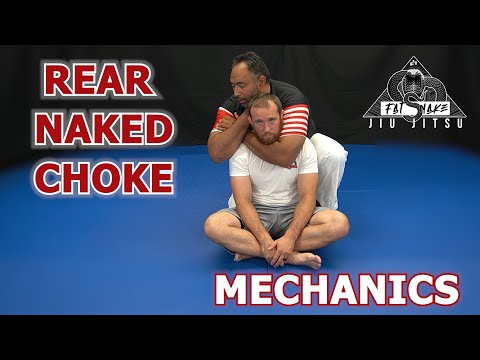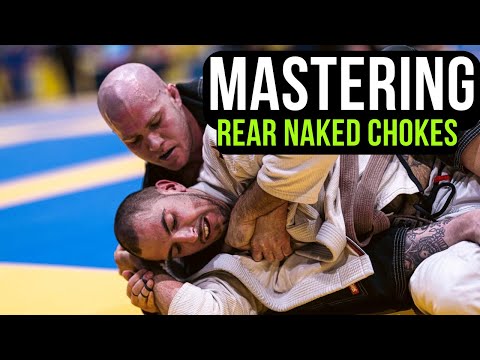
How to do a Rear Naked Choke | BJJ
0
Rear Choke·Stay Safe Martial Arts
In this video, I discuss a few variations of the Rear Naked Choke (RNC) that I like to utilize both in training and comp…
Translation: Bare Strangle
The rear choke subfamily encompasses all no-gi strangles applied from behind the opponent without using collar or lapel grips. [1],[2] The rear naked choke (hadaka-jime) is the defining technique: from back control, the attacker slides one arm under the opponent's chin and across the front of the throat, places the choking hand on the opposite bicep, and uses the free hand behind the opponent's head to push it forward into a figure-four compression of both carotid arteries. [1],[2],[3] Variations include the one-arm rear naked choke (finishing with only the choking arm), the short choke (a compact version using less arm length), and the arm-triangle rear naked crossover (incorporating the opponent's trapped arm). [1] The rear naked choke is widely regarded as the highest-percentage submission in all of grappling and mixed martial arts due to the dominant positional control from which it is applied. [1],[4]
The rear naked choke has ancient origins across multiple martial traditions. In judo, hadaka-jime (裸絞め, 'naked strangle') was codified by the Kodokan as a fundamental shime-waza. [2],[3] The technique appears in historical European wrestling manuals and was practiced in pankration. [4] Mitsuyo Maeda brought judo strangles to Brazil, where the Gracie family refined the rear naked choke as the premier finishing technique from back control. [1] In MMA, the rear naked choke has consistently been the most common submission finish since the early UFC era, with fighters like Royce Gracie demonstrating its effectiveness against larger opponents. [1],[5]
Rear chokes from back control are the highest-percentage finishing position in grappling, as the opponent cannot see the attacker's hands and has limited defensive options against the choking arm sliding across the front of the throat. [1]
Rear chokes derive from judo's shimewaza and were central to the BJJ system developed by the Gracie family. [1]
Rear chokes are the most common submission category in UFC history. [1]
No images yet for this technique.
Sign in to suggest an image.
In this video, I discuss a few variations of the Rear Naked Choke (RNC) that I like to utilize both in training and comp…
Does your Rear Naked Choke suck? Do you lock your arms, squeeze with everything you’ve got, and still end up exhausted w…
No instructional courses yet for this technique.
Sign in to suggest a course.
Risk of injury to the person this technique is applied to
Rear chokes are among the highest-percentage finishes; back control limits defensive options
Skill level needed to execute this technique reliably
Whether this technique is allowed under major competition rule sets
Kodokan Judo — Hadaka-jime
Japanese terminology sourced from Kodokan Judo — Hadaka-jime
Official Kodokan ground technique classification system
Standard Japanese martial arts terminology (kanji/hiragana)
Established Japanese martial arts naming convention — native Japanese term (和語/漢語)
Japanese terminology sourced from Kodokan Judo — Hadaka-jime
hip flexibility, long legs relative to torso
longer limbs for easier figure-four lock around head and arm
hip adductors, hamstrings, quadriceps
Every move, in any martial art, shares a few universal traits. Mix and match below to pinpoint the right tool — or compare equivalents across styles.
The arm triangle rear naked crossover combines elements of the rear naked choke and arm triangle by trapping the opponent's arm alongside their neck while the choking arm threads across the front of the throat from back control, then using the figure-four grip to compress the neck and trapped arm together. [1,2] Unlike the standard RNC where the arm is excluded, this variation deliberately includes the opponent's arm as a wedge against one carotid artery. [1] The crossover aspect refers to the choking arm threading across to the opposite side of the neck. [1,3]
The one-arm rear naked choke is a variation where the attacker finishes the strangle using only the choking arm without the standard figure-four reinforcement from the second arm. [1,2] The choking arm wraps around the opponent's neck under the chin with the bicep and forearm targeting the carotid arteries on the sides of the neck rather than the trachea, and the attacker creates compression on the opposite carotid using a structural anchor — pinning the opponent's shoulder, posting against their own shoulder or hip, or using a rotational scoop with the radius bone. [1] This variation is used when the second arm is occupied controlling the opponent's body or when the figure-four grip cannot be established due to defensive hand-fighting. [1,3]
The short choke is a compact rear strangle variation where the attacker uses a shallow grip — often just the forearm across the side of the neck targeting the carotid, with a palm-to-palm or fist grip — rather than the deep figure-four of the standard RNC. [1,2] The 'short' refers to the abbreviated grip configuration that requires less arm length threaded around the neck. [1] This makes it effective for attackers with shorter arms or when the opponent's chin defense prevents deep arm insertion. [1,3]
The standard rear naked choke (hadaka-jime) is one of the most fundamental and highest-percentage rear strangles in grappling. [1,2] From back control, the attacker wraps one arm around the opponent's neck under the chin, with the bicep and forearm targeting the carotid arteries on the sides of the neck rather than the trachea, places the choking hand on the opposite bicep, and secures the free hand behind the opponent's head; the finish comes from compressing both elbows inward (and, in some teachings, pressing the head forward into the choke), squeezing to compress both carotid arteries simultaneously. [1,2,3] The figure-four arm configuration creates a mechanical advantage that requires minimal strength to produce unconsciousness, typically within 5–10 seconds of a fully locked choke. [1,4] It is applicable in both gi and no-gi contexts. [1]
Avoid placing your hand on top of the head, as this is a primary defense point where your opponent can easily pull your arm down. Instead, use your knuckles against the back of the head, which allows you to position your hand farther back and makes the choke harder to defend.
Never wrap your arm completely around the neck; instead, pass your elbow over your first hand's wrist to create a secure triangle lock. Fat Snake Jiu Jitsu emphasizes that wrapping around exposes you to a two-on-one grip where your opponent can break your arm.
If your opponent pulls your choking arm down, you lose control of that arm and must either get it back up immediately or switch hands. Stay Safe Martial Arts recommends not going into the choke with the mindset of finishing it right away, but instead applying steady pressure and letting your opponent hand-fight before capitalizing on openings.
Keep your fingers visible on your secondary hand as it comes around, then pass your elbow over your first hand's wrist to create a triangle. Fat Snake Jiu Jitsu emphasizes hiding your arm so your opponent doesn't see the second hand coming, allowing you to secure the position before they can defend it.
The rear choke subfamily encompasses all no-gi strangles applied from behind the opponent without using collar or lapel grips. The rear naked choke (hadaka-jime) is the defining technique: from back control, the attacker slides one arm under the opponent's chin and across the front of the throat, places the choking hand on the opposite bicep, and uses the free hand behind the opponent's head to push it forward into a figure-four compression of both carotid arteries.
The rear naked choke has ancient origins across multiple martial traditions. In judo, hadaka-jime (裸絞め, 'naked strangle') was codified by the Kodokan as a fundamental shime-waza.
IBJJF: legal — Legal at all belt levels, gi and no-gi — chokes are the safest submission cat…; IJF: legal — Legal (shime-waza) — strangulation techniques are one of three permitted subm…; ADCC: legal — Legal; Unified MMA: legal — Legal — choke submissions are among the most common finishes in MMA; FIAS Sport Sambo: banned — All chokes prohibited in Sport Sambo; FIAS Combat Sambo: legal — Legal
Danger rating 9/10. Rear chokes are among the highest-percentage finishes; back control limits defensive options
The standard setup chain: Achieve Controlling Position → Isolate the Neck → Set the Grip → Apply Pressure.
Standard counters include: Tuck Chin — protect the neck by lowering the chin to prevent the choke from sinking / Two-on-One Grip Fight — use both hands to strip the choking grip before it locks / Turn Into — rotate toward the choking arm to relieve carotid pressure / Posture Up — straighten the spine and create distance to break the choking angle.
Common variants: Short choke (palm-to-palm grip) (compact grip for tight spaces when the chin is partially …); Gable grip RNC (interlocked fingers behind the head for maximum squeeze p…); Body triangle RNC (adds body triangle control for stronger hip management du…); One-arm RNC (single arm under the chin when the second arm cannot reac…).
Rear chokes are the most common submission category in UFC history.
Top errors to watch for: Jumping to the choke without establishing back control — secure the hooks and seatbelt before attempting any rear choke / Crossing the ankles in back control — crossed ankles are vulnerable to ankle locks; use hooks or body triangle instead / Not controlling the opponent's defensive hands — the opponent's hands will fight the choking arm; use the free hand t… / Squeezing the choke with the arms only — the choke uses the expansion of the chest (deep breath) combined with the sq….
The Rear Choke is also known as Hadaka-jime, Rear Naked Choke Family, RNC.