How to do the Rear Naked Choke in Jiu Jitsu | Jiu Jitsu Tutorial | BJJ Lessons
0
Standard Rear Naked Choke·Matt Arroyo Jiu Jitsu
Join My Online Academy to Improve Your Jiu Jitsu FAST!!! https://www.skool.com/mattarroyojiujitsu/about Looking to MAS…
Translation: Bare Strangle
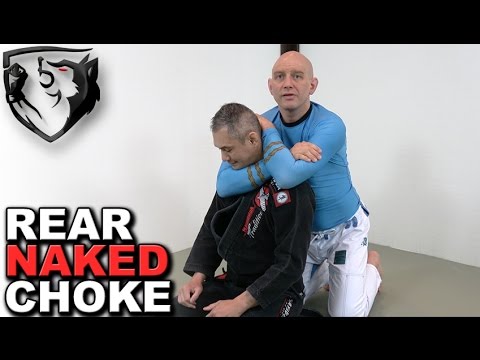
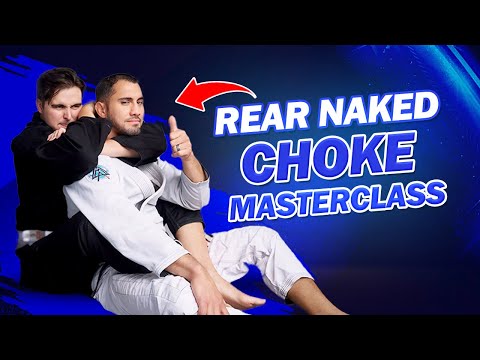
The standard rear naked choke (hadaka-jime) is one of the most fundamental and highest-percentage rear strangles in grappling. [1],[2] From back control, the attacker wraps one arm around the opponent's neck under the chin, with the bicep and forearm targeting the carotid arteries on the sides of the neck rather than the trachea, places the choking hand on the opposite bicep, and secures the free hand behind the opponent's head; the finish comes from compressing both elbows inward (and, in some teachings, pressing the head forward into the choke), squeezing to compress both carotid arteries simultaneously. [1],[2],[3] The figure-four arm configuration creates a mechanical advantage that requires minimal strength to produce unconsciousness, typically within 5–10 seconds of a fully locked choke. [1],[4] It is applicable in both gi and no-gi contexts. [1]
Hadaka-jime (裸絞め, 'naked strangle') was codified in Kodokan Judo's shime-waza curriculum as a strangle requiring no gi fabric. [2],[3] The technique has parallels in pankration, historical wrestling, and military combatives across multiple cultures. [4] Mitsuyo Maeda transmitted judo's strangulation methods to Brazil, where the Gracie family refined the RNC as the definitive back control finish. [1] In the UFC and modern MMA, the rear naked choke is consistently the most common submission finish. [1],[5]
The rear naked choke is widely regarded as the single highest-percentage submission in grappling and MMA. [1] When fully locked with correct figure-four mechanics, bilateral carotid compression produces unconsciousness in 5–10 seconds; defensive options are extremely limited once the choking arm clears the chin. [2],[3] John Danaher identifies the RNC as the most reliable finishing hold across all grappling rulesets, attributing its dominance to the mechanical advantage of the figure-four configuration and the difficulty of late-stage escapes. [4] In self-defence contexts, U.S. Army Combatives (FM 3-25.150) classifies the RNC as a primary lethal/controlling technique. [5]
The strangle was codified in Kodokan Judo's shime-waza syllabus by Jigoro Kano as hadaka-jime ('bare strangle'). [1] Mitsuyo Maeda brought judo's strangling methods to Brazil circa 1914; the Gracie family — particularly Hélio and later Rolls Gracie — refined back-control mechanics and the 'mata leão' finish as a centrepiece of Gracie Jiu-Jitsu. [2],[3] In modern grappling, Marcelo Garcia's no-gi competitive record elevated the one-arm/'short choke' variation, while John Danaher's systematised back-attack system (taught at Renzo Gracie Academy, later at New Wave Jiu-Jitsu) produced a generation of competitors who made the RNC their primary weapon — notably Gordon Ryan and Garry Tonon. [4],[5]
The RNC is the most common submission finish in UFC history, accounting for approximately 29% of all submission victories through 2024. [1] Notable UFC finishes include Royce Gracie's wins at UFC 1–4 (1993–1994), which introduced the technique to mainstream audiences. [2] In ADCC competition, Marcelo Garcia secured multiple titles using the RNC as his primary finish (2003, 2005, 2007, 2009). [3] The technique also dominates EBI overtime formats, where back control and the RNC are statistically the leading finish. [4] In judo (IJF), hadaka-jime remains a legal and frequently applied ne-waza submission at Olympic and World Championship level. [5]
No images yet for this technique.
Sign in to suggest an image.
Join My Online Academy to Improve Your Jiu Jitsu FAST!!! https://www.skool.com/mattarroyojiujitsu/about Looking to MAS…
Here's a great BJJ tutorial from Stephan Kesting, who teaches how to properly apply a rear naked choke and make it extre…
Ready to finish fights faster? Level up your ground game with a FREE custom 14-day Jiu-Jitsu training plan – take the su…
The rear naked choke is widely recognized as the most common and effective submission in Brazilian jiu-jitsu and MMA due to its biomechanical efficiency in occluding the carotid arteries and reducing blood flow to the brain. Matt Arroyo Jiu Jitsu emphasizes that the technique works by cutting off both carotid arteries, rendering unconsciousness in 6–8 seconds with proper application. The standard setup involves wrapping one arm around the opponent's neck with the elbow positioned directly under the chin, while the free hand grabs the bicep or shoulder area, then hooks behind the head as low as possible before clasping. Both Matt Arroyo Jiu Jitsu and fightTIPS (Stephen Kesting) agree on core mechanics: the elbow must be under the chin rather than on the throat, avoiding a painful air choke in favor of a blood choke. Finishing requires three synchronized motions—pushing the elbow down into the chest, bringing the elbows together, and making a muscle while applying steady pressure. Arroyo stresses maintaining 60–70% pressure sustainably rather than maximal squeezing, and positioning the head against the opponent's head to prevent hand escape. fightTIPS adds the detail of the thumb-up hand position behind the head, making it harder to dislodge, and emphasizes that the forearm must align with the opponent's nose and chin to target the arteries effectively. Both instructors address common defensive scenarios: Arroyo details breaking the baseball bat grip and using an underhook leg trap, while fightTIPS describes the shoulder-grab-to-hand-clasp progression. TRITAC Martial Arts takes a different angle, focusing on escapes rather than application, covering throws and positional reversals. All three sources agree the technique is exceptionally reliable across skill levels when mechanically sound.
Synthesized from 3 instructors
No instructional courses yet for this technique.
Sign in to suggest a course.
Risk of injury to the person this technique is applied to
The rear naked choke is the single most effective submission in MMA competition history
Skill level needed to execute this technique reliably
Whether this technique is allowed under major competition rule sets
Kodokan Judo — Hadaka-jime
Japanese terminology sourced from Kodokan Judo — Hadaka-jime
Alias sources — [1] Kodokan Judo (Kano, 1986) [2] Brazilian Portuguese BJJ terminology [3] Common MMA abbreviation
Official Kodokan ground technique classification system
Standard Japanese martial arts terminology (kanji/hiragana)
Established Japanese martial arts naming convention — native Japanese term (和語/漢語)
Japanese terminology sourced from Kodokan Judo — Hadaka-jime
Alias sources — [1] Kodokan Judo (Kano, 1986) [2] Brazilian Portuguese BJJ terminology [3] Common MMA abbreviation
upper body squeeze strength, bicep/forearm endurance
shorter, thicker arms for tighter squeeze
biceps, forearms, pectorals, deltoids
Every move, in any martial art, shares a few universal traits. Mix and match below to pinpoint the right tool — or compare equivalents across styles.
According to Matt Arroyo Jiu Jitsu, use your dominant arm around the neck with your elbow under the chin, ensuring the elbow pit (the skin between your forearm and bicep) touches the opponent's neck with no space. Your other hand grabs the bicep-to-shoulder area, then hooks under the head as low as possible, and you complete the grip by grabbing your own shoulder.
Matt Arroyo Jiu Jitsu recommends three simultaneous motions: push your elbow down into the opponent's chest like giving CPR, bring your elbows together to close them, and make a muscle while applying steady pressure. Pair this with placing your head against theirs to block them from grabbing your hand, and take a deep breath to expand your chest and drive them deeper into the choke.
Matt Arroyo Jiu Jitsu identifies several mistakes: not getting a full grip on the bicep (fingers only instead of wrist and hand), leaving the top hand too high where it can be easily pulled off, lifting upward instead of pressing the elbow downward into the chest, and squeezing at maximum effort then releasing rather than maintaining steady 60-70% pressure for 10-15 seconds.
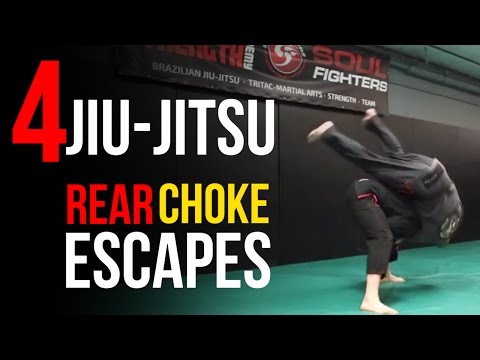
According to TRITAC Martial Arts, the type of defense you use depends on the opponent's response—options include dropping your hips to defend initially, using Osoto Gari or Judolock escape techniques, and as a last resort, performing a sacrifice throw by sitting to your hip and rolling them over the top.
The standard rear naked choke (hadaka-jime) is one of the most fundamental and highest-percentage rear strangles in grappling. From back control, the attacker wraps one arm around the opponent's neck under the chin, with the bicep and forearm targeting the carotid arteries on the sides of the neck rather than the trachea, places the choking hand on the opposite bicep, and secures the free hand behind the opponent's head; the finish comes from compressing both elbows inward (and, in some teachings, pressing the head forward into the choke), squeezing to compress both carotid arteries simultaneously.
Hadaka-jime (裸絞め, 'naked strangle') was codified in Kodokan Judo's shime-waza curriculum as a strangle requiring no gi fabric. The technique has parallels in pankration, historical wrestling, and military combatives across multiple cultures.
IBJJF: legal — Legal at all belt levels, gi and no-gi — chokes are the safest submission cat…; IJF: legal — Legal (shime-waza) — strangulation techniques are one of three permitted subm…; ADCC: legal — Legal; Unified MMA: legal — Legal — choke submissions are among the most common finishes in MMA; FIAS Sport Sambo: banned — All chokes prohibited in Sport Sambo; FIAS Combat Sambo: legal — Legal
Danger rating 9/10. The rear naked choke is the single most effective submission in MMA competition history
The standard setup chain: Achieve Controlling Position → Isolate the Neck → Set the Grip → Apply Pressure.
Standard counters include: Tuck Chin — protect the neck by lowering the chin to prevent the choke from sinking / Two-on-One Grip Fight — use both hands to strip the choking grip before it locks / Turn Into — rotate toward the choking arm to relieve carotid pressure / Posture Up — straighten the spine and create distance to break the choking angle.
Common variants: Short choke (palm-to-palm grip) (compact grip for tight spaces when the chin is partially …); Gable grip RNC (interlocked fingers behind the head for maximum squeeze p…); Body triangle RNC (adds body triangle control for stronger hip management du…); One-arm RNC (single arm under the chin when the second arm cannot reac…).
The RNC is the most common submission finish in UFC history, accounting for approximately 29% of all submission victories through 2024. Notable UFC finishes include Royce Gracie's wins at UFC 1–4 (1993–1994), which introduced the technique to mainstream audiences.
Top errors to watch for: Rushing the choke without winning the hand fight — if the opponent's defensive grips are intact, the arm cannot get u… / Not maintaining back control during the hand fight — the opponent will escape if the hooks and chest-to-back contact … / Squeezing before the figure-four is locked — the figure-four structure must be complete before applying force; premat… / Placing the hand behind the head too early — the rear hand pushes the head forward only after the choking arm reaches….
The Standard Rear Naked Choke is also known as Hadaka-jime, Mata Leão, RNC.
Do not try to force under the chin — this wastes energy. Instead: (1) Apply the choke over the chin. The jaw will compress their own neck, and they will either tap from pain or eventually open up. (2) Use your free hand to peel their chin up by pushing on their forehead. (3) Shift to a short choke (forearm across the throat) which does not require getting under the chin.
The classic RNC grip: choking arm's hand grabs the bicep of the other arm, the free hand goes behind their head and pushes forward. This creates a complete seal around the neck. Alternative: the 'Gable grip RNC' where you palm-to-palm grip behind their neck for a quick squeeze — less technical but effective when you cannot secure the classic grip.
The seatbelt grip (one arm over the shoulder, one under the armpit) is your foundation. From here, insert hooks one at a time — near hook first, then fall to the hook side to create access for the far hook. Once both hooks are in, the choking arm is the arm that goes over the shoulder. Start working under the chin immediately — the longer you wait, the more they defend.
Three reasons: (1) It attacks the carotid arteries bilaterally — unconsciousness in 8-12 seconds regardless of the opponent's size or strength. (2) From back control, the opponent has zero offensive options — they can only defend. (3) It does not require flexibility, long limbs, or specific body type — anyone can finish it. Competition data shows the RNC has the highest finish rate of any submission across all major organizations.