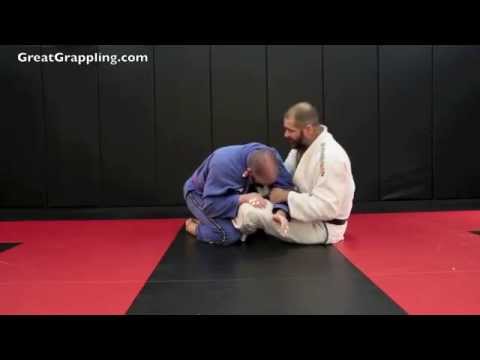
Lapel Choke from Butterfly Guard
0
Lapel Feed Rear Choke·Great Grappling
Here is one of the things that I've been using a lot lately. After looking at the video I've realized that I should hav…
Translation: lapel feed rear strangle
Lapel feed rear chokes involve pulling, threading, or feeding the opponent's lapel (or the attacker's own lapel) around the neck from back control to create a choking loop. [1],[2] Unlike standard cross-collar grips, lapel feed techniques use the extra length of gi fabric as a noose or lever, often wrapping it under the chin and back through the collar to maximize compression distance. [1] The bow-and-arrow choke is the most well-known technique in this subfamily — the attacker feeds the lapel across the neck while gripping the opponent's pants to create opposing forces that tighten the strangle. [1],[2] Gift wrap and lapel tail feed variations offer alternative fabric routing for different back control configurations. [1],[3]
Lapel feeding from the back evolved from classical judo collar strangles where practitioners discovered that using extended fabric created stronger mechanical leverage than simple cross-grips. [2],[3] The bow-and-arrow choke became a signature technique in Brazilian Jiu-Jitsu competition during the 1990s and 2000s, prized for its near-inescapable finish once fully locked. [1] Modern competitors have developed increasingly creative lapel feed routes, including wrapping the lapel through the legs or around the torso before applying the choke. [1],[4]
The lapel feed rear choke threads the lapel from the back to create a powerful collar strangle. [1]
Lapel feed techniques from back control were refined in BJJ competition where gi grips provide additional control. [1]
Lapel feed rear chokes are a common finish from back control in gi BJJ competition. [1]
No images yet for this technique.
Sign in to suggest an image.
Here is one of the things that I've been using a lot lately. After looking at the video I've realized that I should hav…
No instructional courses yet for this technique.
Sign in to suggest a course.
Risk of injury to the person this technique is applied to
Lapel feed chokes from back control use gi material to create a cable-like strangle
Skill level needed to execute this technique reliably
Whether this technique is allowed under major competition rule sets
Kodokan Judo — Official Katame-waza Classification
Judo okuri (送り = feeding/sliding) terminology
Standard Japanese martial arts terminology (kanji/hiragana)
Established Japanese martial arts naming convention — native Japanese term (和語/漢語)
Judo okuri (送り = feeding/sliding) terminology
grip or squeeze strength, positional control
strong upper body for sustained compression
forearms, biceps, pectorals, core stabilisers
Every move, in any martial art, shares a few universal traits. Mix and match below to pinpoint the right tool — or compare equivalents across styles.
The bow-and-arrow choke is a powerful back control strangle where the attacker grips the opponent's collar with one hand and their pants or far leg with the other, then extends the body to create opposing forces that tighten the collar across the neck. [1,2] The name comes from the finishing position, which resembles drawing a bow — one arm pulls the collar while the other pulls the leg in the opposite direction. [1] It is commonly entered from back mount by feeding the collar grip deep, securing a hand grip on the far leg or pants, and then falling to the side while extending. [1,3]
The gift wrap lapel choke uses a controlling position where the attacker wraps the opponent's own arm across their head or body and pins it there, then feeds the lapel around the neck to create a strangle. [1,2] The 'gift wrap' refers to trapping the opponent's arm by threading it across themselves — this eliminates one defensive hand and exposes the neck for the lapel feed. [1] The attacker then routes the collar around the neck and tightens from back control or side control. [1,3]
The lapel tail feed choke involves pulling out the tail end of the opponent's gi lapel and threading it around their neck from back control to create a noose-like strangle. [1,2] Unlike standard collar grips that use the fabric already near the neck, the lapel tail feed uses the loose end of the belt-area fabric, which provides extra length for creative routing around the throat. [1] The extended fabric can be passed hand-to-hand, threaded under the chin, or looped through the collar to create various choking configurations. [1,3]
Instead of relying solely on hand grip, keep your shoulder dropped over the top of your opponent's shoulder. This allows you to apply pressure with your body weight rather than exhausting your grip.
Orient your wrist so it points out to the side rather than bent inward. If there's a contour in the wrist, you won't achieve the choke properly.
When your opponent brings their hands up to defend, grab the sleeve and pull that arm across their body while dropping your shoulder over the top of their shoulder to control the position.
You have multiple finishing options from the same position—you can adjust the angle of their trapped arm and finish from a different angle, giving you multiple tapping opportunities.
Lapel feed rear chokes involve pulling, threading, or feeding the opponent's lapel (or the attacker's own lapel) around the neck from back control to create a choking loop. Unlike standard cross-collar grips, lapel feed techniques use the extra length of gi fabric as a noose or lever, often wrapping it under the chin and back through the collar to maximize compression distance.
Lapel feeding from the back evolved from classical judo collar strangles where practitioners discovered that using extended fabric created stronger mechanical leverage than simple cross-grips. The bow-and-arrow choke became a signature technique in Brazilian Jiu-Jitsu competition during the 1990s and 2000s, prized for its near-inescapable finish once fully locked.
IBJJF: legal — Legal at all belt levels, gi and no-gi — chokes are the safest submission cat…; IJF: legal — Legal (shime-waza) — strangulation techniques are one of three permitted subm…; ADCC: restricted — N/A (no-gi competition only — technique requires gi); Unified MMA: restricted — N/A (technique requires gi — not applicable in MMA); FIAS Sport Sambo: banned — All chokes prohibited in Sport Sambo; FIAS Combat Sambo: legal — Legal
Danger rating 8/10. Lapel feed chokes from back control use gi material to create a cable-like strangle
The standard setup chain: Achieve Controlling Position → Isolate the Neck → Set the Grip → Apply Pressure.
Standard counters include: Tuck Chin — protect the neck by lowering the chin to prevent the choke from sinking / Two-on-One Grip Fight — use both hands to strip the choking grip before it locks / Turn Into — rotate toward the choking arm to relieve carotid pressure / Posture Up — straighten the spine and create distance to break the choking angle.
Common variants: Standard grip variation (primary hand configuration for maximum choking pressure); Gi variation (uses the lapel or collar as an anchor for additional fric…); No-gi variation (adapted grip and positioning for submission grappling wit…); Transition finish (applied during a positional change to catch the opponent …).
Lapel feed rear chokes are a common finish from back control in gi BJJ competition.
Top errors to watch for: Not feeding enough lapel length — the lapel must be long enough to cross the full width of the neck and be gripped on… / Feeding the lapel too high (across the face) — the lapel must cross the throat for a choke; across the face is a crank / Losing control of the lapel end during the feed — the lapel end can be slippery; maintain a firm grip throughout the … / Not maintaining back control — the lapel feed requires patience; don't sacrifice position.
The Lapel Feed Rear Choke is also known as Eri Okuri Ushiro-jime, Lapel Feed Choke, Rear Lapel Choke, Eri-jime variants.