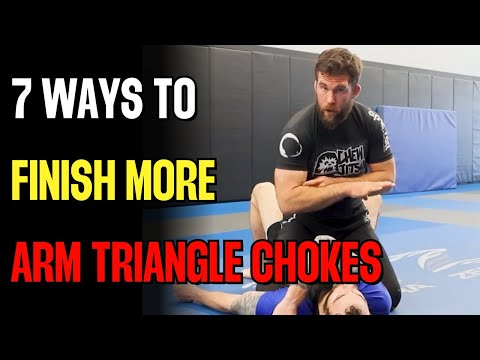
7 Ways to Finish Arm Triangle Chokes Like a Black Belt in BJJ
0
Arm Triangle Choke — From Guard – Collar Grip·Chewjitsu
Today's video is going to be a breakdown of the Arm Triangle Submission in Brazilian Jiu-Jitsu & MMA and how I would mak…
Translation: Shoulder Hold / Arm-and-Head Lock — From Guard – Collar Grip
A collar-grip variation of the arm triangle choke applied from the guard position. The attacker uses one hand to grip the opponent’s collar (gi) while trapping the head and arm, anchoring the choke and increasing shoulder pressure. The hips are pivoted and angled to the side, with the collar grip used to pull the opponent’s posture down while compressing the carotid arteries.
Developed in gi-based grappling arts such as Judo and Brazilian Jiu-Jitsu to enhance control from guard when applying the arm triangle.
The collar grip arm triangle is effective in gi grappling, using the lapel as an additional anchor to maintain head position and increase compression on the trapped side. [1]
The collar-grip arm triangle from guard adds gi gripping to enhance the squeeze from the bottom position. [1]
Collar-grip arm triangles from guard are used in gi BJJ competition at IBJJF events. [1]
No images yet for this technique.
Sign in to suggest an image.
Today's video is going to be a breakdown of the Arm Triangle Submission in Brazilian Jiu-Jitsu & MMA and how I would mak…
No instructional courses yet for this technique.
Sign in to suggest a course.
Risk of injury to the person this technique is applied to
Can render unconscious quickly; requires careful training and fast tap awareness.
Skill level needed to execute this technique reliably
Whether this technique is allowed under major competition rule sets
Kodokan Judo — Official Katame-waza Classification (肩固め Kata-gatame)
Japanese terminology sourced from Kodokan Judo — Official Katame-waza Classification (肩固め Kata-gatame)
Official Kodokan ground technique classification system
Established Japanese martial arts naming convention — native Japanese term (和語/漢語)
Japanese terminology sourced from Kodokan Judo — Official Katame-waza Classification (肩固め Kata-gatame)
hip flexibility, long legs relative to torso
longer limbs for easier figure-four lock around head and arm
hip adductors, hamstrings, quadriceps
Often chained after failed collar choke or as a transition from lapel control in guard.
Chewjitsu explains that when your palm is up, there's a natural gap of space in the choke, but when you turn your palm down, you eliminate that gap and make the choke significantly tighter.
Instead of placing your shoulder underneath the chin, position it on the jaw itself to create proper pressure on the neck.
Chewjitsu emphasizes keeping an angle by bringing your head to your opponent's head and maintaining good positioning; many students make the mistake of positioning themselves flat on the side, which reduces mechanical advantage.
No—continue to breathe through the movement and avoid holding your breath, which prevents you from gassing yourself out and maintains strength throughout the entire submission.
A collar-grip variation of the arm triangle choke applied from the guard position. The attacker uses one hand to grip the opponent’s collar (gi) while trapping the head and arm, anchoring the choke and increasing shoulder pressure.
Developed in gi-based grappling arts such as Judo and Brazilian Jiu-Jitsu to enhance control from guard when applying the arm triangle.
Danger: 9/10 | Can render unconscious quickly; requires careful training and fast tap awareness.
The standard setup chain: closed guard with gi → Secure deep collar grip with one hand, trap opponent’s arm, pivot hips, and lock head-and-arm position while pulling with collar grip → Achieve Controlling Position → Isolate the Neck → Set the Grip.
Standard counters include: Tuck Chin — protect the neck by lowering the chin to prevent the choke from sinking / Two-on-One Grip Fight — use both hands to strip the choking grip before it locks / Turn Into — rotate toward the choking arm to relieve carotid pressure / Posture Up — straighten the spine and create distance to break the choking angle.
Common variants: Deep cross-collar grip (feed the hand deep past the label to the far collar for m…); Shallow collar grip (grip the near side of the collar for a faster setup but w…); Four-finger pistol grip (insert four fingers inside the collar with thumb outside …); Baseball-bat double collar grip (add a second hand to the collar for maximum pulling power…).
Collar-grip arm triangles from guard are used in gi BJJ competition at IBJJF events.
Top errors to watch for: Shallow collar grip / Failing to secure opponent’s arm / Insufficient hip angle / Over-pulling instead of compressing laterally.
The Arm Triangle Choke — From Guard – Collar Grip is also known as Kata Gatame — From Guard – Collar Grip, Collar Grip Arm Triangle from Guard, Collar Grip Guard Kata Gatame, Collar Grip Head-and-Arm Choke from Guard.