7 Ways to Finish Arm Triangle Chokes Like a Black Belt in BJJ
0
Arm Triangle Choke — From Guard·Chewjitsu
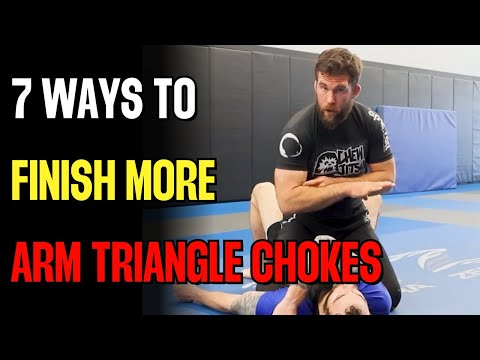
Today's video is going to be a breakdown of the Arm Triangle Submission in Brazilian Jiu-Jitsu & MMA and how I would mak…
Translation: Shoulder Hold / Arm-and-Head Lock — From Guard
A head-and-arm choke applied from the guard position, where the attacker traps the opponent’s arm and head between their own arm and torso. The attacker pivots their hips and angles to the side to compress the opponent’s carotid arteries using the shoulder and opponent’s own arm. Effective when transitioning from failed triangle choke or armbar attempts.
Adaptation of Kata Gatame for use from the guard, popularized in BJJ as a counter to posture breaks and failed submissions.
The arm triangle from guard bottom uses the legs and arms to create a head-and-arm strangle configuration from below. [1]
Guard-bottom arm triangles are used in BJJ competition, though less common than from top positions. [1]
No images yet for this technique.
Sign in to suggest an image.
Today's video is going to be a breakdown of the Arm Triangle Submission in Brazilian Jiu-Jitsu & MMA and how I would mak…
Get my New Course the GUARD ATTACK BLUEPRINT and learn to DOMINATE from the closed guard! https://guardattackblueprint.…
The arm triangle choke from closed guard is a high-percentage submission that requires precise positioning and sequential technical details to execute effectively. All three instructors agree on core mechanical principles: the technique relies on trapping one opponent arm inside the legs while the other arm wraps the neck, creating dual pressure points against the carotid arteries. Chewjitsu emphasizes that the attacking shoulder must be driven underneath the opponent's chin rather than resting on the jaw—a common error that can be corrected by scooting the hips back and diving the shoulder forward. Before dismounting, Chewjitsu stresses achieving maximum arm depth across the face, maintaining a palm-down choking arm orientation to eliminate gaps, and establishing head-to-head contact with the ear near the opponent's ear to maximize shoulder pressure. The dismount itself must occur at an angle with the forehead toward the ground and a driving leg action rather than purely arm squeezing. Matt Arroyo Jiu Jitsu frames the related triangle choke similarly, highlighting the critical need for the knee pit to contact the neck artery and maintaining consistent pressure through leg squeeze rather than muscular arm tension. Brazilian Jiu-Jitsu & Submission Grappling introduces the reverse triangle variant as a defensive adaptation when the opponent resists or stacks, offering better control and access to complementary submissions like the kimura and knee reap. All instructors recommend progressive drilling and partner feedback to refine the technical details that distinguish successful finishes from failed attempts.
Synthesized from 3 instructors
No instructional courses yet for this technique.
Sign in to suggest a course.
Risk of injury to the person this technique is applied to
Can render unconscious quickly; requires careful training and fast tap awareness.
Skill level needed to execute this technique reliably
Whether this technique is allowed under major competition rule sets
Kodokan Judo — Official Katame-waza Classification (肩固め Kata-gatame)
Japanese terminology sourced from Kodokan Judo — Official Katame-waza Classification (肩固め Kata-gatame)
Official Kodokan ground technique classification system
Established Japanese martial arts naming convention — native Japanese term (和語/漢語)
Japanese terminology sourced from Kodokan Judo — Official Katame-waza Classification (肩固め Kata-gatame)
hip flexibility, long legs relative to torso
longer limbs for easier figure-four lock around head and arm
hip adductors, hamstrings, quadriceps
Every move, in any martial art, shares a few universal traits. Mix and match below to pinpoint the right tool — or compare equivalents across styles.
A no-gi variation of the arm triangle choke applied from the closed guard. Without the collar grip, the attacker uses arm positioning and shoulder pressure to trap the opponent’s head and arm. Proper hip angle and shoulder drive close the carotid arteries, making the choke highly effective in no-gi grappling.
A head-and-arm choke applied from the guard position, where the attacker traps the opponent’s arm and head between their own arm and torso. The attacker pivots their hips and angles to the side to compress the opponent’s carotid arteries using the shoulder and opponent’s own arm. Effective when transitioning from failed triangle choke or armbar attempts.
A collar-grip variation of the arm triangle choke applied from the guard position. The attacker uses one hand to grip the opponent’s collar (gi) while trapping the head and arm, anchoring the choke and increasing shoulder pressure. The hips are pivoted and angled to the side, with the collar grip used to pull the opponent’s posture down while compressing the carotid arteries.
A crossface-based variation of the arm triangle choke applied from the guard position. Instead of using a collar grip, the attacker drives a crossface under the opponent’s head, trapping the far arm and head together. The shoulder pressure and hip angle close off the carotid arteries, with the crossface creating strong control and posture break.
A no-gi guard variation of the arm triangle where the attacker first immobilizes the opponent’s arm via wrist control (pinning the wrist to the mat or across the chest). With the wrist anchored, the attacker threads the arm under the head, drives the shoulder across the neck, and angles the hips to compress the carotids. Wrist control prevents the trapped arm from framing or retracting, creating a tighter, more secure finish.
A no-gi variation of the arm triangle choke applied from half guard. The attacker threads their arm under the opponent’s head and traps the far arm, then uses shoulder pressure, chest connection, and hip angling to tighten the choke. The bottom half guard leg is used both to control distance and to maintain leverage until the choke is locked or the guard is transitioned.
Often chained after failed triangle or armbar; useful against strong posture-breaking opponents.
When your palm is up, there's a natural gap of space in the arm triangle. By turning your palm down, you eliminate that gap and make the choke significantly tighter. (Chewjitsu)
Continue to breathe through the movement and don't hold your breath. Maintain steady pressure rather than ripping on the neck, and only apply pressure when you have a good angle to drive through—this conserves energy and prevents burnout. (Chewjitsu)
The arm triangle takes longer to finish than a rear naked choke because you don't have your arm literally wrapped around the opponent's neck. Be patient and maintain pressure rather than expecting an immediate tap. (Chewjitsu)
Bring your head close to your opponent's head and push your shoulder into their neck to apply pressure. Maintain a good angle—avoid sitting flat to the side, as you need an angle to drive pressure effectively. (Chewjitsu)
A head-and-arm choke applied from the guard position, where the attacker traps the opponent’s arm and head between their own arm and torso. The attacker pivots their hips and angles to the side to compress the opponent’s carotid arteries using the shoulder and opponent’s own arm.
Adaptation of Kata Gatame for use from the guard, popularized in BJJ as a counter to posture breaks and failed submissions.
Danger: 9/10 | Can render unconscious quickly; requires careful training and fast tap awareness.
The standard setup chain: Break Posture from Closed Guard → Isolate the Arm Across → Hip Angle and Pivot → Lock the Figure-Four → Squeeze and Finish.
Standard counters include: Posture Recovery — stand up or stack to create distance before the choke locks; the primary defence against any guard… / Arm Extraction (Elbow Push) — push the trapped elbow to the mat and slide the arm free before the figure-four locks / Hand-Fighting the Lock — prevent the attacker from clasping hands by swimming the wrist inside the lock gap / Stack Pass — drive forward and stack the attacker's hips to relieve neck pressure and open a guard pass.
Common variants: Gi collar-grip arm triangle (uses deep cross-collar grip to anchor the head position b…); No-gi wrist-control arm triangle (pins opponent's wrist to the mat to prevent arm extractio…); High-guard arm triangle (locks the choke from a high-guard position with legs clim…); Reverse arm triangle from guard (attacker threads from the opposite side, finishing with a…).
Guard-bottom arm triangles are used in BJJ competition, though less common than from top positions.
Top errors to watch for: Not angling hips enough / Leaving space under the shoulder / Failing to control opponent’s trapped arm / Rushing the choke without proper head-arm seal.
The Arm Triangle Choke — From Guard is also known as Kata Gatame — From Guard, Arm Triangle from Guard, Guard Kata Gatame, Head-and-Arm Choke from Guard.