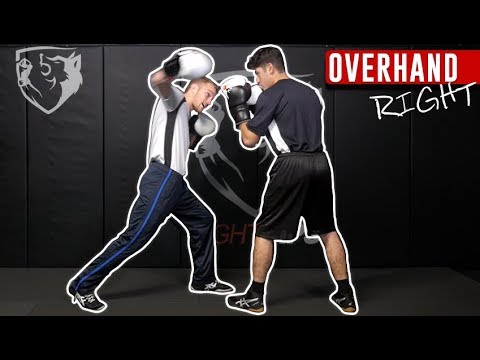
The Correct Way to Throw "The Overhand Right"
0
Overhand Right·fightTIPS·Added by Admin
In this tutorial, Shane covers everything you need to know about the overhand right -- that powerful one-punch knockout …
Translation: overhand right
The overhand right (or overhand left for southpaws) is a looping power punch thrown in a downward arc over the opponent's guard. [1] The overhand has roots in bare-knuckle fighting where wide, sweeping blows were the norm, but it was refined in the modern era as a weapon against taller opponents with high guards. [2] Rocky Marciano's overhand right, nicknamed 'Suzie Q,' became the most famous example of the technique — he used it to compile an undefeated 49-0 record (1947-1955) including his title-winning knockout of Jersey Joe Walcott. [3] Dempsey noted that while the overhand's looping trajectory sacrifices speed and defensive safety, it compensates by attacking an angle that straight punches cannot reach. [1]
The overhand right (or left for southpaws) follows a looping arc over the opponent's guard, making it effective against tall opponents with high guards who are difficult to reach with straight punches. [1] Its arcing trajectory generates substantial rotational force but makes it slower and more telegraphed than the cross. [1]
Rocky Marciano used the overhand right to finish numerous opponents during his undefeated 49-0 career (1947-1955), including his knockout of Jersey Joe Walcott for the heavyweight title. [1] In MMA, Dan Henderson's overhand right knockout of Michael Bisping at UFC 100 (2009) is one of the sport's most iconic moments. [2] Chuck Liddell built his UFC light heavyweight championship reign largely on the effectiveness of his overhand right. [2]
No images yet for this technique.
Sign in to suggest an image.
In this tutorial, Shane covers everything you need to know about the overhand right -- that powerful one-punch knockout …
No instructional courses yet for this technique.
Sign in to suggest a course.
Risk of injury to the person this technique is applied to
Jab/cross; fundamental striking tool, cumulative brain trauma risk
Skill level needed to execute this technique reliably
Whether this technique is allowed under major competition rule sets
Karate-Do Kyohan: The Master Text (Gichin Funakoshi, 1935)
Alias sources — [1] Championship Fighting (Dempsey, 1950) [2] Championship Fighting (Dempsey, 1950)
Effectiveness sources — [1] Championship Fighting (Dempsey, 1950)
Standard katakana transliteration of Western martial arts terminology (外来語) — used in Japanese MMA, boxing, and BJJ communities
Alias sources — [1] Championship Fighting (Dempsey, 1950) [2] Championship Fighting (Dempsey, 1950)
Effectiveness sources — [1] Championship Fighting (Dempsey, 1950)
hand speed, hip rotation, wrist alignment on impact
proportional reach, strong wrists, fast-twitch shoulder muscles
deltoids, pectorals, triceps, core rotators, forearms
According to fightTIPS, this comes down to preference and your fighting style. Boxers and kickboxers like Andy Sauer teach keeping it very direct and straight, similar to a straight right but with your head off the center line. The width of your trajectory depends on what works best for your style.
FightTIPS recommends taking a step with both your front and rear foot rather than just one, as this helps you cover distance and keep your feet underneath you. Avoid taking too wide a base, since a narrow stance allows you to adjust and move quickly if the punch doesn't land.
FightTIPS outlines three primary defenses: lean back to evade the punch, use a helmet guard or gate block to shield your head, or destroy the opponent's forearm by reaching up to block their strike.
According to fightTIPS, the overhand right is one of the most powerful punches you can throw and is known as a potential one-punch knockout, but it must be properly set up using other punches and requires good understanding of distance and timing.
A looping rear-hand punch thrown over the opponent's guard in a slight arc, dropping the body weight forward and downward on impact.
The overhand right (or overhand left for southpaws) is a looping power punch thrown in a downward arc over the opponent's guard. The overhand has roots in bare-knuckle fighting where wide, sweeping blows were the norm, but it was refined in the modern era as a weapon against taller opponents with high guards.
Unified MMA: legal — Legal striking technique; WBC/Boxing: legal — Legal — punches are the core technique of boxing; WKF: legal — Legal, jodan/chudan punch scores 1 point (yuko) — controlled contact required; Kyokushin: restricted — Body punches legal at full power, head punches banned; WT: restricted — Punches to trunk only (1 point), punches to head banned; ITF: legal — Legal — hand techniques to head and body both permitted; WAKO: legal — Legal in Full Contact and Low Kick formats; K: legal — 1/GLORY — Legal — full power punches to head and body; IFMA: legal — Legal
Danger rating 5/10. High — jab/cross; fundamental striking tool, cumulative brain trauma risk
The standard setup chain: Assume Fighting Stance → Generate Power → Execute Strike → Recover to Guard.
Standard counters include: Block — absorb the strike with a protective guard position / Evasion — move the target out of the strike's path / Counter-Attack — time an offensive response during the recovery phase of the strike.
Common variants: Standard variation (primary execution of the strike from the most common stance); Power variation (modified mechanics for maximum force generation); Speed variation (minimised telegraph for a faster, harder-to-read attack); Counter variation (timed to exploit the opponent's offensive commitment).
Rocky Marciano used the overhand right to finish numerous opponents during his undefeated 49-0 career (1947-1955), including his knockout of Jersey Joe Walcott for the heavyweight title. In MMA, Dan Henderson's overhand right knockout of Michael Bisping at UFC 100 (2009) is one of the sport's most iconic moments.
Top errors to watch for: Winding up with a huge visible arc, which turns it into a slow haymaker instead of a tight overhand / Dropping the lead hand during the wind-up, exposing the chin to a straight left or uppercut / Falling forward after the punch lands because all bodyweight committed past the lead foot / Throwing the overhand without bending the knees — you lose the dipping angle that makes it effective.
The Overhand Right is also known as Ōbāhando Raito, Overhand, Overhand Cross.