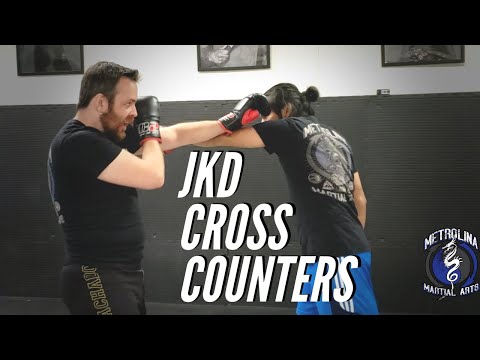
Cross Counters | Make Trapping Work!! | JKD
0
Counter Cross·Metrolina Martial Arts·Added by Admin
The 1-2 Series in JKD works our Cross Counters and in this video we go over 4 of like 22 or 23. Also, a bit about open …
Translation: counter cross
The counter cross is a rear straight punch timed to land as the opponent commits to an attack, effectively combining both fighters' momentum into a single impact. [1] Counter-punching with the straight rear hand was elevated to a systematic strategy by fighters in the classical boxing tradition, beginning with 'Gentleman' Jim Corbett and refined by Gene Tunney. [2] Dempsey described the counter cross as the single most effective technique for ending fights, as the opponent's forward momentum doubles the impact force. [1] Floyd Mayweather Jr. built his undefeated 50-0 career largely on the pull-counter cross, where he would pull back from an opponent's lead and immediately counter with the straight right. [3]
Counter-punching with the straight rear hand was elevated to an art form by fighters in the classical boxing tradition, with Gene Tunney and later Floyd Mayweather Jr. building their styles around precise counter-cross timing. [1]
No images yet for this technique.
Sign in to suggest an image.
The 1-2 Series in JKD works our Cross Counters and in this video we go over 4 of like 22 or 23. Also, a bit about open …
No instructional courses yet for this technique.
Sign in to suggest a course.
Risk of injury to the person this technique is applied to
Jab/cross; fundamental striking tool, cumulative brain trauma risk
Skill level needed to execute this technique reliably
Whether this technique is allowed under major competition rule sets
Karate-Do Kyohan: The Master Text (Gichin Funakoshi, 1935)
Alias sources — [1] Championship Fighting (Dempsey, 1950) [2] Boxing (Fleischer, 1958) [3] Karate-Do Kyohan (Funakoshi, 1935)
Effectiveness sources — [1] Championship Fighting (Dempsey, 1950)
Standard katakana transliteration of Western martial arts terminology (外来語) — used in Japanese MMA, boxing, and BJJ communities
Alias sources — [1] Championship Fighting (Dempsey, 1950) [2] Boxing (Fleischer, 1958) [3] Karate-Do Kyohan (Funakoshi, 1935)
Effectiveness sources — [1] Championship Fighting (Dempsey, 1950)
hip rotation power, rear foot pivot, full kinetic chain coordination
reach advantage, strong hips for power transfer
glutes, obliques, pectorals, triceps, deltoids
A common mistake is rolling your shoulder without keeping your hand up to protect your face. According to Metrolina Martial Arts, you need to keep your hand up after the shoulder roll to prevent getting hit in the face.
The elbow deflection is an extension of the shoulder roll counter. Once you master the basic shoulder roll defense, the elbow deflection builds on that same foundation.
You need to move your lower body along with your upper body defense—don't just defend the upper half. According to Metrolina Martial Arts, you should squat or move with the incoming cross rather than staying stationary.
A rear-hand straight punch timed to land simultaneously or immediately after slipping or parrying an incoming attack, using the opponent's forward momentum against them.
The counter cross is a rear straight punch timed to land as the opponent commits to an attack, effectively combining both fighters' momentum into a single impact. Counter-punching with the straight rear hand was elevated to a systematic strategy by fighters in the classical boxing tradition, beginning with 'Gentleman' Jim Corbett and refined by Gene Tunney.
Unified MMA: legal — Legal striking technique; WBC/Boxing: legal — Legal — punches are the core technique of boxing; WKF: legal — Legal, jodan/chudan punch scores 1 point (yuko) — controlled contact required; Kyokushin: restricted — Body punches legal at full power, head punches banned; WT: restricted — Punches to trunk only (1 point), punches to head banned; ITF: legal — Legal — hand techniques to head and body both permitted; WAKO: legal — Legal in Full Contact and Low Kick formats; K: legal — 1/GLORY — Legal — full power punches to head and body; IFMA: legal — Legal
Danger rating 5/10. High — jab/cross; fundamental striking tool, cumulative brain trauma risk
The standard setup chain: Fighting Stance → Weight Transfer → Extend → Snap Back.
Standard counters include: Slip — move the head off the centre line to evade the punch / Parry — deflect the incoming punch with a quick hand redirection / Counter Cross — time a straight punch over the incoming attack.
Common variants: Standard cross (rear-hand straight punch with full hip rotation); Counter cross (pull counter) (leaning back to avoid the jab, firing the cross as a counter); Step-in cross (stepping forward with the punch for added reach and power); Body cross (targeting the solar plexus or liver with the straight rea…).
Juan Manuel Marquez's counter right cross knockout of Manny Pacquiao in their fourth fight (2012) is widely considered one of the greatest counter punches in boxing history. Floyd Mayweather Jr.
Top errors to watch for: Waiting too long to counter and throwing after the opponent has already retracted — the opening is gone / Leaning back without actually throwing the cross, turning the slip into a purely defensive motion with no payoff / Closing the eyes during the exchange — you must watch the incoming punch to time the counter / Reaching forward to counter instead of letting the opponent come to you — negates the range advantage.
The Counter Cross is also known as Kauntā Kurosu, Counter Right, Counter Straight, Gyaku Tsuki Kaeshi.