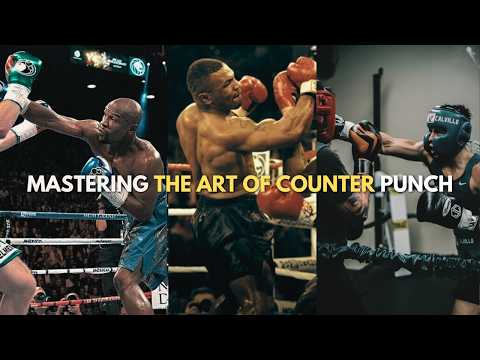
Boxing Punches 1-6 Explained: Perfect Techniques
0
Cross Counter·Oracle Boxing
Number 1 Ranked Boxing Course On Skool (Start Free): https://skool.com/boxing Join the Bali Boxing Camp Aug 2026: https:…
Translation: cross counter-punch (simultaneous slip and rear straight)
The Cross Counter is a boxing technique where the fighter simultaneously slips an incoming jab while throwing a rear straight (cross) over the top of the opponent's extended arm. [1] It is one of the highest-skill counter-punching techniques in boxing — requiring precise timing to slip the jab while landing the cross at the exact moment the opponent is extended and exposed. [1] The slip moves the head offline while the rear hand fires straight down the center, using the opponent's forward momentum against them. [1]
One of the most effective counter-punching techniques in boxing — the opponent's forward momentum meets the counter, dramatically increasing impact force. [1] Knockouts from the cross counter are common because the opponent is moving into the punch. However, mistiming results in getting hit by the jab, making it a high-risk, high-reward technique.
Western boxing lineage: ancient Greek pygmachia → bare-knuckle boxing under Broughton's Rules (1743) → Marquess of Queensberry Rules (1867) → modern professional boxing. The cross counter was refined in the golden age of boxing (1920s–1950s). [1]
One of the most important counter-punching techniques in professional boxing history. Used extensively by counter-punching specialists from Jack Johnson to Floyd Mayweather Jr. A fundamental technique in every boxing match. [1]
No images yet for this technique.
Sign in to suggest an image.
Number 1 Ranked Boxing Course On Skool (Start Free): https://skool.com/boxing Join the Bali Boxing Camp Aug 2026: https:…
Counterpuncing is one of the most effective ways to win in a boxing match . this video is a detailed guide on boxing tra…
The cross counter is a defensive counterpunching technique where a boxer slips, pulls back, parries, or rolls away from an incoming punch and immediately responds with a cross. FightBoxing's counterpunching tutorial identifies several counter strategies applicable to cross execution: the slip counter (evading laterally then countering), the pull counter (leaning back to avoid the strike before responding), the parry counter (deflecting the punch to create an opening), and the roll counter (moving under the punch). Oracle Boxing provides detailed biomechanics for the cross itself—the fundamental offensive technique often deployed as the counter response. The cross requires maintaining weight on the back foot with the heel slightly elevated, rotating the hips from neutral position while keeping the arm relaxed and cocked, then allowing the arm to extend naturally under body rotation rather than arm extension alone. The wrist should kink naturally as the arm extends, landing on the knuckles to concentrate force. The elbow traces the same path as the wrist and knuckles, following the body's rotation to maximize power transfer. Both instructors emphasize that successful countering depends on proper stance maintenance, timing, and explosiveness—Oracle Boxing stresses keeping the back knee at a consistent angle throughout execution, while FightBoxing highlights the importance of speed and accuracy in capitalizing on the opponent's committed strike.
Synthesized from 2 instructors
No instructional courses yet for this technique.
Sign in to suggest a course.
Risk of injury to the person this technique is applied to
The opponent's forward momentum meets the counter cross, amplifying impact.
Skill level needed to execute this technique reliably
Whether this technique is allowed under major competition rule sets
Lynch, J. The Complete Boxer.
[1] Lynch, The Complete Boxer; Hatmaker, Boxing Mastery
[1] Lynch, The Complete Boxer; Hatmaker, Boxing Mastery
excellent timing, head movement ability, hip rotation speed
neck (slip), core obliques (rotation), shoulder, triceps
The cross counter — timing a straight rear hand to land as the opponent throws their own jab or cross — is one of the most important counter-punching techniques in boxing history. The technique requires reading the opponent's rhythm and firing into their open guard. Jack Dempsey's Championship Fighting devotes significant attention to counter-timing. (Dempsey, Championship Fighting; boxing history)
The slip counter is the most common type of counter punch in boxing. It involves pressuring your opponent to throw a jab or cross, then slipping the punch and coming up with a counter punch.
The best way to master the slip counter is through partner drills where you practice against a real person who throws punches at you, slipping and countering without hurting your partner. You can also use mitt work with a coach or progress to light sparring sessions.
Common counter punching methods include the slip counter, pull counter, parry counter, and roll counter. Each involves a different defensive movement—slipping, pulling back, parrying, or rolling—followed by a quick counter strike.
The pull counter is risky because your opponent can close in and punch you while you are pulling back, before you have time to land your counter punch.
The Cross Counter is a boxing technique where the fighter simultaneously slips an incoming jab while throwing a rear straight (cross) over the top of the opponent's extended arm. It is one of the highest-skill counter-punching techniques in boxing — requiring precise timing to slip the jab while landing the cross at the exact moment the opponent is extended and exposed.
The cross counter is one of the classical counter-punching techniques in boxing, documented in boxing manuals since the bare-knuckle era. It gained particular fame through fighters like Floyd Mayweather Jr.
WBC/WBA/IBF/WBO Boxing: Legal: legal — fundamental counter-punching technique; Unified MMA: Legal {src:Unified Rules of MMA, August 2025|/sources/Unified: legal — MMA-Rules-August-2025.pdf}; WAKO Kickboxing: Legal: legal — hand strikes fully permitted; WT Taekwondo: Banned: banned — punches to the head not permitted
Danger rating 6/10. High — the opponent's forward momentum meets the counter cross, amplifying impact.
The standard setup chain: Bait with low guard → opponent jabs → cross counter → Throw your own jab → opponent returns jab → cross counter → Walk forward to draw the jab → slip and cross counter.
Standard counters include: Feint the jab — draw the counter then follow with a hook / Double jab — the second jab catches the counter-puncher mid-slip / Body jab — go low instead of high to avoid the counter.
Common variants: Slip-cross (slip outside the jab and cross over the top); Pull-cross (pull back from the jab then fire the cross as the opponen…); Shoulder roll cross (deflect with the lead shoulder then fire the rear cross); Check hook cross (throw a lead hook check then follow with the cross).
One of the most important counter-punching techniques in professional boxing history. Used extensively by counter-punching specialists from Jack Johnson to Floyd Mayweather Jr.
Top errors to watch for: Slipping too early — the cross misses because the opponent hasn't committed / Slipping too late — getting hit by the jab before the counter / Reaching with the cross — overextension loses power and balance / Not returning to guard after the counter — exposed to the follow-up.
The Cross Counter is also known as Kurosu Kauntā, Cross-Counter, Counter Cross, Right Cross Counter, Straight Counter.