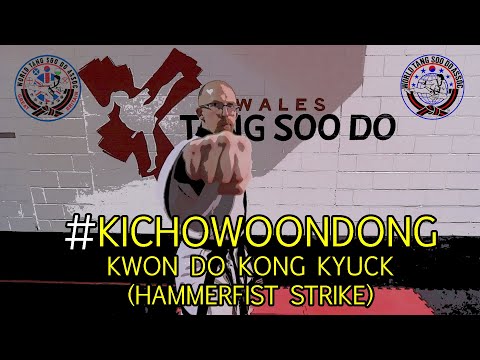
Ki Cho Woon Dong - Hammerfist Strike (Tutorial)
0
Standard Downward Hammer Fist·Heads of the Valleys Tang Soo Do·Added by Admin
Please watch part 10 on the low block first as the mechanics are the same and the hammerfist is just the striking versio…
Translation: standard downward hammer fist
The standard downward hammer fist is the basic vertical hammering strike, delivered from above onto the opponent's head, face, or collarbone. [1] In Shotokan karate, Nakayama documented this as otoshi tetsui uchi, a technique found in the Heian and Tekki kata series. [2] The technique gained widespread recognition in MMA when fighters such as Tito Ortiz and Matt Hughes used it extensively as a ground-and-pound finishing tool in early UFC competition (late 1990s-2000s). [3]
Mark Hunt became known for his walk-off hammer fist knockouts in the UFC, with his ground-and-pound hammer fists finishing several opponents. [1]
No images yet for this technique.
Sign in to suggest an image.
Please watch part 10 on the low block first as the mechanics are the same and the hammerfist is just the striking versio…
No instructional courses yet for this technique.
Sign in to suggest a course.
Risk of injury to the person this technique is applied to
Fleshy fist edge strike; common in ground-and-pound
Skill level needed to execute this technique reliably
Whether this technique is allowed under major competition rule sets
Karate-Do Kyohan: The Master Text (Gichin Funakoshi, 1935)
Alias sources — [1] Karate-Do Kyohan (Funakoshi, 1935) [2] Dynamic Karate (Nakayama, 1966) [3] Kukkiwon Taekwondo Textbook (Kukkiwon, 2006)
Effectiveness sources — [1] Karate-Do Kyohan (Funakoshi, 1935)
Official karate technique names (和語/漢語)
Established Japanese martial arts naming convention — native Japanese term (和語/漢語)
Alias sources — [1] Karate-Do Kyohan (Funakoshi, 1935) [2] Dynamic Karate (Nakayama, 1966) [3] Kukkiwon Taekwondo Textbook (Kukkiwon, 2006)
Effectiveness sources — [1] Karate-Do Kyohan (Funakoshi, 1935)
hand speed, hip rotation, wrist alignment on impact
proportional reach, strong wrists, fast-twitch shoulder muscles
deltoids, pectorals, triceps, core rotators, forearms
Make sure there's a slight micro bend in your arm to avoid overextending or hyperextending it. According to Heads of the Valleys Tang Soo Do, striking against something (like your waist) while practicing helps ensure proper form.
Traditionally, the hammer fist goes to the center or face/higher striking areas rather than low. Heads of the Valleys Tang Soo Do notes it can be performed in front stance or side stance depending on whether you're doing line work.
People often fail to put power into the strike and use only their hand, which can look weak. According to Heads of the Valleys Tang Soo Do, you must use your whole body while doing the strikes to generate proper power.
Heads of the Valleys Tang Soo Do emphasizes maintaining a strong stance and staying well-balanced throughout the technique, and to look before you strike and go through your stance when performing the spinning variation.
The fundamental downward hammer fist raising the fist overhead and driving it straight down onto the opponent's head, face, or collarbone using gravity and arm strength.
The standard downward hammer fist is the basic vertical hammering strike, delivered from above onto the opponent's head, face, or collarbone. In Shotokan karate, Nakayama documented this as otoshi tetsui uchi, a technique found in the Heian and Tekki kata series.
Unified MMA: legal — Legal (palm strikes, slaps permitted); WBC/Boxing: banned — Only closed-fist punches permitted; WKF: restricted — Varies by technique — some open-hand strikes legal in kata, generally restric…; Kyokushin: banned — Only closed-fist strikes to body permitted; WT: banned — Prohibited; ITF: restricted — Some knife hand techniques legal; WAKO: banned — Closed fist only; K: banned — 1/GLORY — Closed fist only; IFMA: legal — Legal — palm strikes permitted in Muay Thai
Danger rating 5/10. High — fleshy fist edge strike; common in ground-and-pound
The standard setup chain: Assume Fighting Stance → Generate Power → Execute Strike → Recover to Guard.
Standard counters include: Block — absorb the strike with a protective guard position / Evasion — move the target out of the strike's path / Counter-Attack — time an offensive response during the recovery phase of the strike.
Common variants: Overhead hammer fist (bringing the fist straight down onto the target from above); Side hammer fist (swinging horizontally using the bottom of the fist); Ground-and-pound hammer fist (delivered from mount or top position on the ground).
Mark Hunt became known for his walk-off hammer fist knockouts in the UFC, with his ground-and-pound hammer fists finishing several opponents.
Top errors to watch for: Raising up too high on the hips to generate power — this creates space for the bottom fighter to escape / Posting too far forward and rolling over the opponent's head / Hitting the forehead or hairline where the skull is strongest — target the nose, jaw, or temple / Not alternating hands, becoming predictable and easy to block.
The Standard Downward Hammer Fist is also known as Shitamuki Tettsui-uchi (Kihon-gata), Standard Tetsui Otoshi Uchi, Standard Dropping Hammer, Mejumeok Naeryeo Chigi.