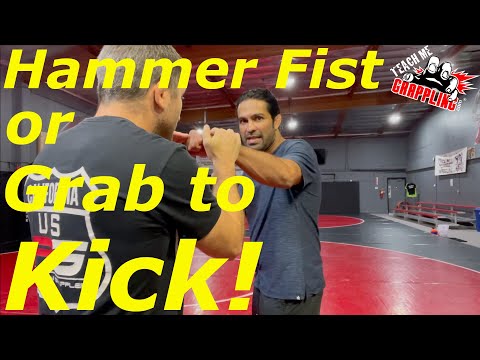
Hammer Fist to Setup the KICK!
0
Hammer Fist·TeachMeGrappling Coach Brian
This video Majid demonstrates a hammer fist that you can use as a strike or a grab to setup a kick to the face. Check o…
Translation: hammer fist
The hammer fist (tetsui uchi in Japanese) is one of the most instinctive striking techniques, using the bottom of the closed fist in a hammering motion. [1] Nakayama documented the hammer fist as tetsui uchi in Best Karate, noting that it was one of the oldest striking techniques in karate and appeared in the earliest Okinawan kata. [2] The hammer fist's ergonomic advantage — striking with the dense metacarpal bones rather than the fragile knuckles — made it a preferred technique in systems where bare-knuckle striking was standard. [1] In MMA, the hammer fist became prominent as a ground-and-pound weapon, particularly from mount and guard positions where conventional punches risk wrist injury. [3]
Hammer fists are found in many martial arts and are particularly effective in MMA ground-and-pound. [1]
Hammer fists are one of the most commonly used ground strikes in MMA. [1]
No images yet for this technique.
Sign in to suggest an image.
This video Majid demonstrates a hammer fist that you can use as a strike or a grab to setup a kick to the face. Check o…
No instructional courses yet for this technique.
Sign in to suggest a course.
Risk of injury to the person this technique is applied to
Fleshy fist edge strike; common in ground-and-pound
Skill level needed to execute this technique reliably
Whether this technique is allowed under major competition rule sets
Karate-Do Kyohan: The Master Text (Gichin Funakoshi, 1935)
Alias sources — [1] Dynamic Karate (Nakayama, 1966) [2] Dynamic Karate (Nakayama, 1966) [3] Dynamic Karate (Nakayama, 1966)
History sources — [1] The Art of Striking (Blauer, 2004) [2] Best Karate Vol. 3 (Nakayama, 1978) [3] Ultimate MMA Conditioning (Jamieson, 2009)
Official karate technique names (和語/漢語)
Established Japanese martial arts naming convention — native Japanese term (和語/漢語)
Alias sources — [1] Dynamic Karate (Nakayama, 1966) [2] Dynamic Karate (Nakayama, 1966) [3] Dynamic Karate (Nakayama, 1966)
History sources — [1] The Art of Striking (Blauer, 2004) [2] Best Karate Vol. 3 (Nakayama, 1978) [3] Ultimate MMA Conditioning (Jamieson, 2009)
hand speed, hip rotation, wrist alignment on impact
proportional reach, strong wrists, fast-twitch shoulder muscles
deltoids, pectorals, triceps, core rotators, forearms
Every move, in any martial art, shares a few universal traits. Mix and match below to pinpoint the right tool — or compare equivalents across styles.
A hammer fist driven straight downward onto the target, commonly used in ground-and-pound positions or against a bent-over opponent.
A hammer fist swung in a horizontal or lateral arc, using the bottom of the fist to strike the temple or side of the head in a sweeping motion.
The hammer fist appears in 156 passages across 39 books. Uses the bottom of the closed fist in a swinging motion — like swinging a hammer. The safest striking surface (lowest self-injury risk). Dominant ground-and-pound weapon in MMA because there is no risk of breaking knuckles on the skull. (39 books; MMA training manuals)
Coach Brian from TeachMeGrappling demonstrates using the hammer fist as part of a combination to open up kicks and other strikes. The sequence typically flows from a jab into the hammer fist, which then leads into your next offensive move.
Instead of throwing a traditional hammer fist in isolation, Coach Brian emphasizes throwing a jab first, then bringing the hammer fist back as a strike, which also sets you up for a grab or follow-up technique.
A strike delivered with the bottom of the closed fist (the ulnar side), swinging the fist in a downward or horizontal arc like a hammer.
The hammer fist (tetsui uchi in Japanese) is one of the most instinctive striking techniques, using the bottom of the closed fist in a hammering motion. Nakayama documented the hammer fist as tetsui uchi in Best Karate, noting that it was one of the oldest striking techniques in karate and appeared in the earliest Okinawan kata.
Unified MMA: legal — Legal (palm strikes, slaps permitted); WBC/Boxing: banned — Only closed-fist punches permitted; WKF: restricted — Varies by technique — some open-hand strikes legal in kata, generally restric…; Kyokushin: banned — Only closed-fist strikes to body permitted; WT: banned — Prohibited; ITF: restricted — Some knife hand techniques legal; WAKO: banned — Closed fist only; K: banned — 1/GLORY — Closed fist only; IFMA: legal — Legal — palm strikes permitted in Muay Thai
Danger rating 5/10. High — fleshy fist edge strike; common in ground-and-pound
The standard setup chain: Assume Fighting Stance → Generate Power → Execute Strike → Recover to Guard.
Standard counters include: Block — absorb the strike with a protective guard position / Evasion — move the target out of the strike's path / Counter-Attack — time an offensive response during the recovery phase of the strike.
Common variants: Overhead hammer fist (bringing the fist straight down onto the target from above); Side hammer fist (swinging horizontally using the bottom of the fist); Ground-and-pound hammer fist (delivered from mount or top position on the ground).
Hammer fists are one of the most commonly used ground strikes in MMA.
Top errors to watch for: Hitting with the knuckle side of the fist instead of the bottom pad — this negates the safety advantage / Swinging too wide and losing accuracy — the hammer fist should follow a controlled arc / Not using the shoulder and core to power the strike — arm-only hammer fists lack force / Throwing hammer fists from outside range where a punch would be more effective.
The Hammer Fist is also known as Tettsui-uchi, Tetsui Uchi, Fist Hammer, Bottom Fist.