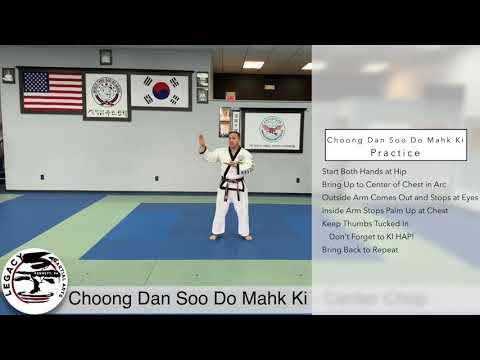
Legacy Martial Arts Center Chop Instructions
0
Standard Chop Strike·Legacy Martial Arts·Added by Admin
Translation: standard chop strike
The standard chop strike is the basic execution of an edge-of-hand blow, typically targeting the neck or collarbone with the ulnar edge of the hand. [1] Fairbairn described this as one of the simplest yet most effective close-combat strikes, requiring minimal training to execute effectively. [2] The technique was widely taught in Allied military training during World War II and subsequently incorporated into post-war self-defence and law enforcement programmes. [2] In Japanese martial arts, the equivalent chopping motion forms the basis of several shuto (knife hand) and tegatana (hand sword) techniques. [3]
A standard chop technique. [1]
From karate. [1]
Used in competition. [1]
No images yet for this technique.
Sign in to suggest an image.
No instructional courses yet for this technique.
Sign in to suggest a course.
Risk of injury to the person this technique is applied to
Open hand chopping strike; less force than closed fist
Skill level needed to execute this technique reliably
Whether this technique is allowed under major competition rule sets
Karate-Do Kyohan: The Master Text (Gichin Funakoshi, 1935)
Alias sources — [1] Karate-Do Kyohan (Funakoshi, 1935) [2] Dynamic Karate (Nakayama, 1966) [3] Kukkiwon Taekwondo Textbook (Kukkiwon, 2006)
History sources — [1] The Art of Striking (Blauer, 2004) [2] Get Tough! (Fairbairn, 1942) [3] Best Karate Vol. 3 (Nakayama, 1978)
Standard katakana transliteration of Western martial arts terminology (外来語) — used in Japanese MMA, boxing, and BJJ communities
Alias sources — [1] Karate-Do Kyohan (Funakoshi, 1935) [2] Dynamic Karate (Nakayama, 1966) [3] Kukkiwon Taekwondo Textbook (Kukkiwon, 2006)
History sources — [1] The Art of Striking (Blauer, 2004) [2] Get Tough! (Fairbairn, 1942) [3] Best Karate Vol. 3 (Nakayama, 1978)
speed, power generation through kinetic chain, striking surface conditioning
athletic build with fast-twitch muscle fibres
varies by strike — hip rotators, shoulders, core
Your palm should be rotated to face away from you, with your hand positioned so the strength comes from the outside edge of your hand. Legacy Martial Arts emphasizes this hand rotation is critical for both striking and defending.
Cross both of your arms in front of you as if waving hello with both hands, then practice stepping forward and twisting into the chop strike repeatedly. Legacy Martial Arts recommends performing this drill ten times to build proper form.
The basic chopping strike raising the hand and driving the outer edge down onto the target in a committed downward arc, targeting the base of the neck or trapezius.
The standard chop strike is the basic execution of an edge-of-hand blow, typically targeting the neck or collarbone with the ulnar edge of the hand. Fairbairn described this as one of the simplest yet most effective close-combat strikes, requiring minimal training to execute effectively.
Unified MMA: legal — Legal (palm strikes, slaps permitted); WBC/Boxing: banned — Only closed-fist punches permitted; WKF: restricted — Varies by technique — some open-hand strikes legal in kata, generally restric…; Kyokushin: banned — Only closed-fist strikes to body permitted; WT: banned — Prohibited; ITF: restricted — Some knife hand techniques legal; WAKO: banned — Closed fist only; K: banned — 1/GLORY — Closed fist only; IFMA: legal — Legal — palm strikes permitted in Muay Thai
Danger rating 4/10. Moderate — open hand chopping strike; less force than closed fist
The standard setup chain: Assume Fighting Stance → Generate Power → Execute Strike → Recover to Guard.
Standard counters include: Block — absorb the strike with a protective guard position / Evasion — move the target out of the strike's path / Counter-Attack — time an offensive response during the recovery phase of the strike.
Common variants: Standard variation (primary execution of the strike from the most common stance); Power variation (modified mechanics for maximum force generation); Speed variation (minimised telegraph for a faster, harder-to-read attack); Counter variation (timed to exploit the opponent's offensive commitment).
Used in competition.
Top errors to watch for: Telegraphing by raising the hand high above the head in a visible windup / Using a horizontal chop trajectory at the neck when a diagonal delivers more force / Not engaging the shoulder and back muscles — arm-only chops are weak / Striking with a loose, relaxed hand — the hand must be rigid on impact.
The Standard Chop Strike is also known as Choppu-uchi (Kihon-gata), Standard Shuto Uchi, Standard Knife Hand Strike, Sonnal Chigi.